

Shouzhou XIII crew finishes cargo spacecraft, space station docking test
 The Shenzhou XIII astronauts in China's space station core module have completed the manual rendezvous and docking experiment with the Tianzhou 2 cargo craft, the China Manned Space Agency (CMSA) said Saturday.
At the beginning of the experiment, the astronauts in the core module teleoperated the Tianzhou 2 cargo craft to leave the front docking port of the core module's node cabin and mov
The Shenzhou XIII astronauts in China's space station core module have completed the manual rendezvous and docking experiment with the Tianzhou 2 cargo craft, the China Manned Space Agency (CMSA) said Saturday.
At the beginning of the experiment, the astronauts in the core module teleoperated the Tianzhou 2 cargo craft to leave the front docking port of the core module's node cabin and mov Sol 3349: Ridges, Big and Small
 Another successful drive on Mars resulted in a dusty bedrock workspace with nodules and small raised ridges in front of the rover. Curiosity also has a view towards larger scale, dark, resistant ridges that we have noticed within the more subdued and lighter coloured, more typical bedrock in this area.
The science team decided to investigate the chemistry and texture of one of the small, r
Another successful drive on Mars resulted in a dusty bedrock workspace with nodules and small raised ridges in front of the rover. Curiosity also has a view towards larger scale, dark, resistant ridges that we have noticed within the more subdued and lighter coloured, more typical bedrock in this area.
The science team decided to investigate the chemistry and texture of one of the small, r Sending Life to the Stars
 No longer solely in the realm of science fiction, the possibility of interstellar travel has appeared, tantalizingly, on the horizon. Although we may not see it in our lifetimes - at least not some real version of the fictional warp-speeding, hyperdriving, space-folding sort - we are having early conversations of how life could escape the tether of our solar system, using technology that is with
 New year's mission to start new phase of exoplanet research
 A mission to one of the coldest and most remote places on earth will enable a new phase in the search for distant planetary systems. University of Birmingham PhD researcher Georgina Dransfield has travelled to the Franco-Italian Concordia Research Station in Antarctica, to oversee the installation of a new state-of-the-art camera at the ASTEP (Antarctic Search for Transiting ExoPlanets) telescop
 No returning to climate of the past even with CO2 reduction
 While the entire world focuses on achieving carbon neutrality - zero carbon dioxide (CO2) emissions - a new research shows climate change in some regions is inevitable even if the already increased CO2 level is reduced. As CO2 decreases, the intertropical convergence zone (ITCZ) shifts southwards, which can trigger persistent El Nino conditions. El Nino refers to a phenomenon in which the sea su
 Bringing the Sun into the lab
 Why the Sun's corona reaches temperatures of several million degrees Celsius is one of the great mysteries of solar physics. A "hot" trail to explain this effect leads to a region of the solar atmosphere just below the corona, where sound waves and certain plasma waves travel at the same speed. In an experiment using the molten alkali metal rubidium and pulsed high magnetic fields, a team from t
 Space Force to take a fresh look at communications satellite needs
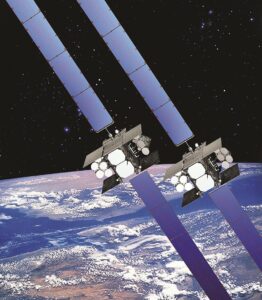
What mix of satellites will be needed to meet rising demand for connectivity will be the subject of a deep-dive study by the U.S. Space Force.
Other ISS partners start planning for extension to 2030
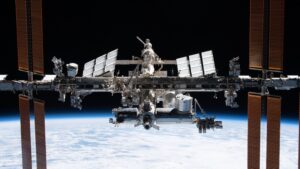
The White House’s decision to extend operations of the International Space Station through the end of the decade is a “trigger” for other partners to make their own plans to continue participation in the station.
Astrobee robots in 360° | Cosmic Kiss
 Video:
00:02:16
Video:
00:02:16
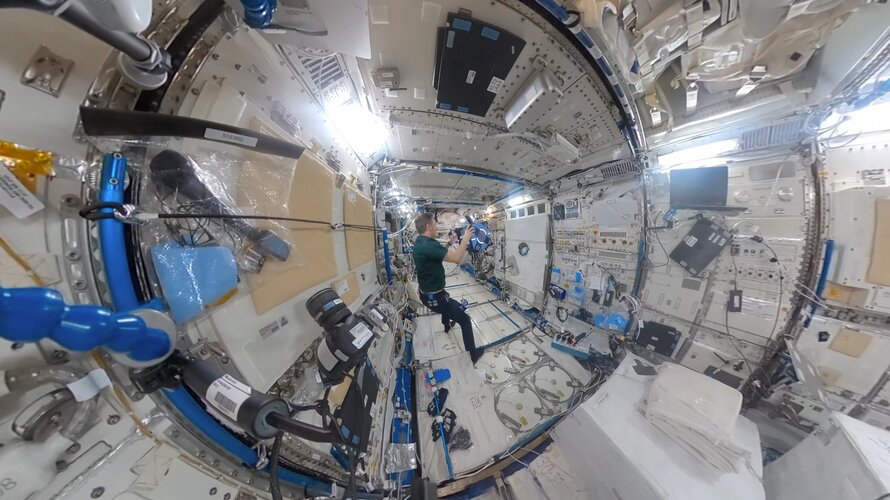
Join ESA astronaut Matthias Maurer inside Kibo, the Japanese laboratory module of the International Space Station in 360°, setting up Astrobee robotic free-flyers for the ReSWARM experiment, short for RElative Satellite sWArming and Robotic Maneuvering. The robotics demonstration tests autonomous microgravity motion planning and control for on-orbit assembly and coordinated motion.
Thus, this investigation aims to test coordination between multiple robots, robots and cargo, and robots and their operating environment as developers envision the future of autonomous robot operations in space.
Matthias was launched to the International Space Station on Crew Dragon Endurance as part of Crew-3 at 02:03
ESA reignites space-based solar power research
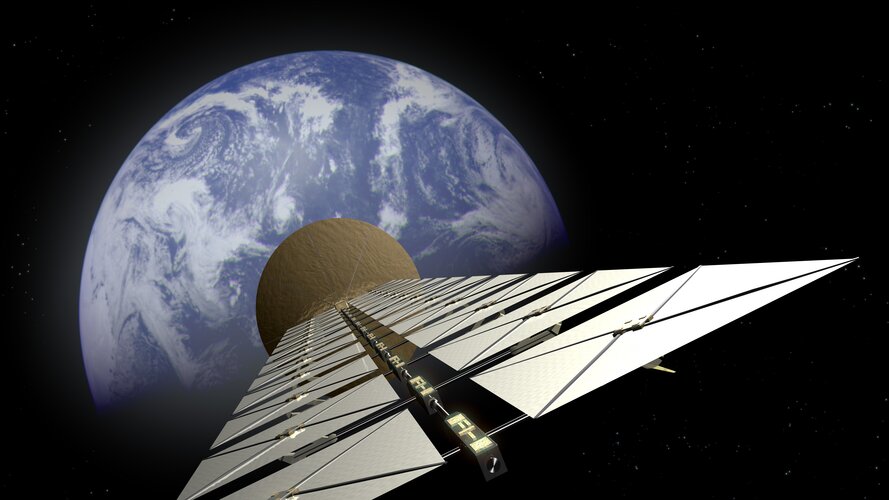
We urgently need solutions to tackle climate change on Earth. Meanwhile, the space sector is working hard to make space exploration more sustainable. ESA is targeting both ambitions by enabling European academia and industry to take further steps towards space-based solar power (SBSP).


