



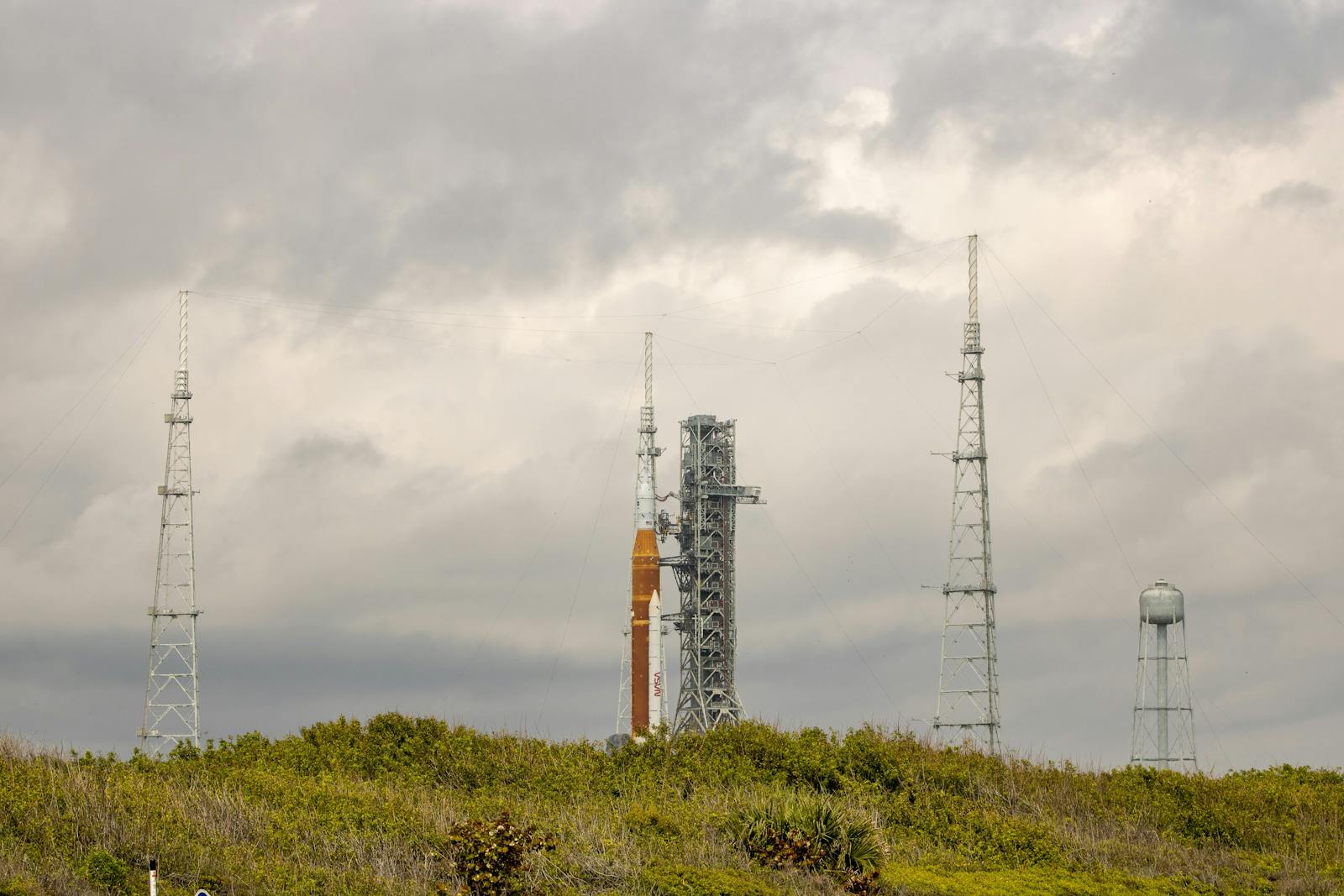
The top 80% of the core stage for NASA’s next Space Launch System rocket arrived at Kennedy Space Center on April 27, 2026, locking in hardware for an Artemis 3 mission that has now slipped from mid-2027 to late 2027 and shed its original ambition of putting boots on the moon. The 212-foot-tall stage rolled off the Pegasus barge after a 900-mile trip from NASA’s Michoud Assembly Facility in New Orleans, according to Space.com.
The hardware looks the same as the rocket that flew Artemis 2 around the moon in early April 2026. The mission it will fly does not.
What Artemis 3 actually is now
Artemis 3 has been redefined from a crewed lunar landing into a crewed Earth-orbit rendezvous and docking test. The Orion capsule will meet up with commercial lunar landers from SpaceX and Blue Origin in low Earth orbit, exercising the docking interfaces and operations that any future surface mission depends on. No moon landing. No lunar orbit. The headline mission of the Artemis program, as originally pitched, is now Artemis 4, currently targeting 2028.
This matters because it confirms what industry observers have argued for two years: the limiting factor on Artemis is not SLS or Orion. It is the human landing system. Both Starship and Blue Moon need more time, more flights, and in Starship’s case, a still-unproven orbital propellant transfer architecture before either can carry astronauts to the lunar surface. Pushing Artemis 3 to late 2027 and stripping the landing out of it is NASA’s acknowledgment that the lander side of the program is the pacing item.
Hardware is moving. Schedules are not.
The arrival in Florida is real progress on the government rocket. Engineers will mate the core stage with its solid rocket boosters, upper stage, and Orion crew capsule inside the Vehicle Assembly Building over the next year and a half. That work is well-understood. Michoud has now delivered multiple flight-ready core stages, and the Kennedy integration teams have flown several of them.
What’s harder to predict is whether the commercial landers will be ready when Orion is. SpaceX’s Starship program has demonstrated impressive cadence on Super Heavy and ship test flights, but the orbital refilling demonstrations that make a crewed lunar Starship possible remain ahead. Blue Origin’s Blue Moon Mark 1 cargo lander development continues, while the crewed Mark 2 vehicle is on a longer development arc. NASA’s revised schedule effectively buys both contractors another six months without admitting that’s what it’s doing.
The Artemis 2 effect
Context matters here. Artemis 2 splashed down off San Diego on April 10, 2026, after sending Reid Wiseman, Victor Glover, Christina Koch and Jeremy Hansen far beyond low Earth orbit, the first crewed flight beyond low Earth orbit since Apollo 17 in 1972. The mission landed in a way few NASA programs have lately. The crew came across as unrehearsed and emotionally present, and the public response surprised even the astronauts. Wiseman described the reaction as “shocked,” in the BBC’s coverage of the post-flight press conference.
That goodwill is political capital. NASA is spending some of it now by acknowledging the Artemis 3 slip and the mission redefinition without a major crisis narrative. A program with less public momentum would be in much harder waters making the same admission.
The cost question gets louder
Significant funds have been spent on Artemis to date, with billions more allocated to future missions. In a Guardian commentary, astronomer royal Martin Rees and astrophysicist Donald Goldsmith argue that as robotic capability and AI improve, the practical case for sending humans to the moon weakens, and what’s left is essentially an expensive sport. That view will not move policy in Washington or Beijing, but it does frame the cost-benefit conversation that grows louder every time a major Artemis milestone slips.
The counter-argument runs through the door the Artemis 2 crew opened. Public engagement with crewed spaceflight, when it works, does something robotic missions cannot. Whether that justifies the price tag is a political judgment, not a technical one. But it is the judgment Congress keeps making.
What to watch over the next 18 months
Three things will determine whether late 2027 holds for Artemis 3.
First, Starship orbital propellant transfer. SpaceX needs to demonstrate ship-to-ship cryogenic transfer at scale. Without it, there is no crewed Starship lunar architecture, even for an Earth-orbit docking rehearsal. The Artemis 3 redefinition takes the lunar surface off the critical path but still requires a flight-ready lander to dock with.
Second, Blue Moon Mark 2 progress. Blue Origin has been quieter than SpaceX, which in this industry sometimes means real engineering is happening and sometimes means problems are being managed. The next 12 months should clarify which.
Third, the SLS stack itself. The core stage is in Florida. Boosters are stacking. Orion for Artemis 3 is in final integration. The Artemis 2 integration sequence ran roughly to plan, and the team has institutional muscle memory now. Barring a serious anomaly, the rocket will be ready before the landers are.
The strategic read
NASA is doing something pragmatic and politically risky at the same time. By turning Artemis 3 into a docking rehearsal, the agency keeps SLS and Orion flying on something close to schedule, gives both lander contractors more runway, and avoids the worse outcome of a multi-year gap with no crewed flights at all. The cost is rhetorical: “return humans to the moon” now means Artemis 4, in 2028, if everything holds.
China’s lunar program sets the outer bound on how much more slippage is politically tolerable in Washington. The Artemis 3 redefinition probably buys NASA one more cycle of grace. Probably not two.
The hardware in the Vehicle Assembly Building is the easy part. The harder questions about Artemis were never about whether SLS would fly. They were about whether the broader architecture, with its dependencies on commercial landers and orbital refilling, could be made to close. Those questions are still open. The barge arriving in Florida does not answer them. It just keeps the option alive.
Photo by Daniel Dzejak on Pexels