



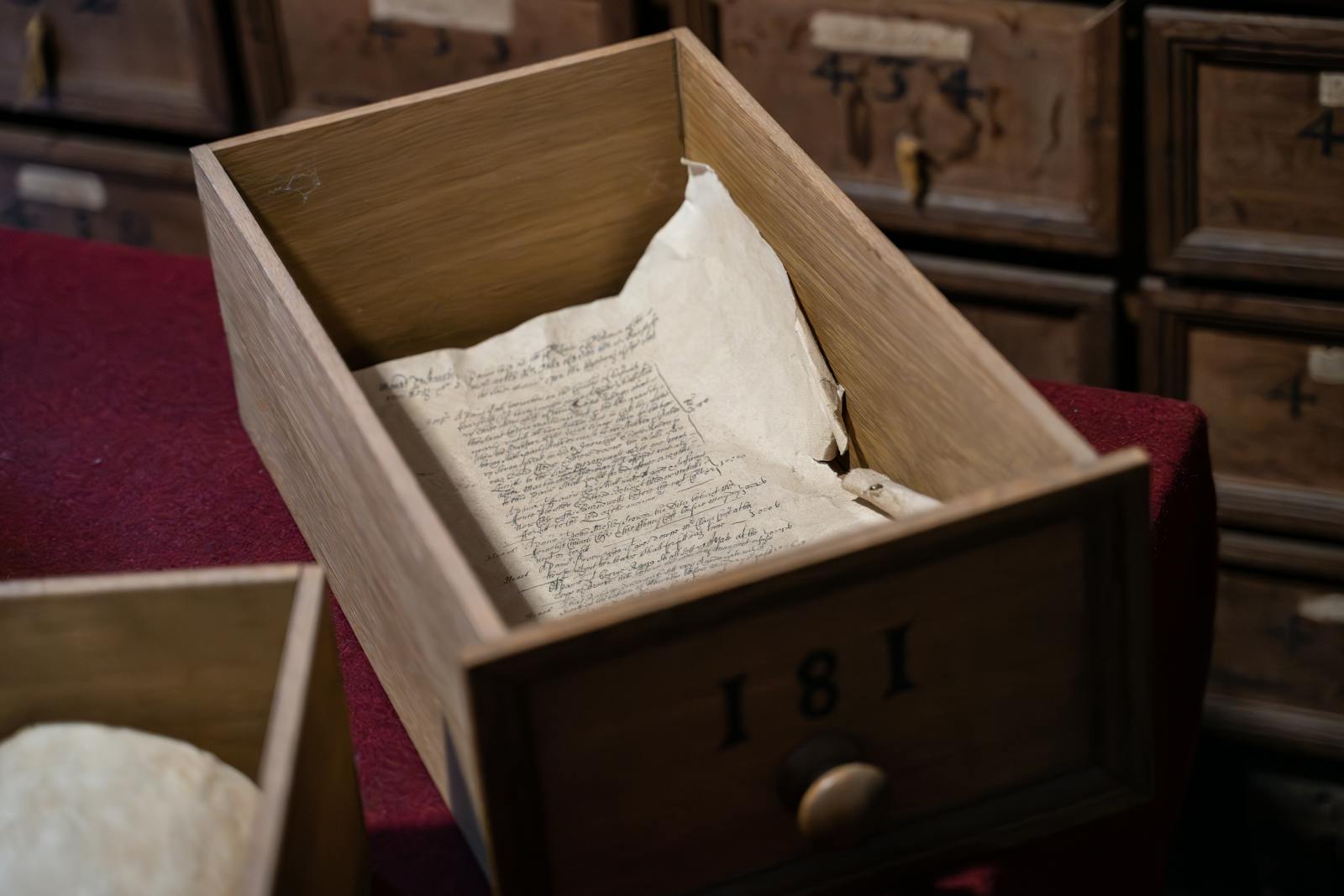
The conventional wisdom about adults who hoard their childhood paperwork — old report cards, art projects, certificates from a third-grade spelling bee — is that they are sentimental people clinging to past glories. The wisdom is wrong. The drawer that never gets opened is not a shrine. It is an archive of a self that existed before performance metrics replaced personhood, and the people who keep it are not bragging. They are preserving evidence.
Most of them cannot tell you why they kept the folder. They moved it through three apartments, two cities, one marriage. It sits in a drawer they do not open because opening it is not the point. The point is that it exists.
The drawer is not about the grades
Ask any adult what is in the drawer and they will tell you, vaguely, that it contains old school materials or childhood artifacts. Press them and the inventory tightens: a fourth-grade book report with a teacher’s note in the margin, a science fair ribbon, a parent-teacher conference summary on yellowed paper. None of it is impressive by adult standards. That is the entire reason it matters.
The drawer captures the last era in which the person was being evaluated for things that had no economic output attached. Penmanship. Effort. Whether they were kind to other students. Whether they participated. The metrics were arbitrary and gentle in a way adult metrics never are again.
Rachel Bristol, a cognitive psychology lecturer at the University of Washington, told the Daily UW that memories tend to live in the physical artifacts and spaces around them. The objects are not just reminders. They are the distributed storage of a self that the brain alone cannot reliably hold. Bristol explained that memory is not contained solely within an individual, but is distributed across spaces, people, and physical objects.
The report card in the drawer is one of those artifacts. Throw it out and a piece of the self goes with it.
What useful actually means
Somewhere between age twenty-two and age thirty, most people stop being measured for who they are and start being measured for what they produce. The shift is so gradual it is rarely noticed in real time. The first job-performance review feels like a continuation of school. By the fifth one, the person realizes nobody is grading their handwriting anymore. Nobody is noting whether they were kind to the new hire. The metrics narrowed to output, revenue, deliverables.
This is what adults mean, even if they cannot articulate it, when they talk about feeling “used up” by work. The complaint is not really about hours. It is about the collapse of the evaluation framework. A child gets graded on twenty-three different dimensions of being a person. An adult gets graded on one: how useful you are to the institution paying you.
The drawer is the receipt from a period when the person was richer than that. When somebody, somewhere, took the time to write encouraging comments in a margin and meant it.
Nostalgia is not weakness
For decades, psychology treated nostalgia as a kind of pathology, a failure to be present, a regressive longing. That framework has been collapsing. Research by Constantine Sedikides and Tim Wildschut, summarized in a recent Psychology Today review, has reframed nostalgia as a stabilizing force — one of the primary ways adults maintain a coherent sense of self across decades of change.
The felt sense that the person you are today is connected to the person you were at seven and at seventeen, that the through-line is real, helps people handle transitions better, recover from setbacks faster, and find more meaning in their lives. People without it report feeling fragmented, unmoored, as if they are performing a series of unrelated lives in sequence.
The drawer is a device for maintaining that connection. The person does not need to open it. They need to know it is there. Knowing is enough.
Why the drawer never gets opened
The reluctance to actually look at the contents is not avoidance. It is a kind of memorial caution. Bristol noted that every act of recall subtly alters the memory itself, and that each retrieval makes the original experience incrementally less accurate.
Adults intuit this. They sense, without being able to name it, that pulling the report cards out and reading them under fluorescent kitchen light at thirty-eight will not produce the experience they want. It will overwrite a tender memory with a more cynical adult one. The eight-year-old’s pride will be filtered through the thirty-eight-year-old’s awareness of how arbitrary the system was, how the teacher had her own bad day, how the grades meant less than they seemed to.
So the drawer stays closed. The artifact is preserved precisely by not being touched. This is the same logic that governs why people do not visit certain childhood places, why they do not Google certain old friends. Some memories are load-bearing. You do not renovate load-bearing walls casually.
The artifacts of a pre-utility self
Frontiers in Psychology published a study on how people in transition cling to childhood objects as a way of maintaining identity across rupture. Immigrants, in particular, often preserve childhood toys and papers with a near-religious carefulness, because the objects carry a self that the new country does not know about and cannot evaluate. The objects are proof of a person who existed before the new context started measuring them.
My wife works in immigration law, and the pattern shows up in her clients constantly. People who left their countries with three suitcases will have devoted half of one suitcase to childhood papers. Not money. Not jewelry. Papers. School records, certificates, things written in a language their American-born children may never read.
The instinct is universal. The drawer in suburban America is the same drawer in a Queens apartment, the same drawer in a Lagos walk-up. It is the place where the version of the person that predates their current usefulness is held in trust.
The parents who saved them in the first place
There is a generational layer here that often gets missed. The drawer typically did not start as the adult’s drawer. It started as the parent’s drawer. Somewhere around age twenty-five, the parent handed over a folder or a banker’s box with the implicit suggestion that these items now belong to the adult child.
The handoff is the unspoken contract. The parent kept the evidence for two decades because they could not bear to discard it. Then they transferred custody, and the child — now an adult — could not bear to discard it either. The drawer is a multigenerational refusal to throw a person away.
I have a three-year-old. I already have a folder. I know what is in it because I just put it there last week. A drawing that is mostly a green smear. A daycare progress note. A photograph from his second birthday. He will not remember any of these things. I am keeping them anyway, because someday, when he has reduced himself to a job title and a salary band, I want him to be able to open a drawer and find evidence that he was, at three, evaluated for whether he shared the blocks. And that he did.
What it means to be measured generously
The deepest sadness of the drawer is also its quiet hope. The grown person knows, in some chamber of themselves, that they were once measured generously. By teachers who graded effort. By parents who saved everything. By a culture that, for a brief window, was willing to evaluate a person on whether they were nice rather than whether they were profitable.
That window closed. For most adults, it does not reopen. The drawer is the proof it was real.
It is also, quietly, an instruction. The person who keeps the drawer is telling themselves something they cannot say out loud: that they would like to be measured that way again. By someone who notices the effort. Someone who writes a note in the margin. Someone who saves the drawing.
What to do with it
I am not going to tell anyone to throw out the drawer. The instinct to keep it is correct. Some commentators frame childhood nostalgia as a roadblock to growth, but maintaining connection to who we once were helps us take a hit and still know who we are afterward.
What might be worth examining is the question the drawer is asking. Not whether to open it. Whether to start a new one. Whether there is anyone in your current life — a partner, a child, a friend, yourself — who is being evaluated by you generously enough that the artifacts of that evaluation would be worth saving.
The drawer is a memorial to having once been seen as a whole person. The harder, more important question is whether you are willing to see anyone that way now. Whether you can look at the people in front of you — including the version of yourself that grew up and forgot they used to win ribbons for things that did not pay — and grade them on something other than what they produce. Whether you can be, for someone else, the teacher who wrote the note. The parent who saved the drawing. The witness who decided a person was worth keeping evidence of.
That is what the drawer is really asking. Not whether you remember being seen. Whether you are willing to do the seeing now. Because the folder in the drawer is patient — it will wait, and it does not need you to open it — but the people in your life are not folders. They will not wait forever to be measured by someone generous. And the only person in a position to do that measuring, for at least a few of them, is you.
Photo by T6 Adventures on Pexels