

AP Interview: NASA chief big on climate, hedges on moon date

U.S. role in global greenhouse gas constellation still up in the air
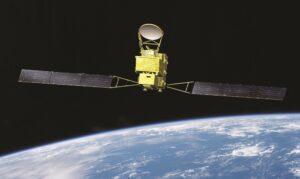
The United States is expected to play a supporting role in an international campaign to monitor greenhouse gas emissions from space.
Through the Committee on Earth Observation Satellites, nations are coordinating efforts for space-based monitoring of air quality, greenhouse gases, the ozone layer and natural climate drivers like solar energy.
NOAA tracks and analyzes the changing climate
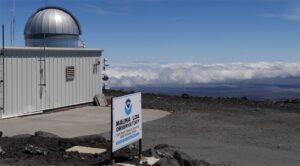
Earlier this month, atmospheric carbon dioxide reached a daily average of 421 parts per million, 50% higher than levels measured before the industrial revolution, according to data gathered at Hawaii’s Mauna Loa Observatory.
Long March 5B falls into Indian Ocean after world follows rocket reentry

HELSINKI — Debris from a large Chinese rocket stage fell into the Indian Ocean late May 8 Eastern as people around the world watched for signs of the fiery reentry event in the skies.
String of satellites baffles residents, bugs astronomers

A string of lights that lobbed across the night sky in parts of the U.S. on Wednesday, Thursday and Friday had some people wondering if a fleet of UFOs was coming, but it had others— mostly amateur stargazers and professional astronomers— lamenting the industrialization of space.
Large Chinese rocket segment disintegrates over Indian Ocean
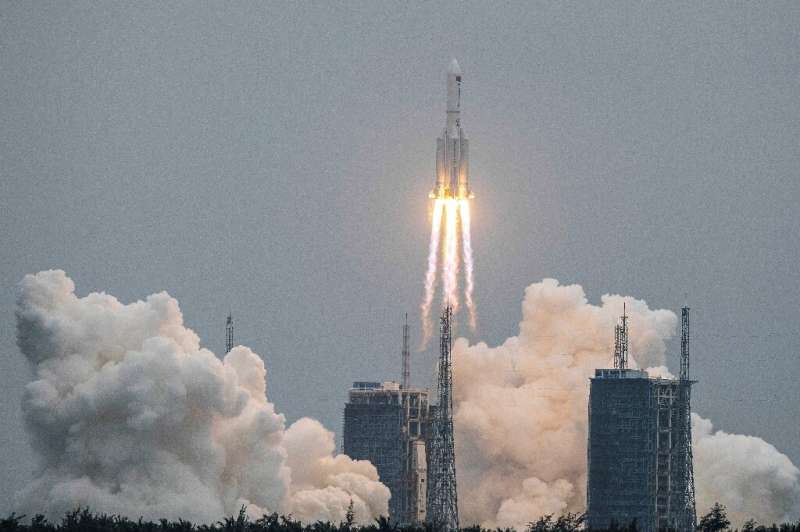
A large segment of a Chinese rocket re-entered the Earth's atmosphere and disintegrated over the Indian Ocean on Sunday, the Chinese space agency said, following fevered speculation over where the 18-tonne object would come down.
Officials in Beijing had said there was little risk from the freefalling segment of the Long March-5B rocket, which had launched the first module of China's new space station into Earth orbit on April 29.
But the US space agency NASA and some experts said China had behaved irresponsibly, as an uncontrolled re-entry of such a large object risked damage and casualties.
"After monitoring and analysis, at 10:24 (0224 GMT) on May 9, 2021, the last-stage wreckage of the Long March 5B Yao-2 launch vehicle has re-entered the atmosphere," the China Manned Space Engineering Office said in a statement, providing coordinates for a point in the Indian Ocean near the Maldives.
SpaceX sets booster reuse milestone on Starlink launch

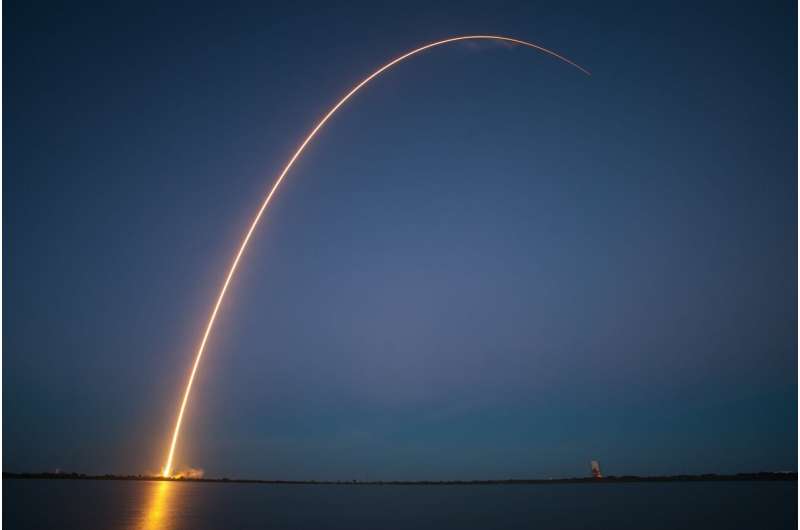
WASHINGTON — SpaceX launched a set of Starlink satellites May 9 on a Falcon 9 whose first stage was making its tenth flight, a long-awaited goal in the company’s reusability efforts.
The Falcon 9 lifted off from Space Launch Complex 40 at Cape Canaveral Space Force Station at 2:42 a.m.
Installing Juice at ESTEC
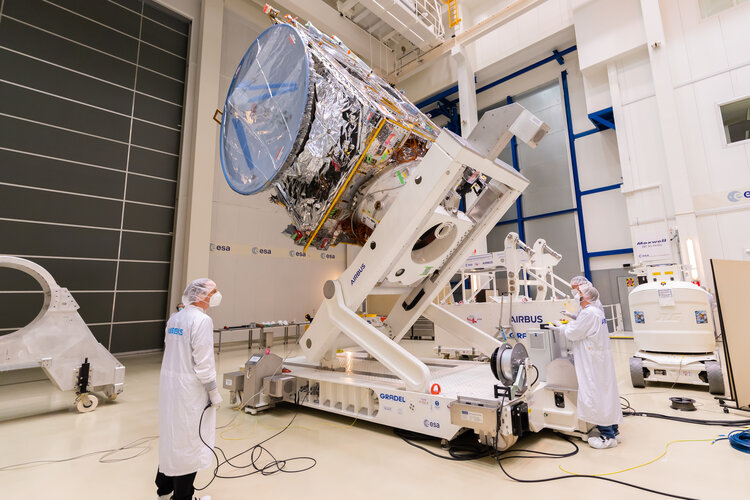 Image:
Installing Juice at ESTEC
Image:
Installing Juice at ESTEC SpaceX to launch lunar mission paid with cryptocurrency Dogecoin
SpaceX will launch a satellite to the Moon next year funded entirely with the cryptocurrency Dogecoin, Canadian company Geometric Energy Corporation, which will lead the lunar mission, announced Sunday.
The satellite, dubbed DOGE-1, will be launched aboard a SpaceX Falcon 9 rocket in the first quarter of 2022, the Calgary-based company said in a statement.
The cubic satellite, weighing 88 pounds (40 kilograms), will aim to obtain "lunar-spatial intelligence from sensors and cameras on-board," according to the statement.
The "DOGE-1 Mission to the Moon" will be "the first-ever commercial lunar payload in history paid entirely with" Dogecoin, Geometric Energy Corporation said, without specifying how much the project cost.
"We're excited to launch DOGE-1 to the Moon!" Tom Ochinero, SpaceX vice president of commercial sales, said in the statement.
"This mission will demonstrate the application of cryptocurrency beyond Earth orbit and set the foundation for interplanetary commerce."
The announcement comes the day after SpaceX founder Elon Musk hosted the live sketch comedy show "Saturday Night Live" (SNL), during which he praised Dogecoin, originally created as a joke but legitimized through the eccentric tech entrepreneur's tweets.
Protests over SpaceX contract put timetable for lunar return in limbo
 Two space companies that are protesting NASA's $2.9 billion lunar contract award to SpaceX allege the deal would make future moon landings more risky, while the claims leave the timetable for a crewed mission in limbo.
The companies that are protesting the award, Jeff Bezos' Blue Origin and space tech firm Dynetics, have filed formal complaints with the Government Accountability Office,
Two space companies that are protesting NASA's $2.9 billion lunar contract award to SpaceX allege the deal would make future moon landings more risky, while the claims leave the timetable for a crewed mission in limbo.
The companies that are protesting the award, Jeff Bezos' Blue Origin and space tech firm Dynetics, have filed formal complaints with the Government Accountability Office, 


