



The Parker Solar Probe is the first human-made object to touch a star, and the data it is sending back is quietly dismantling assumptions about stellar physics that have stood for half a century. On December 24, 2024, the spacecraft skimmed just 3.8 million miles above the Sun’s visible surface, traveling at close to 430,000 miles per hour — faster than any object humans have ever built. It survived. It kept taking pictures. And what it saw inside the corona is forcing scientists to rewrite the textbooks on how stars work. The old picture — a Sun with neat concentric layers, a smoothly accelerating wind, and a corona explained by a single elegant mechanism — is being replaced by something messier, more dynamic, and far more honest about what we didn’t know.
I’ve spent the better part of a decade writing about space and fundamental physics, and I can tell you that the working physicists I speak with still sound a little stunned when they describe Parker’s results. This is a mission that was theorized for sixty years and dismissed as impossible for most of them. Now it is routine. That shift, from impossible to routine, is worth sitting with for a moment, because it tells you something about what human curiosity can actually accomplish when it refuses to look away from a problem.
The engineering miracle that shouldn’t exist
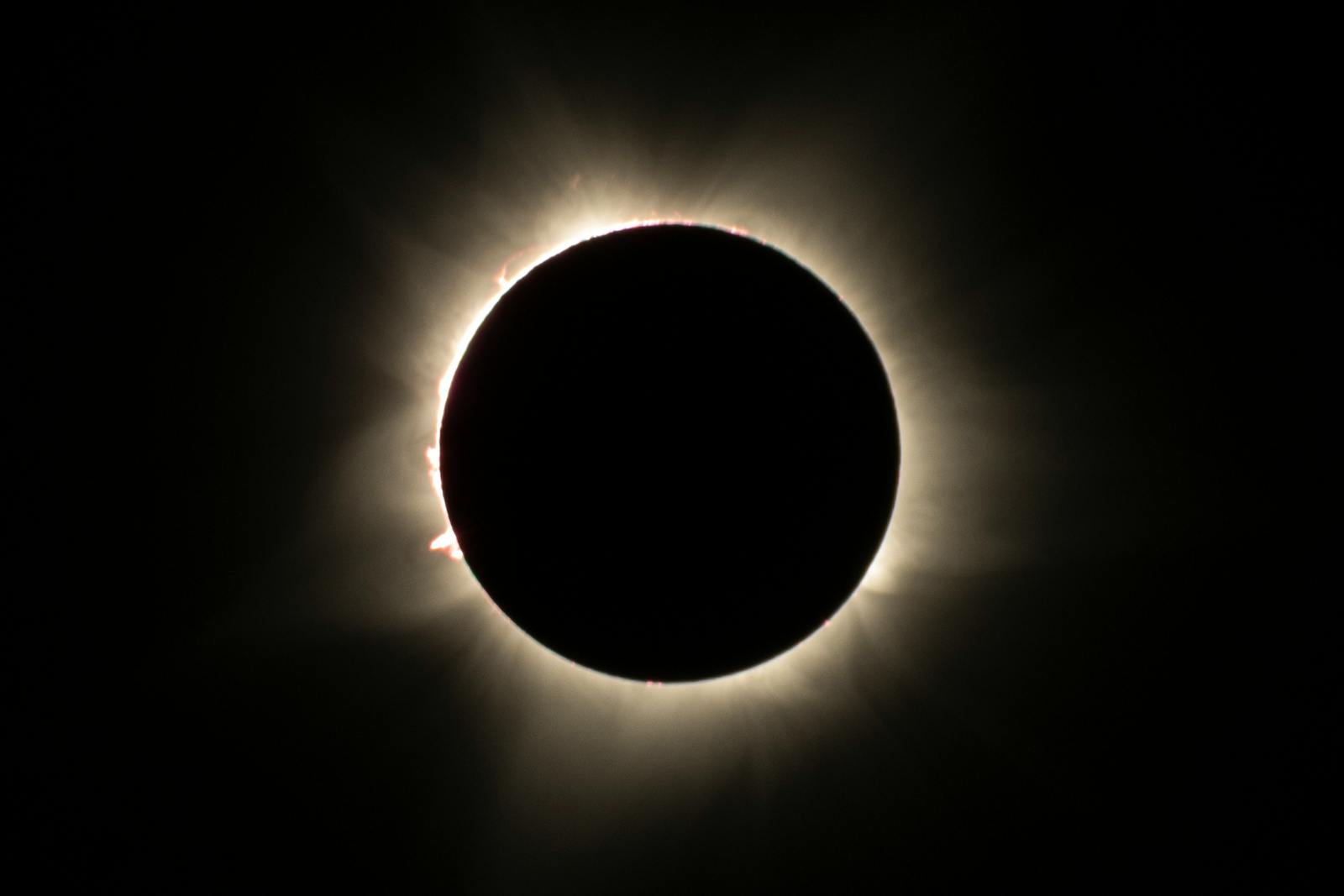
To understand what Parker is doing, you first have to understand what it is surviving. The Sun’s corona — the wispy outer atmosphere visible during total solar eclipses — reaches temperatures of over a million degrees Fahrenheit. Parker flies through it. The spacecraft’s Thermal Protection System, a 4.5-inch-thick carbon-composite shield, endures front-face temperatures of roughly 2,500 degrees Fahrenheit while the instruments tucked behind it operate at close to room temperature. That temperature gradient, sustained across a few inches of material, is one of the strangest engineering feats of our century.
The team behind it, based at NASA and the Johns Hopkins Applied Physics Laboratory, won the Robert J. Collier Trophy — aviation’s most prestigious American award — for pulling off what had been considered physically unachievable for more than six decades. The engineering advances developed for the mission have attracted interest from researchers working on hypersonic applications.
The shield is only one piece. Parker also carries the first actively cooled solar arrays ever flown, which retract behind the shield as the spacecraft approaches the Sun and peek out at precisely calculated angles to capture enough light to power the mission without vaporizing. And because the round-trip light delay makes real-time control impossible near perihelion, Parker is fully autonomous. It manages its own orientation, its own thermal configuration, its own survival, for months at a stretch. If something goes wrong inside the corona, no one on Earth can help it.
A theory ridiculed, then vindicated, then finally witnessed
The mission carries the name of Eugene Parker, the University of Chicago heliophysicist who in 1958 proposed that the Sun was constantly shedding a supersonic wind of charged particles. His paper faced initial skepticism from reviewers, though it was ultimately published. Within a few years, spacecraft observations confirmed the solar wind was real. Parker lived to see a spacecraft bearing his name launch toward the Sun in 2018. He passed away in 2022, before the closest approaches.
There is something quietly moving about this arc. A young physicist insists on an unfashionable idea. The idea turns out to be correct. Decades later, humanity builds an impossible machine to go and watch his theory unfold in person. So much of astronomy compresses human timescales against cosmic ones — the light from distant nebulae arriving after thousands of years, the slow churn of stellar evolution playing out over billions. Parker Solar Probe compresses them differently. It closes a sixty-year loop between prediction and confirmation, between a rejected paper and a spacecraft flying through the phenomenon the paper described.
What the closest images actually show
The Wide-Field Imager for Solar Probe, known as WISPR, captured the closest images of the Sun ever taken during the December 2024 flyby. They are not the pretty amateur-astronomy images you might expect. They are strange, grainy, almost abstract views of streaming plasma and magnetic structure. What they reveal, though, is extraordinary.
The images show the heliospheric current sheet — the boundary where the Sun’s magnetic field flips from northward to southward — in higher resolution than ever before. They also captured, for the first time in this kind of detail, multiple coronal mass ejections colliding with each other. Scientists have observed CMEs piling up on top of one another, which matters because when these outbursts merge their trajectories shift, their particles accelerate, and their magnetic fields mix in ways that can make their eventual impact on Earth harder to predict and more dangerous when it arrives.
This is not abstract. Space weather can overwhelm power grids, disable satellites, degrade GPS, and irradiate astronauts. Understanding how CMEs merge in their first few million miles of travel is directly relevant to how well we can predict the next giant solar storm before it knocks out the infrastructure of a continent.
Switchbacks, slow wind, and the coronal heating problem
One of the oldest puzzles in solar physics is why the Sun has a wind at all. The corona is a million degrees. Why? The visible surface, the photosphere, is only about 10,000 degrees Fahrenheit. The atmosphere above it is more than a hundred times hotter than the surface. Nothing in ordinary thermodynamics predicts this. Heat should flow from hot to cold, not the other way around. For fifty years, the coronal heating problem has been the single most embarrassing gap in our understanding of the nearest star. Before Parker, the leading candidates — wave dissipation, nanoflares, magnetic reconnection — were debated largely on theoretical grounds. Parker is turning the debate into an empirical one.
Parker has started filling it in. When the spacecraft first crossed into the corona in recent years, it found the boundary was uneven and far more structured than models predicted. As Parker ventured closer, it encountered something even stranger: zig-zagging reversals in the magnetic field, arriving in clumps, which the team named switchbacks. These turn out to be traceable to specific patches on the Sun’s visible surface where magnetic funnels form. The old assumption was that the solar wind emerged more or less uniformly from broad coronal regions. The new picture is one of a patchy, funneled, magnetically channeled outflow — less like air rising from a heated floor and more like steam escaping from a network of vents.
Recent findings from the Parker team have shown that switchbacks partly power the fast solar wind — one of the two main varieties of particle stream pouring off the Sun. That was a major answer to a decades-old question. The slow solar wind, which moves at several hundred miles per second and is denser than the fast variety, remains more mysterious, but Parker has helped identify distinct sub-types with different origins: likely from coronal holes for one, helmet streamers for the other. Scientists working on Parker have described the slow solar wind as a major outstanding challenge: understanding how this continuous flow of particles manages to escape the Sun’s gravity and why its streams are so varied. The slow wind sounds sleepy, but it isn’t. Its interaction with the fast wind can generate moderately strong geomagnetic storms at Earth that sometimes rival those produced by CMEs. If you want to predict the aurora, or protect a satellite constellation, or keep power transformers from melting, you need to know where the slow wind comes from and what makes it behave the way it does.
The Parker mission team has been careful to say they don’t have a final consensus yet — only a wealth of new data. That caution is characteristic of the good scientists I’ve interviewed over the years. They hold their conclusions loosely until the observations converge. Parker is still in its closest orbit, and each perihelion pass provides new data, with more close approaches planned through the coming years as the mission continues its science-rich phase.
Dust and energetic particles: the discoveries nobody planned
Parker has also done something its designers didn’t quite plan for: it has become the best instrument we have for studying the dust of the inner solar system. As the spacecraft plows through the zodiacal cloud at unprecedented speeds, grains of cometary and asteroidal debris slam into its heat shield at velocities that vaporize them instantly, generating tiny plasma clouds that Parker’s fields instruments detect.
From this accidental dust detection, the team has begun reconstructing the structure and behavior of inner solar system dust, including regions where the solar wind appears to be carving dust-free zones and where collisions between grains cascade into finer and finer populations. It is a reminder that the best missions don’t just answer the questions they were built to answer. They ask new ones nobody thought to ask.
The same spirit of unexpected discovery applies to Parker’s energetic particle observations. Closer measurements have revealed that the Sun’s atmosphere is alive with highly energetic particles behaving in ways distant observations had obscured. Some of these particles appear to gain energy through mechanisms that haven’t been fully pinned down — a finding that matters practically as much as it does scientifically, because solar energetic particles are the population that poses the greatest radiation hazard to astronauts traveling beyond Earth’s magnetosphere.
If NASA is serious about sending humans to the Moon for extended stays and to Mars for years-long missions, understanding these particle populations is not optional. A single severe solar event in the wrong place at the wrong time could be fatal to an unshielded crew. Parker’s data is the closest thing we have to a forecast system grounded in direct measurement rather than extrapolation. In both cases — dust and energetic particles — the old models were built from observations made at Earth’s distance or farther. Parker has shown that the inner heliosphere is a different environment entirely, one whose physics cannot be reliably inferred from the outside looking in.
The record-breaking December pass
The Christmas Eve 2024 flyby was the culmination of seven years of progressively tighter orbits, each one using a Venus gravity assist to shed a bit more energy and fall deeper into the Sun’s well. Parker spent that holiday inside the corona, out of contact, its team on Earth waiting for a beacon signal to confirm the spacecraft had survived. When the signal arrived, it was the first time any human-made object had passed that close to a star and lived.
The spacecraft cleared its closest approach intact and continued returning data. That moment, announced publicly in early January 2025, marked the formal beginning of what NASA and APL describe as the science-rich phase of the mission. Every subsequent close pass happens at roughly this same 3.8-million-mile distance, and each one provides new opportunities to sample the corona under different solar conditions as the Sun moves through its 11-year activity cycle.
What this is rewriting about stellar physics
Pull back from the specifics for a moment. The Sun is the only star we can study up close. Every other star in the galaxy is a point of light. If we want to understand stellar physics as a general discipline — the physics of the trillions of stars in the Milky Way alone — we have to extrapolate from our single example. What Parker has done is reveal that our single example is far more structured, more chaotic, more dynamic at small scales than the models assumed. The neat concentric shells of the textbook Sun are a simplification. The real Sun is turbulent, patchy, threaded with magnetic funnels and shaped by reconnection events that happen on scales we couldn’t see before.
This has implications for how we interpret every other star we observe. Stellar flares, stellar winds, stellar magnetic activity — all of it has been inferred from distant light curves. If the Sun at close range looks this different from the Sun at distance, other stars are probably hiding similar complexity. The habitability of exoplanets, for instance, depends heavily on the wind and flare behavior of their host stars. A young M-dwarf can strip the atmosphere off a rocky planet in its habitable zone. Understanding how stellar winds originate, accelerate, and evolve at our Sun gives us a physical grounding for predicting what is happening at stars light-years away.
What is being dismantled, piece by piece, is the assumption of smoothness. Before Parker, solar physics models often treated the corona as a continuous medium, the solar wind as a steady outflow varying mainly by speed, and the magnetic field as a large-scale dipole with perturbations. Parker has shown that nearly every layer of this picture is wrong at the scales that matter. The corona has sharp boundaries that breathe in and out. The solar wind is channeled through discrete magnetic funnels rooted in specific surface features. The magnetic field snaps back on itself in switchbacks that carry energy and momentum in ways no model predicted. The dust environment is sculpted by forces we hadn’t mapped. The energetic particle populations are richer and more variable than remote sensing suggested.
Each of these corrections is narrow on its own. Taken together, they amount to a fundamental shift: from a Sun understood in broad statistical averages to a Sun understood as a specific, structured, restless magnetic engine. That shift propagates outward to every star in every catalog. The models used to estimate mass loss rates for red giants, flare frequencies for young G-type stars, and wind-stripping timescales for exoplanet atmospheres all inherit their baseline physics from solar observations. When the solar baseline changes, everything downstream changes with it.
The long view of what Parker means
There is a tendency, when writing about space missions, to reach for awe. I try to resist it, because awe without specificity is just sentiment. But I think Parker Solar Probe earns a particular kind of reverence, and it is not the reverence of looking at a beautiful image. It is the reverence of watching a species solve a problem it had been told it couldn’t solve, using materials it had to invent, to go somewhere it had been assured was unreachable.
The Sun has been the central fact of every human life. Every civilization has built mythology around it. Every crop that has ever fed a human being was grown in its light. And for all of that time, we have looked at it from 93 million miles away and guessed at what was happening on its surface and in its atmosphere. Now a small spacecraft flies through that atmosphere regularly and sends back pictures. The symbolic weight of this is easy to miss because the engineering is so precise and the data so technical.
Parker’s mission is planned to continue for several more years, with additional close passes collecting data through different phases of the solar cycle. Each pass refines the picture. Each refinement changes something small in how we understand stars, space weather, or the chemistry of particles in the interplanetary medium. The mission won’t end with a single headline result. It will end with a new baseline for what we know about the nearest star, against which every future discovery will be measured.
We built a machine that touches the Sun. It works. It keeps working. And slowly, perihelion by perihelion, it is replacing the star we thought we knew with the star that is actually there.
Photo by Eclipse Chasers on Pexels