



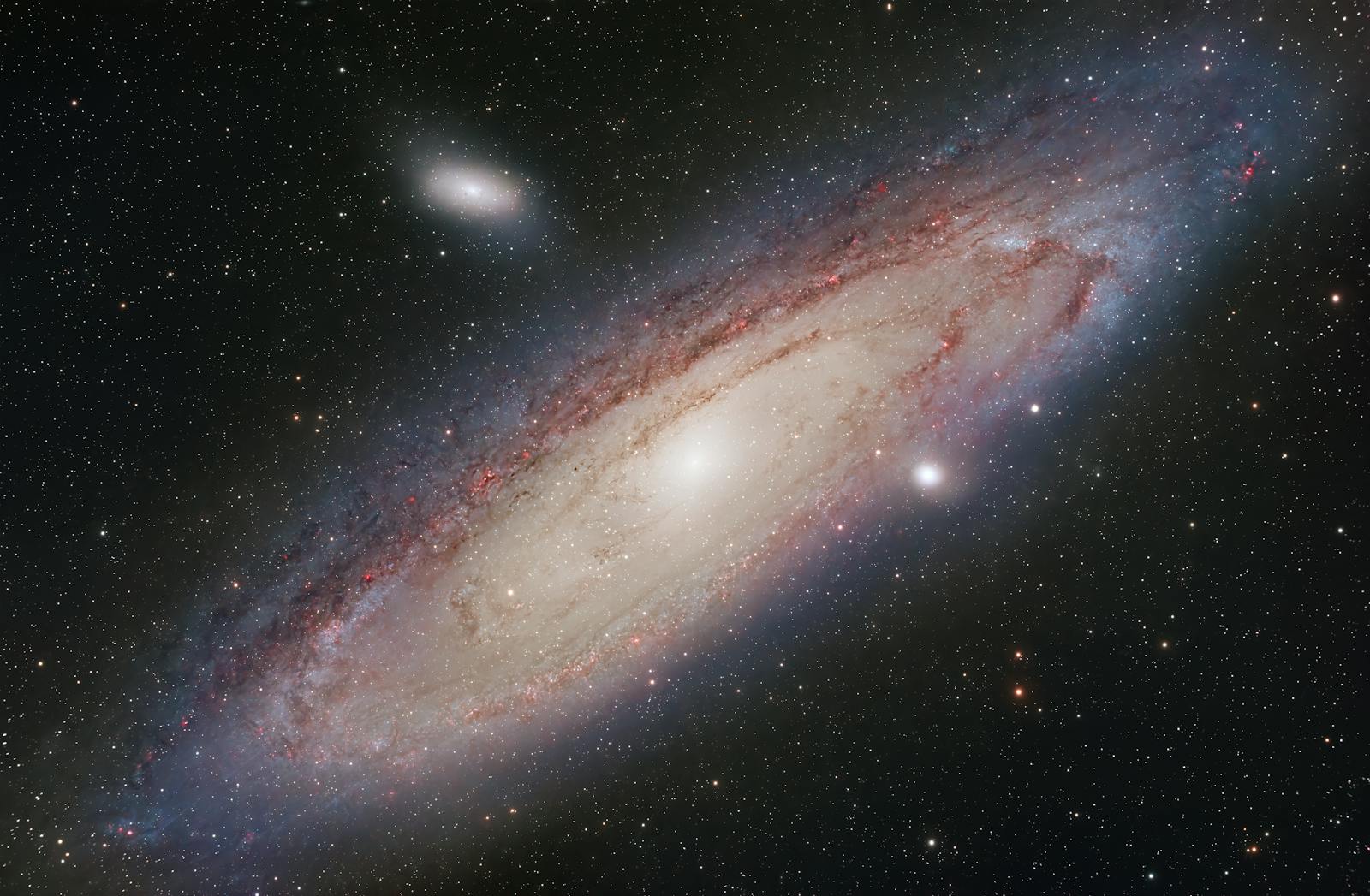
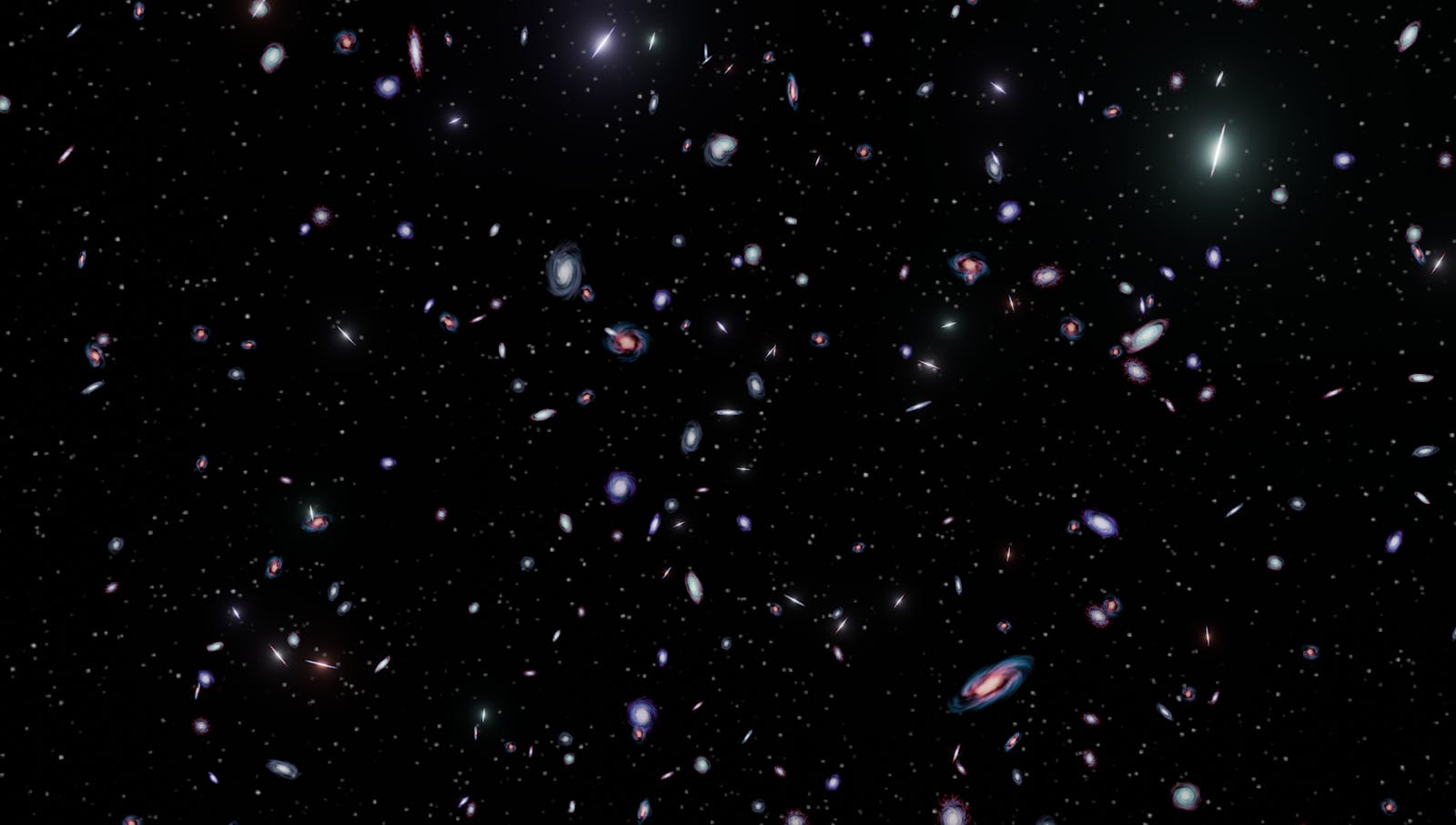
Astronomers have built a virtual universe detailed enough that its simulated galaxies are nearly indistinguishable from the real ones the James Webb Space Telescope sees in deep space. The project, called COLIBRE, traces cosmic evolution from the first billion years after the Big Bang to the present day, and for the first time in a large-scale simulation, it captures the cold, dusty gas where stars are actually born.
The results, published April 13 in Monthly Notices of the Royal Astronomical Society, offer a striking validation of the standard Lambda Cold Dark Matter model of cosmology — the framework that has guided physicists for decades but has looked increasingly strained under the weight of Webb’s early-universe observations.
A Universe You Can Watch Being Born
COLIBRE is not a single simulation but a suite. Run on the COSMA8 supercomputer at Durham University’s Institute for Computational Cosmology, it solves the equations of gravity, gas dynamics, radiation, and chemistry across expanding volumes of synthetic space. The largest run consumed 72 million CPU hours. Development took nearly a decade and pulled in researchers across Europe, Australia, and the United States.
What emerges is a cosmos you can scroll through, zoom into, and — unusually — listen to. The team built sonified videos in which sound encodes physical properties of the simulated galaxies, alongside interactive maps that let users move through the virtual volumes.
According to reports, James Trayford of the University of Portsmouth, who led the sonification work, emphasized the team’s enthusiasm for developing new exploratory tools alongside the scientific findings. The tools are intended to provide new insights, improve accessibility in the field, and help researchers develop better intuition about galaxy evolution, according to the research team.
Why Cold Gas Changed Everything
Previous large cosmological simulations had a problem they could not escape: they refused to let gas get cold. Modelling gas below roughly 10,000 degrees Fahrenheit — colder than the surface of the Sun, and the actual temperature at which stars form — was computationally too expensive and physically too complex. So simulations approximated, and star formation was inferred rather than directly modelled.
COLIBRE handles the cold phase directly. It also simulates cosmic dust grains, the tiny solid particles that catalyze hydrogen molecule formation, shield gas clouds from ultraviolet radiation, and absorb starlight to re-emit it in infrared.
Project leader Joop Schaye of Leiden University explained that previous large simulations were unable to properly model the cold, dusty gas found in real galaxies. COLIBRE represents an advancement by incorporating these essential physical components into the simulation framework.
The payoff is not merely aesthetic. Dust profoundly shapes how galaxies appear in telescopes. A simulated galaxy that does not account for dust absorption will produce a colour, luminosity, and morphology that observers cannot meaningfully compare to real data. COLIBRE’s synthetic galaxies can be placed next to Webb images and tested directly.
The Standard Model Holds — Mostly
When Webb began returning images of the early universe in 2022, some of what it found looked wrong. Galaxies appeared more massive, more numerous, and more evolved than the standard cosmological model predicted for the first few hundred million years after the Big Bang. Headlines suggested the framework might be broken.
COLIBRE pushes back on that narrative. When the physics of cold gas, dust, and feedback from stars and black holes are modelled carefully, the synthetic universe reproduces what Webb actually sees — including the early massive galaxies that initially seemed anomalous.
Evgenii Chaikin of Leiden University, lead author on several companion papers, noted that some early JWST observations initially appeared inconsistent with standard cosmological models. The COLIBRE simulations demonstrate that more realistic modeling of key physical processes produces results consistent with observations.
Carlos Frenk, Ogden Professor of Fundamental Physics at Durham and a core COLIBRE team member, expressed excitement about the simulation producing synthetic galaxies that closely resemble real observations in their measurable properties. He added that the synthetic galaxies match real observations in number, luminosity, colour, and size.
That claim has a philosophical weight worth pausing on. A theoretical framework, solved forward in time from equations of physics applied to an expanding universe, produces a population of objects that a working astronomer cannot distinguish from the catalogues compiled from telescope data. The universe, at least at the level of galaxy populations, appears to be comprehensible.
The Little Red Dots Still Don’t Fit
COLIBRE cannot explain everything. One mystery remains stubbornly unresolved: the “Little Red Dots” that Webb has discovered in abundance roughly 600 million years after the Big Bang, which then largely vanish from the record by the time the universe reaches 1.5 billion years old.
These objects are compact, red, and — based on spectral analysis — appear to harbour supermassive black holes that are far too large for the galaxies hosting them. A recent Webb study of one such object, CANUCS-LRD-z8.6, found a black hole of roughly 100 million solar masses sitting inside a galaxy that existed just 570 million years after the Big Bang, according to research published in Nature Communications. The black hole is growing faster than the stellar population of its host.
COLIBRE assumes black hole seeds already exist when its simulations start. It does not attempt to form them from scratch. So the Little Red Dots — which may represent heavy black hole seeds forming through some pathway we do not yet understand — fall outside what the model can currently address.
Modelling their origin, the team says, will require higher-resolution simulations and new physics. That is honest science: an admission of what a remarkable tool still cannot do.
What a Synthetic Cosmos Is For
The value of a simulation like COLIBRE is not that it replaces observation. It is that it provides a controlled laboratory in which theories can be tested, observational biases measured, and interpretations sharpened. When a telescope like Webb sees something strange, the question is always: strange compared to what? COLIBRE provides a rigorous “what.”
This approach echoes other recent efforts to build synthetic universes as interpretive tools, including work on how NASA’s Roman Space Telescope could expand on Hubble’s deepest views. Simulations are increasingly the bridge between raw telescope data and physical understanding.
Most of COLIBRE’s runs were completed in 2025. The highest-resolution simulations are still running and are expected to finish later this year. The team estimates it will take years to fully analyse the data already produced.
What this means for the science of Webb — and for forthcoming instruments that will probe the early universe in ever finer detail — is that astronomers finally have a theoretical counterpart rich enough to argue with their data seriously.
The Mirror of Equations
There is something quietly profound in Frenk’s remark that the team produced a synthetic universe by solving physics equations within an expanding universe model. The cosmos, at the scale of galaxies, appears to yield to mathematics written down on Earth. Cold gas, dust, gravity, radiation — assembled in the right proportions inside a supercomputer, they produce something recognisable as home.
The Little Red Dots remind us that the mirror is not yet complete. Somewhere in the first billion years of cosmic history, objects existed that our best theories still cannot conjure. That gap is where the next discoveries live.
Photo by Luis Felipe Alburquerque Briganti on Pexels