What could we build with lunar regolith?
It has often been likened to talcum powder. The ultra fine lunar surface material known as the regolith is crushed volcanic rock. For visitors to the surface of the moon it can be a health hazard, causing wear and tear on astronauts and their equipment, but it has potential. The fine material may be suitable for building roads, landing pads and shelters. Researchers are now working to analyze its suitability for a number of different applications.
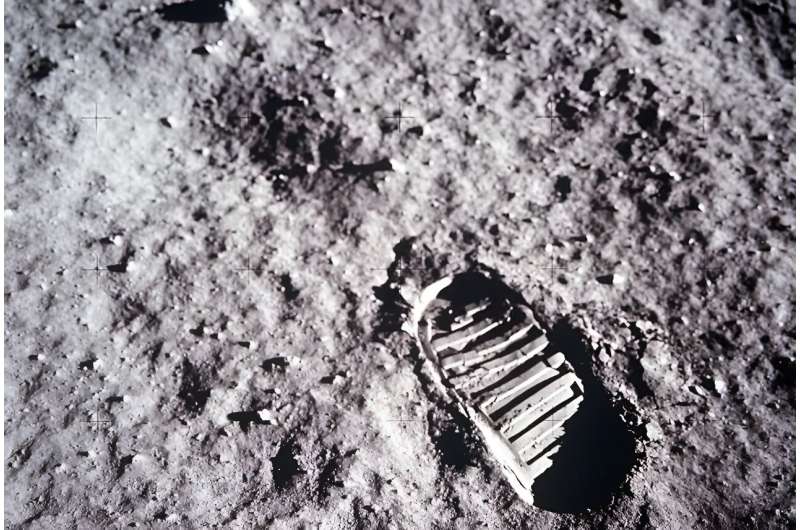
Back in the summer of 1969, Armstrong and Aldrin became the first visitors from Earth to set foot on the moon. Now, 55 years on and their footprints are still there.
If we want to visit more asteroids, we need to let the spacecraft think for themselves
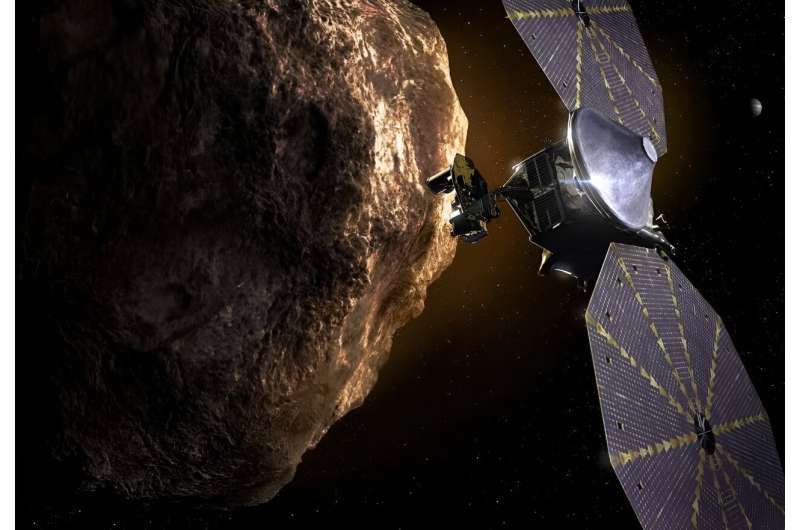
Missions to asteroids have been on a tear recently. Visits by Rosetta, Osirix-REX, and Hayabusa2 have all visited small bodies and, in some cases, successfully returned samples to the Earth. But as humanity starts reaching out to asteroids, it will run into a significant technical problem—bandwidth.
There are tens of thousands of asteroids in our vicinity, some of which could potentially be dangerous. If we launched a mission to collect necessary data about each of them, our interplanetary communication and control infrastructure would be quickly overwhelmed. So why not let our robotic ambassadors do it for themselves—that's the idea behind a new paper published in the Journal of Guidance, Control, and Dynamics and available on the arXiv preprint server from researchers at the Federal University of São Paulo and Brazil's National Institute for Space Research.
The paper primarily focuses on the control problem of what to do when a spacecraft is approaching a new asteroid.
Investment banks take stock of evolving space finance challenges


Astrobotic and Mission Control to partner on lunar rover mission


NRO eyes diverse satellite fleet and AI-powered ground systems in modernization push


Delta IV Heavy Completes Its Final Mission with NROL-70 Launch by US Space Force and ULA
 The US Space Force's Space Systems Command (SSC), together with the National Reconnaissance Office (NRO) and United Launch Alliance (ULA), has successfully launched the NROL-70 mission. This launch, utilizing the Delta IV Heavy rocket for its final mission, occurred at 12:53 p.m. EDT from Space Launch Complex 37 at Cape Canaveral Space Force Station, Florida.
Col. Jim Horne, SSC's senior m
The US Space Force's Space Systems Command (SSC), together with the National Reconnaissance Office (NRO) and United Launch Alliance (ULA), has successfully launched the NROL-70 mission. This launch, utilizing the Delta IV Heavy rocket for its final mission, occurred at 12:53 p.m. EDT from Space Launch Complex 37 at Cape Canaveral Space Force Station, Florida.
Col. Jim Horne, SSC's senior m ExoMars 2028 Mission Secures euro 522 Million Contract for Mars Exploration
 Thales Alenia Space has finalized a contract with the European Space Agency (ESA), valued at euro 522m, to progress the ExoMars 2028 mission. The contract encompasses the Mars Entry, Descent and Landing Module (EDLM) development and sustaining activities for vehicles from the 2022 mission.
Scheduled for an October to December 2028 launch at Kennedy Space Center, the mission aims to uncove
Thales Alenia Space has finalized a contract with the European Space Agency (ESA), valued at euro 522m, to progress the ExoMars 2028 mission. The contract encompasses the Mars Entry, Descent and Landing Module (EDLM) development and sustaining activities for vehicles from the 2022 mission.
Scheduled for an October to December 2028 launch at Kennedy Space Center, the mission aims to uncove Planetary Fates as Sun Transitions to White Dwarf Explored in New Study
 As our Sun ages and evolves into a white dwarf, the planets within our solar system face drastically different futures.
While Earth's destiny-whether engulfed or spared by the expanding Sun-remains uncertain, it's clear that Mercury and Venus are likely to be consumed, according to insights from a new study published in the Monthly Notices of the Royal Astronomical Society.
Although
As our Sun ages and evolves into a white dwarf, the planets within our solar system face drastically different futures.
While Earth's destiny-whether engulfed or spared by the expanding Sun-remains uncertain, it's clear that Mercury and Venus are likely to be consumed, according to insights from a new study published in the Monthly Notices of the Royal Astronomical Society.
Although