



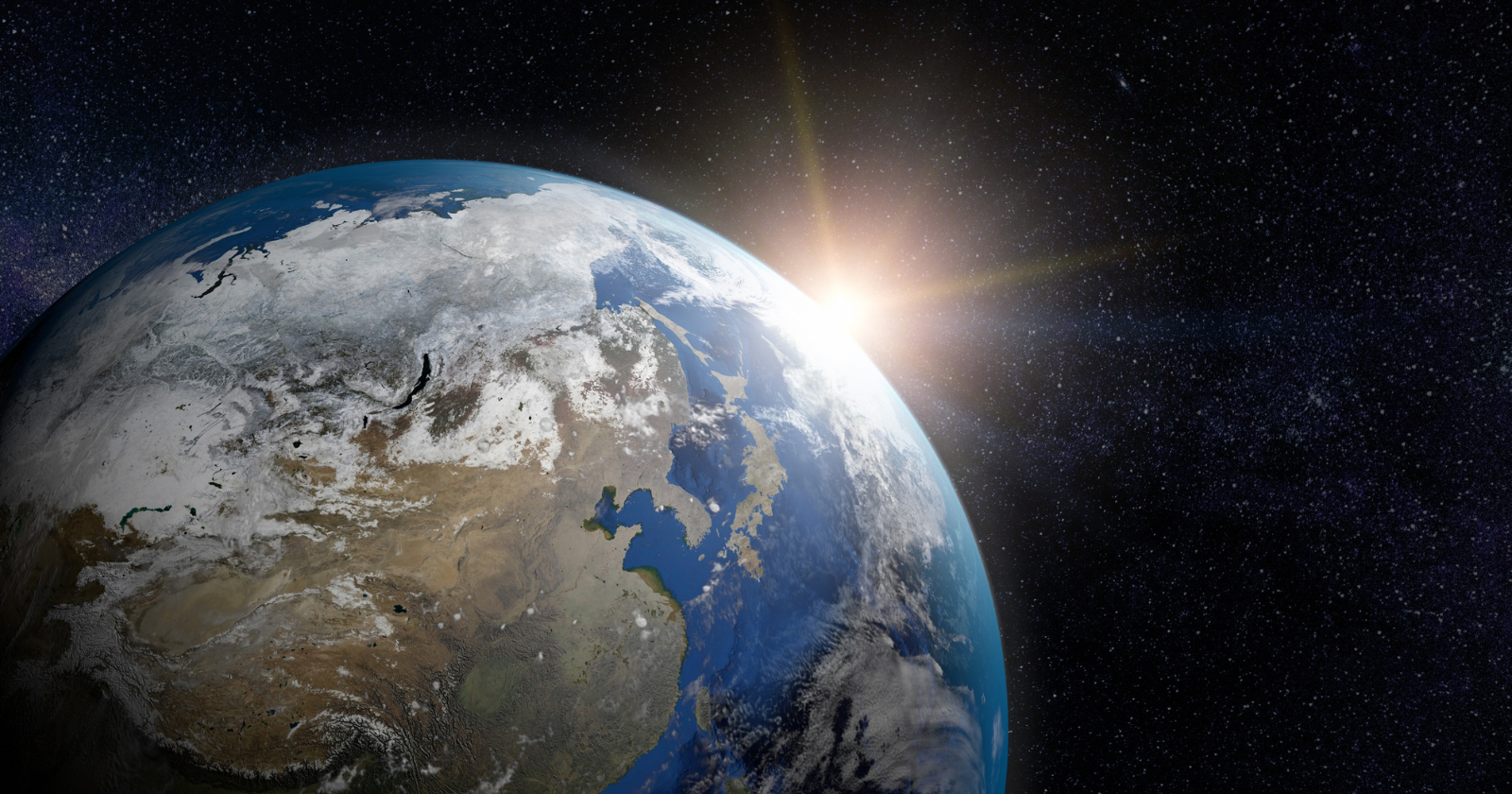
I published an article recently on Space Daily arguing that we will probably find alien life in the next 50 years. I still think the case for that is strong. But there is a competing argument I have not given enough credit, and it deserves its own honest hearing.
It is the possibility that Earth is genuinely rare. Not just statistically uncommon. Rare in a way that means complex life, the kind that builds telescopes and asks questions, may exist on essentially no other world in our galaxy and possibly in the observable universe.
This is the Rare Earth hypothesis, and 25 years after Peter Ward and Donald Brownlee laid it out in their 2000 book, the case for it has actually grown stronger in several specific ways. The more we learn about exoplanetary systems, galactic chemistry, and the history of life on our own planet, the more the conditions that produced us look like a stack of improbabilities. None of this is proof. But it is a serious argument, and people who think life is everywhere should be able to engage with it on its merits.
The basic claim
Ward and Brownlee’s thesis was specific. Microbial life might be common in the universe. Complex multicellular life, of the kind that produces fish, trees, and humans, almost certainly is not. Their argument rested on a list of conditions that all had to be satisfied for complex life to emerge and persist on a planet. The list was long. The probability of all the conditions being met simultaneously, even on a planet with the right chemistry, was vanishingly small.
The conditions, as the Wikipedia summary lays out, include the right galactic location, the right type of star, a stable orbit in a circumstellar habitable zone, a terrestrial planet of the right mass, the protective presence of a Jupiter-class gas giant, a large stabilising moon, an active magnetosphere, plate tectonics, the right atmospheric and ocean chemistry, the right mix of evolutionary pressures across billions of years, and whatever specific factors led to the emergence of eukaryotic cells, sexual reproduction, and the Cambrian explosion of animal phyla.
That is not one improbability. That is roughly a dozen, multiplied together.
The galactic location problem
Start with where Earth sits in the Milky Way. The galaxy is roughly 100,000 light-years across, but the region capable of supporting complex life appears to be much narrower than that. Astronomers call it the Galactic Habitable Zone.
The inner galaxy is a high-radiation environment crowded with massive stars and frequent supernovae. A Type II supernova within about eight parsecs of a planet would destroy more than half of its ozone layer, exposing the surface to lethal ultraviolet radiation. Stars are also packed densely enough near the galactic centre that gravitational interactions can disrupt planetary orbits. The supermassive black hole at the centre adds X-ray and gamma-ray flux that becomes problematic for biospheres at close range.
The outer galaxy has a different problem. It is metal-poor, meaning it lacks the heavy elements that terrestrial planets and gas-giant cores are made of. Studies of stars with detected exoplanets consistently show high metallicity, while metal-poor stars rarely host planets. The further out you go in the galaxy, the harder it is to make a rocky world in the first place.
What is left is a relatively narrow ring. Earth sits about 26,000 light-years from the galactic centre, comfortably inside what the modelling suggests is the survivable zone. A 2015 paper by Pratika Dayal and colleagues modelling the Milky Way’s habitability over time concluded that the simultaneous requirements of metallicity, supernova safety, and time for evolution dramatically narrow the regions of the galaxy where complex life is plausible.
This is not just an abstract worry. It means a meaningful fraction of the stars in our galaxy are essentially ruled out as plausible homes for complex life from the start.
Jupiter is doing more than people realise
The next condition is even more specific. Earth has Jupiter, a gas giant 318 times Earth’s mass, sitting in the outer solar system. Most exoplanetary systems we have catalogued do not look like ours. They have hot Jupiters orbiting close to their stars, eccentric giants on chaotic orbits, or no large gas giants at all.
What Jupiter does for Earth, according to Ward and Brownlee, is act as a gravitational shield. Comets and asteroids inbound from the outer solar system are mostly captured, deflected, or flung away by Jupiter before they can reach the inner planets. Their estimate was that without Jupiter, the frequency of comet impacts on Earth would increase by a factor of roughly 10,000.
That figure is debated. Some computer modelling has suggested Jupiter may also be responsible for sending some comets in our direction during certain orbital configurations. But the broader point holds. Whether Jupiter is a net protector or a mixed influence, what is striking is how rare its specific configuration appears to be. The standard architecture of an exoplanetary system, based on the more than 5,000 confirmed worlds we have catalogued, is not a calm circular orbit of a giant planet at five times Earth’s distance from a stable G-type star. It is messier and more violent than that.
The moon is not a small detail
Then there is the Moon. Earth’s moon is unusually large relative to its host planet, about 25% of Earth’s diameter, and very close, at around 400,000 kilometres. The leading explanation for this configuration is that a Mars-sized body called Theia struck the early Earth, ejecting enough material to coalesce into our oversized companion.
The Moon’s gravitational influence stabilises Earth’s axial tilt at around 23.5 degrees. Without that stabilisation, calculations suggest Earth’s tilt would wander chaotically over geological timescales, producing wildly different climates. Mars, which has only two tiny moons, has experienced exactly this kind of chaotic obliquity variation in its history.
For complex life to evolve over hundreds of millions of years, you need climate stability across that timeline. A wobbling planetary axis subjects the surface to extreme seasonal swings that can sterilise environments before complex ecosystems can establish themselves. The Moon, in this view, is not a romantic backdrop. It is a load-bearing piece of climate engineering.
How common is a Theia-style impact that produces a moon of the right size, at the right distance, with the right orbit, around a planet that survives the collision? We have no idea. We have a sample size of one.
Plate tectonics is unique to Earth so far
Plate tectonics deserves its own paragraph. Earth’s surface is divided into roughly a dozen major plates that drift, collide, and subduct on geological timescales. This process regulates atmospheric carbon dioxide on million-year cycles, which in turn regulates temperature. When the planet warms, more carbon dioxide is absorbed into rocks. When it cools, less is absorbed and the greenhouse effect strengthens. The net result is a thermostat that has kept Earth’s surface temperature within liquid-water range for billions of years.
So far, Earth is the only solar system body confirmed to have active plate tectonics. Mars appears to have had something like it briefly and then lost it. Venus has subduction-like activity but no full plate cycle. Europa shows tantalising evidence of ice-shell plate tectonics, but that is in a frozen ocean world rather than a rocky planet, and the analogy may be limited.
Why Earth has it and other rocky bodies do not is genuinely unclear. It probably involves Earth’s specific water content, internal heat, and core composition, possibly combined with the tidal effects of the Moon and the heat injection from the Theia impact. None of those conditions can be assumed to hold elsewhere.
The eukaryote bottleneck is the hardest one
And then there is the part of the Rare Earth argument that is hardest to wave away. Even if you grant that habitable rocky planets are common, that they have moons and gas-giant guardians and plate tectonics and stable orbits, you still have to explain how complex life emerges once microbes are already there.
This is where Earth’s own history becomes uncomfortable. Simple microbial life appears in the fossil record by about 3.5 billion years ago, and possibly earlier. Eukaryotes, the cells with nuclei that all complex life is built from, appear roughly 2 billion years ago, give or take. For 1.5 to 2 billion years, life on Earth was essentially nothing more sophisticated than bacteria and stromatolites. Then eukaryotes appeared, in what looks like a single, deeply improbable event involving one cell engulfing another and forming the symbiotic relationship that would eventually give rise to mitochondria.
This is the eukaryote bottleneck, and it matters. Complex multicellular life only became possible once eukaryotes existed. The Cambrian Explosion, when most major animal body plans appeared, did not happen until about 540 million years ago, more than 3 billion years after life itself began. The transition from origin-of-life chemistry to eukaryotic cells took the vast majority of Earth’s biological history.
If eukaryogenesis is genuinely a one-in-a-billion event at planetary scale, the universe could be teeming with bacteria and still produce essentially no civilizations. Microbial mats on a billion worlds. Trilobites on none of them.
The objections
None of this proves Earth is unique. The Rare Earth hypothesis has serious critics, and they have legitimate points.
Plate tectonics may not actually require a moon, according to computer modelling by Tilman Spohn in 2014, which suggested it might have arisen from biological processes rather than being a precondition for them. Some researchers argue that life may not need plate tectonics at all, and that other geophysical mechanisms could regulate climate. Others have pointed out that Jupiter’s protective role is more ambiguous than Ward and Brownlee made it sound. Subsurface ocean worlds may bypass several of the Rare Earth requirements entirely, since they do not need atmospheres, magnetospheres, or surface temperature regulation in the same way that Earth does.
And the discovery rate of exoplanets has produced one finding that arguably weakens the Rare Earth view considerably. Earth-sized rocky planets in habitable zones are not rare. They are extremely common. The Charbonneau estimate that at least 1 in 4 stars hosts a rocky habitable-zone world is one of the more “very secure conclusions” in modern astronomy. Whatever else is true about Earth, the basic real estate exists in the billions in our galaxy alone.
What the Rare Earth view actually implies
The strongest version of the Rare Earth argument is not that Earth is unique. It is that complex life requires so many independent conditions to be met simultaneously that, even with billions of habitable-zone worlds, the actual count of complex-life-bearing planets in the galaxy may be very low. Possibly one. Possibly a handful. Possibly somewhere between zero and a few dozen.
This is a different claim from “we are alone in the universe.” It is a claim that the bottlenecks between basic chemistry and complex biology are far steeper than the popular imagination assumes, and that the Drake Equation’s optimistic factors may be off by orders of magnitude on the biological side.
If that is right, the search for alien life is likely to find plenty of microbes, plenty of biosignature chemistry, plenty of evidence that life-as-chemistry is common. But it may find essentially no technosignatures, no civilizations, and no neighbours. The galaxy in this view is a vast garden of bacteria with very few flowers.
Why this argument deserves to be heard
The reason to take Rare Earth seriously is not that it is provably correct. It is that the case for it rests on physical arguments grounded in actual planetary science, and those arguments have not been refuted. Most of the popular case for ubiquitous alien life rests on the size of the universe and the basic chemistry of carbon. That is a legitimate starting point, but it is not the same as a complete argument. Size and chemistry get you to “life-as-microbes is plausible.” They do not get you to “civilizations are common.”
It is entirely possible that we live on the only planet in the Milky Way where chemistry was given the right combination of stability, time, and luck to produce something that looks back at the stars. If that is true, it is one of the most consequential facts about the universe, and it should change how we think about our own situation.
It might be that we will find alien life in the next 50 years. It might be that we will not. The honest version of this argument has both possibilities live, and treats Earth’s apparent improbabilities as data rather than romanticism.
Sometimes the most boring explanation, that we are genuinely rare and the silence is what it sounds like, is the one that fits the evidence best.