

Defence Procurement Minister launches Defence Space Strategy
 It's a huge pleasure to be here today on the next step in our execution of the Integrated Review, the Defence Command Paper and Defence and Security Industrial Strategy.
A lot has happened in Defence in the last year. From assisting in homeland resilience in issues as varied at vaccine delivery to Heavy Goods Vehicle support to the largest Royal Navy deployment in decades making our positi
It's a huge pleasure to be here today on the next step in our execution of the Integrated Review, the Defence Command Paper and Defence and Security Industrial Strategy.
A lot has happened in Defence in the last year. From assisting in homeland resilience in issues as varied at vaccine delivery to Heavy Goods Vehicle support to the largest Royal Navy deployment in decades making our positi Rocket Lab expands Colorado facilities, prepares for busy launch year
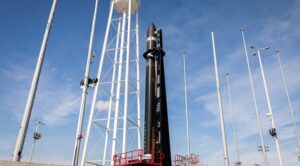
Rocket Lab will expand facilities in Colorado it obtained from a corporate acquisition last year as the company gears up for the first launch in a “crazy busy” year.
The post Rocket Lab expands Colorado facilities, prepares for busy launch year appeared first on SpaceNews.
Week in images: 31 January - 4 February 2022

Week in images: 31 January - 4 February 2022
Discover our week through the lens
New eruption at Krakatoa Volcano
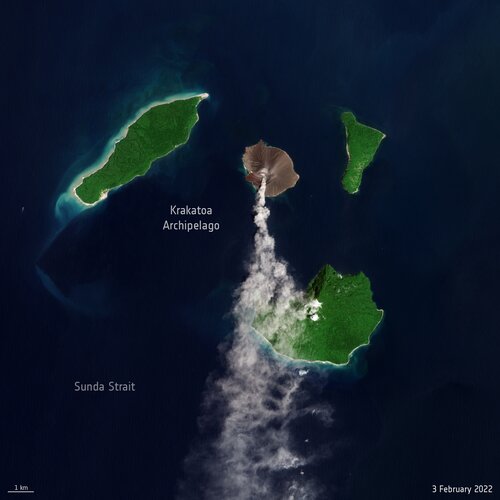 Image:
A new eruption started at the Anak Krakatoa volcano in Indonesia on 3 February 2022, as seen in this image captured by the Copernicus Sentinel-2 mission.
Image:
A new eruption started at the Anak Krakatoa volcano in Indonesia on 3 February 2022, as seen in this image captured by the Copernicus Sentinel-2 mission. NASA, NOAA to get new weather eyes in the sky with March launch from Cape Canaveral
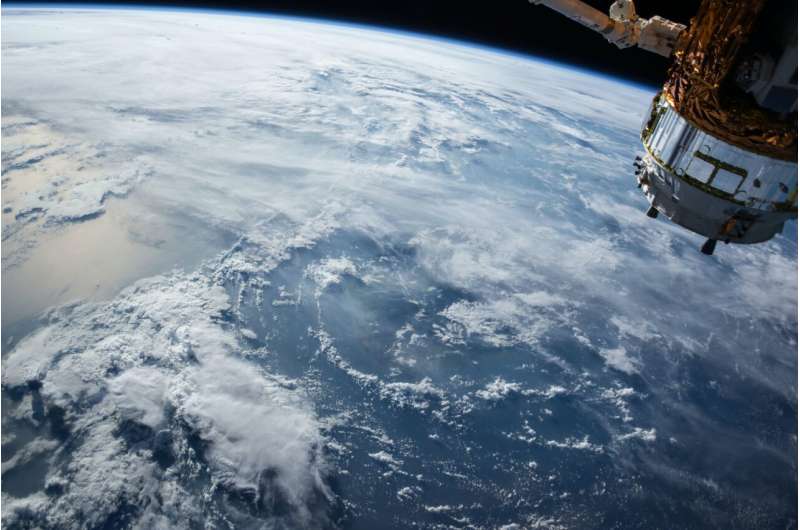
Soon, weather scientists will have an even stronger pair of eyes in the sky once a new advanced weather satellite launches this March.
The GOES-T, short for Geostationary Operational Environmental Satellite, is aiming for liftoff March 1 from Cape Canaveral Space Force Station on a United Launch Alliance Atlas V rocket thanks to a collaboration between the National Oceanic and Atmospheric Administration and NASA along with several other partners.
GOES-T, roughly the size of a small school bus, is the third in the GOES-R series of four advanced weather satellites. The value of GOES-T isn't exactly clear as the NOAA doesn't individually price out satellites one by one, said Pam Sullivan director of the GOES-R program. However, Sullivan did say the four-part project costs $11.7 billion.
"The value is returned to us public in benefits provided," Sullivan. "The observations of these satellites is even more critical now that the U.S. is experiencing a record number of billion dollar disasters."
Last year, dry and heated conditions led to an unprecedented amount wildfires in the northwest U.S. with thousands of acres burnt. Both Germany and China experienced historic flooding, and the Atlantic observed 21 named tropical systems—the third highest amount behind 2020′s 30 named storms and 2005′s 27 total.
Video: Webb Quest—mind-blowing mission to the early Universe
Use this form if you have come across a typo, inaccuracy or would like to send an edit request for the content on this page. For general inquiries, please use our contact form. For general feedback, use the public comments section below (please adhere to guidelines).
Please select the most appropriate category to facilitate processing of your request
Asteroid sharing Earth's orbit discovered. Could it help future space missions?
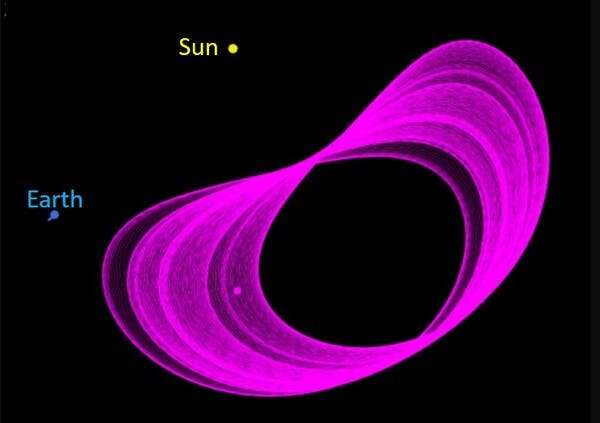
Research has shown that the Earth trails an asteroid barely a kilometer across in its orbit about the Sun—only the second such body to have ever been spotted. It goes round the Sun on average two months ahead of the Earth, dancing around in front like an excited herald of our coming.
This object, known as 2020 XL₅, was first spotted in December 2020 using Pan-STARRS telescopes on the summit of Haleakala on the Hawaiian island of Maui. But determination of its orbit required follow-up observations using the 4.1-meter SOAR (Southern Astrophysical Research) telescope in Chile.
Based on this data, a team led by planetary scientist Toni Santana-Ros of the University of Alicante in Spain has now announced that 2020 XL₅ is trapped for at least the next several thousand years in an orbit about one of the Sun-Earth "Lagrange points.
NASA and SpaceX say lagging Dragon parachute may be normal phenomenon
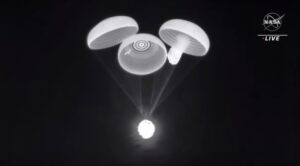
NASA and SpaceX are studying why parachutes on two consecutive Dragon missions opened late but said they don’t believe the issue poses a safety risk.
The post NASA and SpaceX say lagging Dragon parachute may be normal phenomenon appeared first on SpaceNews.
Lack of critical skilled workers delays first ViaSat-3 launch to late summer

A shortage of skilled workers has pushed the launch of the first ViaSat-3 broadband satellite from the first half of 2022 to “late summer,” Viasat said Feb. 3 as the pandemic continues to disrupt the industry’s supply chains.
SpaceX, NASA looking into sluggish chutes on last 2 flights
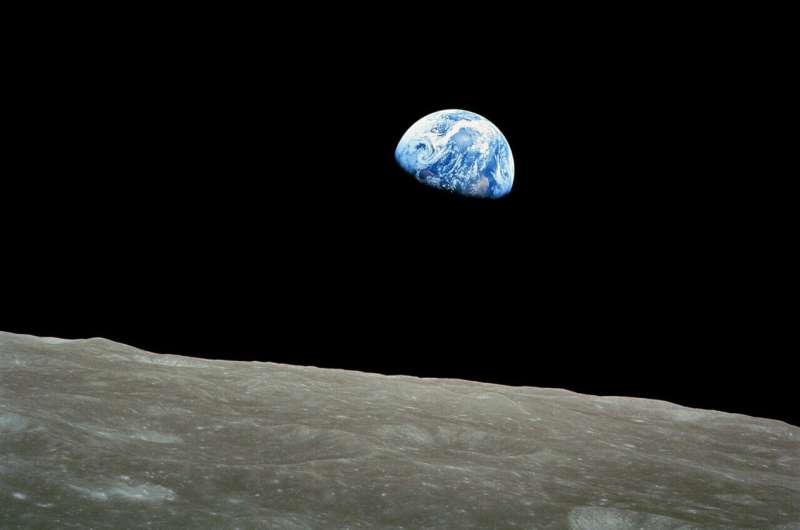
SpaceX and NASA are investigating a parachute issue that occurred on the last two capsule flights.
One of the four main parachutes was slow to inflate during the return of four astronauts to Earth last November. The same thing happened last week as a Dragon cargo capsule was bringing back science experiments from the International Space Station. In both cases, the sluggish parachute eventually opened and inflated—although more than a minute late—and the capsules splashed down safely off the Florida coast.
Officials for SpaceX and NASA said Friday they want to better understand what's happening, especially before launching another crew in a month or two. They're looking at photographs and inspecting the parachutes for clues, taking "extra caution with this very critical system," said Steve Stich, manager of NASA's commercial crew program.
"We're not taking anything for granted," SpaceX's William Gerstenmaier, a former NASA official, told reporters.
SpaceX's first private flight to the space station, with three ticket-buying businessmen and their retired astronaut escort, is set to blast off from NASA's Kennedy Space Center on March 30. NASA's next astronaut ferry flight would follow on April 15.


