
Chinese astronauts give science lesson from space station

Chinese astronauts on Thursday beamed back a science lesson from the country's under-construction space station.
The lecture focused on physics, aiming to illustrate how the weightless environment affects buoyancy, the movement of objects and optics.
NASA's newest X-ray telescope rockets into orbit
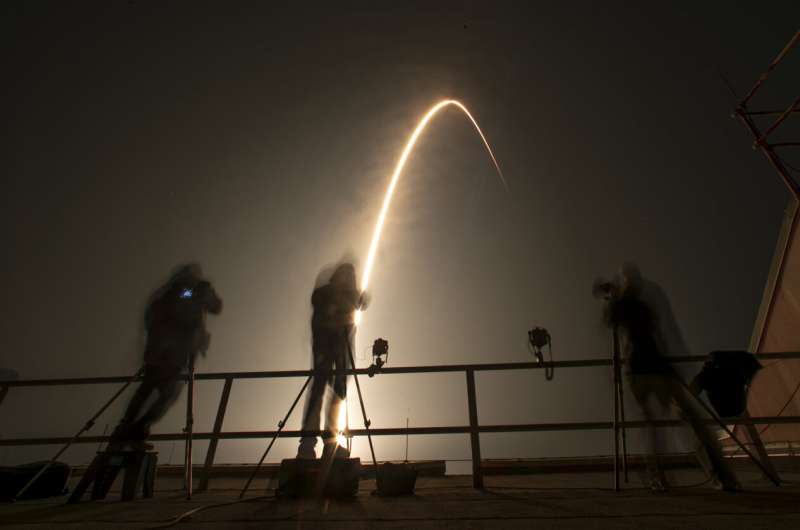
NASA's newest X-ray observatory rocketed into orbit Thursday to shed light on exploded stars, black holes and other violent high-energy events unfolding in the universe.
Third consortium gets UK funds to study potential deorbit mission
A consortium led by British small satellite maker SSTL has secured UK Space Agency funding to study a mission to remove two spacecraft from low Earth orbit by 2025.
Op-ed | The ‘S’-word: How Standards can Advance the Satellite Industry
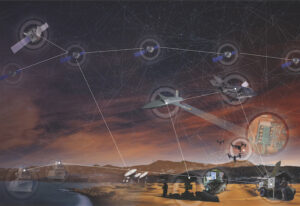
In comparison to terrestrial wireless, standards have played a much more limited role in the satellite world’s more insular ecosystem. But as the industry transitions from legacy analog hardware to digital software, standards will be essential for realizing true interoperability between satellites and the new ground infrastructures.
NASA Goddard helps ensure asteroid deflector hits target, predicts and will observe impact results
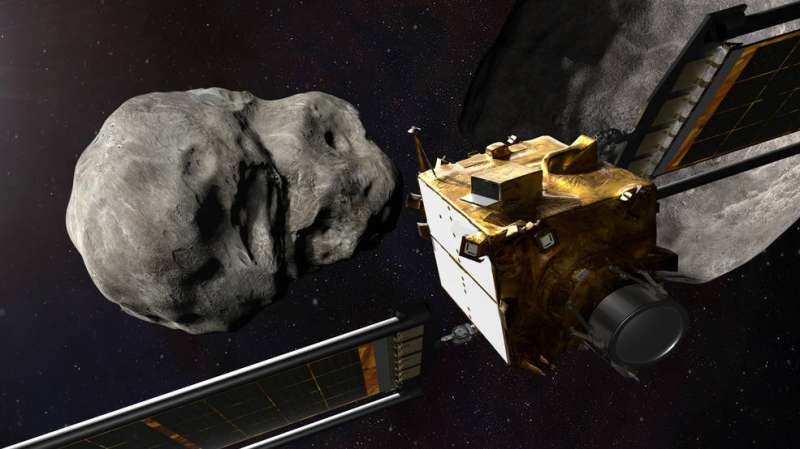
Although the chance of an asteroid impacting Earth is small, even a relatively small asteroid of about 500 feet (about 150 meters) across carries enough energy to cause widespread damage around the impact site. NASA leads efforts in the U.S. and worldwide both to detect and track potentially hazardous asteroids and to study technologies to mitigate or avoid impacts on Earth. If an asteroid were discovered and determined to be on a collision course with Earth, one response could be to launch a "kinetic impactor"—a high-velocity spacecraft that would deflect the asteroid by ramming into it, altering the asteroid's orbit slightly so that it misses Earth. NASA's Double Asteroid Redirection Test (DART) will be the first mission to demonstrate asteroid deflection using a kinetic impactor.
DART will test kinetic impactor technology by targeting a double asteroid that is not on a path to collide with Earth and therefore poses no actual threat to the planet.
Mini-jet found near Milky Way's supermassive black hole
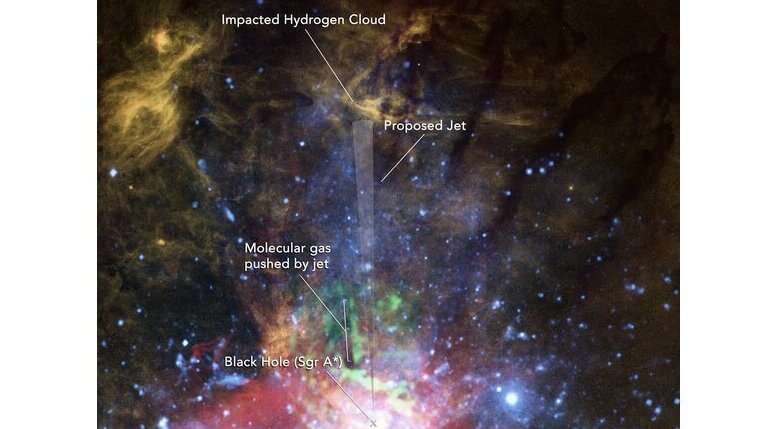
Our Milky Way's central black hole has a leak. This supermassive black hole looks like it still has the vestiges of a blowtorch-like jet dating back several thousand years. NASA's Hubble Space Telescope hasn't photographed the phantom jet but has helped find circumstantial evidence that it is still pushing feebly into a huge hydrogen cloud and then splattering, like the narrow stream from a hose aimed into a pile of sand.
This is further evidence that the black hole, with a mass of 4.1 million Suns, is not a sleeping monster but periodically hiccups as stars and gas clouds fall into it. Black holes draw some material into a swirling, orbiting accretion disk where some of the infalling material is swept up into outflowing jets that are collimated by the black hole's powerful magnetic fields. The narrow "searchlight beams" are accompanied by a flood of deadly ionizing radiation.
"The central black hole is dynamically variable and is currently powered down," said Gerald Cecil of the University of North Carolina in Chapel Hill.
South Australia’s Oculus Observatory hosts passive radar to track space objects
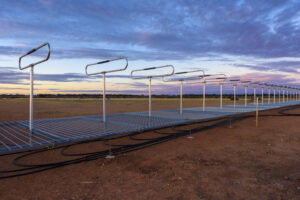
South Australia’s Oculus Observatory, which opened Dec. 9, houses the first in a planned global network of passive radars to track objects in orbit.
DoD has to explain to Congress how it will buy low-latency satellite broadband
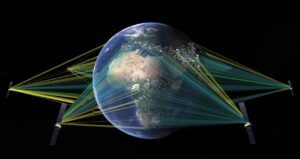
The 2022 NDAA directs the Pentagon to brief lawmakers on military use of commercial satellite communications services, specifically those from non-geostationary orbit satellites.
On National Security | Russia showed it can attack. Is U.S. Space Force ready to defend?
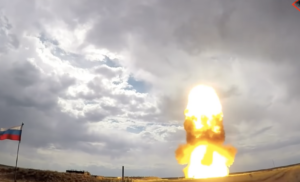
Russia’s anti-satellite missile test has raised calls for the United States and its allies to push for international norms to ban such tests. But reaching an agreement on space arms control could take years or even decades.
Rocket Lab launches 109th satellite to orbit
 Rocket Lab USA, Inc. has successfully deployed two satellites to orbit for real-time geospatial intelligence company BlackSky, bringing the total number of satellites deployed by Rocket Lab to 109.
The 'A Data With Destiny' mission, arranged for BlackSky through global launch services provider Spaceflight Inc., was Electron's 23rd liftoff from Rocket Lab Launch Complex 1 on New Zealand's M
Rocket Lab USA, Inc. has successfully deployed two satellites to orbit for real-time geospatial intelligence company BlackSky, bringing the total number of satellites deployed by Rocket Lab to 109.
The 'A Data With Destiny' mission, arranged for BlackSky through global launch services provider Spaceflight Inc., was Electron's 23rd liftoff from Rocket Lab Launch Complex 1 on New Zealand's M