



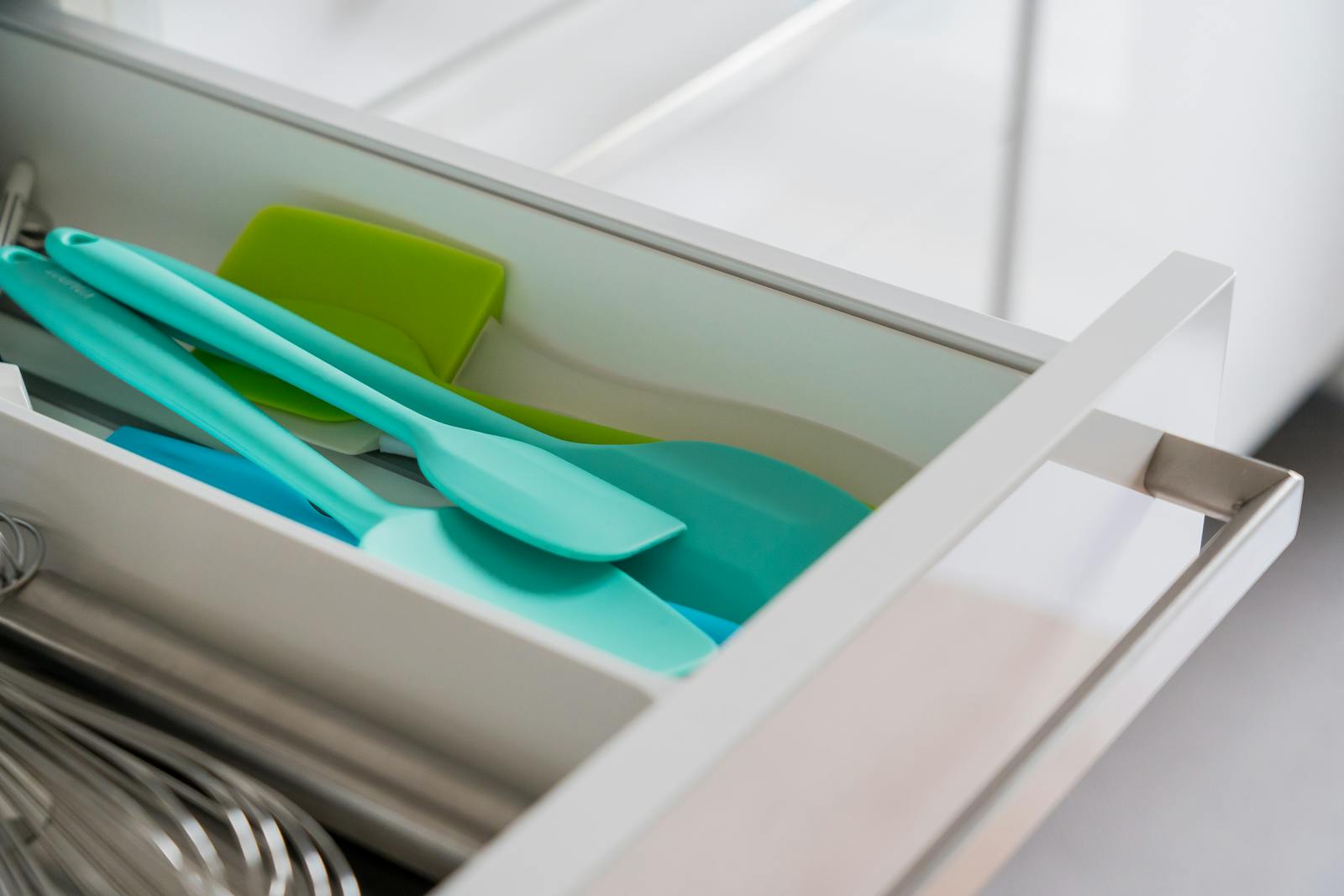
I have a drawer in my kitchen that is, by any reasonable standard, perfect. Spice jars aligned by frequency of use. Measuring spoons nested. A small ceramic dish that holds exactly the bottle openers and nothing else. Open any other drawer in the house and you will find chaos: tangled charging cables, half-used birthday candles, a single AirPod whose partner has been missing for eleven months. My seven-year-old once asked why one drawer gets to be nice when the rest of the kitchen is, in her words, a disaster. I did not have a good answer at the time. I have been thinking about it ever since.
The drawer is not about the drawer. It never is.
The single point of order
People who maintain one immaculate zone inside a larger mess are doing something psychologically specific. They are not failed minimalists. They are not lazy about the rest. They have selected a small, controllable territory and poured a disproportionate amount of attention into it because attention has to go somewhere, and everywhere else feels too big.
This is selective focus dressed up as housekeeping. The drawer becomes a kind of altar. You can’t fix the mortgage, the diagnosis, the strained relationship with a sibling, the news cycle, or the fact that your kid is growing up faster than you are emotionally prepared for. You can fix the drawer. So you do. Repeatedly.
The broader pattern is called compartmentalization, and the conventional view treats it as a defense mechanism — a way the mind separates overwhelming feelings into different mental rooms so they don’t all flood the same space at once. But in certain seasons of life, compartmentalization is less avoidance and more triage. The drawer is triage made physical.
What the brain is actually doing
When the world feels unpredictable, the nervous system looks for places where prediction still works. Predictive coding research describes the brain as a forecasting machine that constantly compares what it expects to see against what it actually encounters. When the gap between expectation and reality gets too wide too often, the system gets noisy. Anxious. Tired.
An organized drawer is a tiny, reliable forecast. You open it. The thing is where it should be. The prediction holds. There is something almost medicinal about that small confirmation, repeated daily.
The rest of the house, by contrast, is full of unresolved variables. The stack of mail you haven’t opened. The closet you’ve been meaning to deal with. The shelf where unfinished projects go to age. Each of those is a low-grade prediction error humming in the background.
The drawer is the one place the hum stops.
Control where you can find it
My parents ran a dry cleaner for almost three decades. Small business, thin margins, dozens of small operational decisions a day. What I remember most is how my mother kept the front counter. The pens were always in the same cup. The receipt book sat at exactly the same angle. The candy dish for kids was refilled every Monday. Behind that counter, the back room was a different universe — steam, plastic sheeting, garments in motion, a controlled riot.
The counter was the drawer. It was the part customers saw, yes, but it was also the part she could keep predictable while everything behind it changed by the hour. I understand now that she was managing herself as much as the business.
People who run something demanding learn this trick early. Compartmentalizing stress between work and life is often described as a productivity skill, but underneath it is something more basic: choosing one zone where the rules are clear, and protecting it.
The drawer is a self-portrait
If you want to know what someone is most worried about losing control of, look at what they over-control. The person whose inbox is at zero often has a relationship they can’t talk about. The person whose car is spotless sometimes has a body they feel betrayed by. The person whose kitchen drawer is a museum exhibit is frequently managing a level of internal noise that the visible chaos of the rest of the house can’t account for.
This isn’t pathology. It’s signal. The body picks a representative — a stand-in — for everything it cannot currently fix. Tending to the representative is a way of saying: I am still here. I am still capable. Some part of my life still responds when I touch it.
People who keep their childhood bedrooms exactly as they were preserve a small, frozen room as evidence that an earlier version of themselves existed. The organized drawer is a close cousin of that behavior. Both are physical anchors. Both say: this much, at least, I get to keep intact.
When the drawer becomes the only thing
Selective focus tips into something less helpful when the controlled zone becomes the only place a person feels competent. If you can spend forty minutes rearranging the spice drawer but cannot make a phone call to the doctor’s office, the drawer has stopped being triage and started being a hiding place.
The clinical literature on dissociative compartmentalization describes a spectrum: at one end, healthy mental separation that lets people function under stress; at the other, rigid splitting where whole regions of experience get walled off and become inaccessible. The drawer person is usually nowhere near the deep end of that spectrum. But the mechanism is on the same continuum, and that’s worth knowing.
The question to ask yourself is not whether you have a perfect drawer. The question is whether the rest of the house has gotten worse at exactly the rate the drawer has gotten better.
The cost of the unspoken inventory
There is a particular exhaustion that comes from running a private inventory of everything you’re not currently dealing with. The closet you’ll get to. The conversation you’ll have eventually. The medical thing you’ve been postponing. Each item lives rent-free in the back of the mind, and the mental cost of hosting them all is real.
Chronic background activation — the kind produced by unresolved demands hanging over you — keeps certain neural circuits humming in ways that produce sustained anxiety-like behavior in animal models. Humans aren’t mice, but the basic principle survives the translation. Things you are carrying without addressing are not free.
The organized drawer is, in a way, the brain’s attempt to stop carrying. It says: at least one item on the list is closed. At least one corner is finished. Don’t underestimate how much that matters when the list is otherwise long.
Why the rest of the house gets worse
Here’s the part people don’t usually say out loud. The mess outside the drawer often gets worse the harder the drawer gets maintained, because the drawer is absorbing energy that would otherwise be distributed.
You only have so much executive function in a day. If a disproportionate share of it is going into one zone, the other zones have to coast. The pile on the dining table grows. The car gets dustier. The unread tabs multiply. None of it is laziness. It’s a budget problem.
Some people can’t rest after finishing something big — stillness has a way of making you hear everything you’ve been outrunning. The drawer works on the same logic. As long as you’re tending it, you don’t have to sit with the rest. The activity is the avoidance and the comfort at the same time.
The healthy version of this
The version of this behavior that works is the one where the drawer is honest about what it is. You let it be a small, deliberate ritual of control. You don’t pretend it’s a personality. You don’t expand it into a moral system about how the rest of the house ought to be.
Letting yourself separate from a hard feeling, taking a beat, and then coming back to confront it can be valuable. Recent work suggests that suppressing unwanted thoughts, when paired with eventual return, can actually reduce anxiety and depression rather than worsen them.
Translated to the drawer: the drawer is fine as long as you eventually open the other drawers too. Not all at once. Not as a punishment. But on some schedule, however loose, that keeps the rest of the house from drifting into territory you can no longer face.
What it looks like in a family
My daughter doesn’t yet have a drawer of her own. She has a shoebox under her bed that contains what she considers her most important possessions, including three rocks, a friendship bracelet, a school photo of a kid I’ve never met, and a feather. The rest of her room looks like a small weather event passed through it.
I don’t tell her to clean the room. I tell her the shoebox is a good idea. Because what she’s actually doing — at seven, without language for it — is learning that you get to choose one thing to keep careful, and that the choosing matters more than the cleaning. The rest of the room will sort itself out across decades. The shoebox is the skill.
I think a lot about what world she’s going to inherit, and what habits will help her stay intact in it. The ability to designate a small, defended zone of order in the middle of a noisy life is not a small skill. It’s one of the more useful ones.
How to tell which kind of drawer you have
A few honest questions, if you’re the kind of person this article is about.
Does maintaining the drawer make you feel calmer, or does it make you feel like you’ve earned the right not to deal with anything else? The first is regulation. The second is a deal you’re making with yourself that doesn’t always hold up.
Could you tolerate the drawer being mildly disorganized for a week? If the answer is no, the drawer might be doing more emotional work than it should be doing alone.
What did you stop doing when the drawer started getting perfect? That’s usually the more interesting question. The thing the drawer replaced is often the thing worth looking at.
The drawer is allowed
None of this is an argument against having an organized drawer. I have one. I’m going to keep having one. The point is to know what it’s doing for you, so it doesn’t have to do it secretly.
People who keep one corner of their life immaculate while the rest goes soft are not hypocrites and they’re not failing at adulthood. They’re managing load. They’ve found a small, repeatable way to feel competent in a life that doesn’t always reward competence visibly. The drawer is a quiet announcement, mostly to themselves, that they haven’t given up.
That’s worth respecting. It’s also worth noticing. Because the drawer can tell you, if you let it, exactly where the rest of the house needs you next.
Photo by Castorly Stock on Pexels