

TMC Technologies wins contract to support NASA's IV&V Program
 TMC Technologies of West Virginia, a leading-edge technology services firm, is proud to announce it has been awarded a five-year, Blanket Purchase Agreement, with a ceiling value of $24 million, by NASA to provide advanced systems and software engineering services in support of the Katherine Johnson Independent Verification and Validation (IV&V) Facility, home of NASA's IV&V Program in Fairmont,
 Worms on a mission to research muscle loss in space
 Today hundreds of tiny worms are being flown to the International Space Station (ISS) as part of an experiment to understand more about human muscle loss and how to prevent it.
Led by scientists from Nottingham and Exeter University, with hardware designed by Oxford-based Kayser Space, a research team aims to determine the causes of muscle changes during spaceflight and find ways to mitiga
Today hundreds of tiny worms are being flown to the International Space Station (ISS) as part of an experiment to understand more about human muscle loss and how to prevent it.
Led by scientists from Nottingham and Exeter University, with hardware designed by Oxford-based Kayser Space, a research team aims to determine the causes of muscle changes during spaceflight and find ways to mitiga Government fund will support new ideas for cleaning up space
 Space firms are being invited to apply for a share of up to 800,000 pounds in funding from the UK Space Agency to develop ideas for space debris removal missions.
One of the biggest global challenges facing the space sector is orbital congestion and space debris. There are currently an estimated 900,000 pieces of space debris including old satellites, spent rocket bodies and even tools dro
Space firms are being invited to apply for a share of up to 800,000 pounds in funding from the UK Space Agency to develop ideas for space debris removal missions.
One of the biggest global challenges facing the space sector is orbital congestion and space debris. There are currently an estimated 900,000 pieces of space debris including old satellites, spent rocket bodies and even tools dro NASA announces two new missions to Venus
 NASA announced two new missions to Venus on Wednesday that will launch at the end of the decade and are aimed at learning how Earth's nearest planetary neighbor became a hellscape while our own thrived.
"These two sister missions both aim to understand how Venus became an inferno-like world, capable of melting lead at the surface," said Bill Nelson, the agency's newly-confirmed administrator
NASA announced two new missions to Venus on Wednesday that will launch at the end of the decade and are aimed at learning how Earth's nearest planetary neighbor became a hellscape while our own thrived.
"These two sister missions both aim to understand how Venus became an inferno-like world, capable of melting lead at the surface," said Bill Nelson, the agency's newly-confirmed administrator The Incredible Adventures of the Hera mission - Presenting Hera
 Meet Hera, our very own asteroid detective. Together with two briefcase-sized Cubesats - Milani the rock decoder and Juventas the radar visionary - Hera is off on an adventure to explore Didymos and Dimorphos, an asteroid pair typical of the thousands that pose an impact risk to planet Earth.
Planetary defence requires planetary cooperation. Hera is set to rendezvous with the asteroid pair
Meet Hera, our very own asteroid detective. Together with two briefcase-sized Cubesats - Milani the rock decoder and Juventas the radar visionary - Hera is off on an adventure to explore Didymos and Dimorphos, an asteroid pair typical of the thousands that pose an impact risk to planet Earth.
Planetary defence requires planetary cooperation. Hera is set to rendezvous with the asteroid pair Launcher raises $11.7 million Series A round
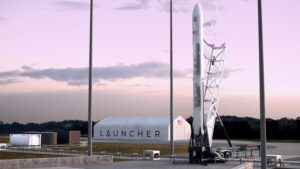
WASHINGTON — Small launch vehicle developer Launcher has raised $11.7 million in a Series A funding round, which the company says puts it on a path to reaching orbit with a fraction of the total investment of other launch startups.
Axiom Space purchases three Crew Dragon missions
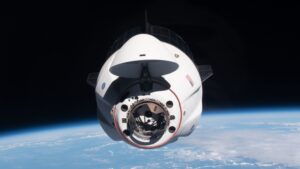
WASHINGTON — Axiom Space has signed a contract with SpaceX for three additional Crew Dragon missions, enough to meet its projections for private astronaut missions to the International Space Station through at least 2023.
Axiom, which already has a deal with SpaceX for the Ax-1 mission to the ISS launching in early 2022, said June 2 the new contract covers the projected Ax-2, 3 and 4 missions to the station.
China launches Fengyun-4B meteorological satellite
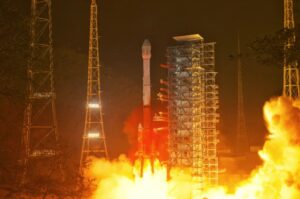
HELSINKI — China successfully sent the Fengyun-4B weather satellite into geosynchronous transfer orbit Wednesday with the country’s 16th orbital launch of 2021.
Astronomers calculate genesis of Oort cloud in chronological order
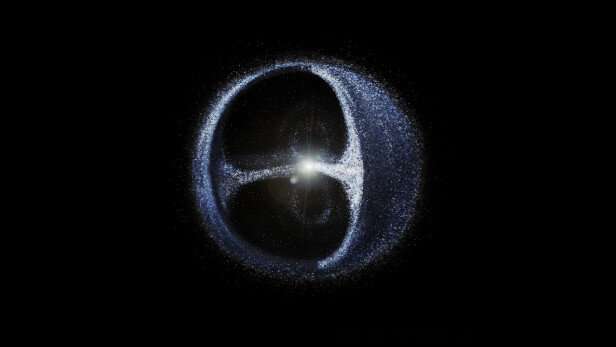
A team of Leiden astronomers has managed to calculate the first 100 million years of the history of the Oort cloud in its entirety. Until now, only parts of the history had been studied separately. The cloud, with roughly 100 billion comet-like objects, forms an enormous shell at the edge of our solar system. The astronomers will soon publish their comprehensive simulation and its consequences in the journal Astronomy & Astrophysics.
The Oort cloud was discovered in 1950 by the Dutch astronomer Jan Hendrik Oort to explain why there continue to be new comets with elongated orbits in our solar system. The cloud, which starts at more than 3000 times the distance between the Earth and the Sun, should not be confused with the Kuiper belt.
Op-ed | Damage to Canadarm2 on ISS once again highlights space debris problem
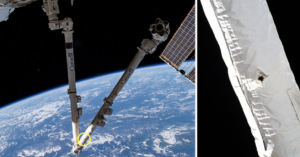
A piece of orbital debris recently hit Canadarm2, the nearly 18-meter-long robotic arm on the International Space Station that helps with maintenance tasks and “catches” visiting spacecraft. Thankfully, the functioning of the robotic arm is unaffected.


