

DoD space agency to launch laser communications experiments on SpaceX rideshare

WASHINGTON — A pair of cubesats built by General Atomics for the Space Development Agency will seek to demonstrate optical communications between satellites, and from satellites to a military drone aircraft.
The satellites are scheduled to fly to a sun-synchronous orbit later this month aboard a SpaceX Falcon 9 rideshare mission called Transporter-2.
Image: It's a wrap! Multi-layer satellite insulation
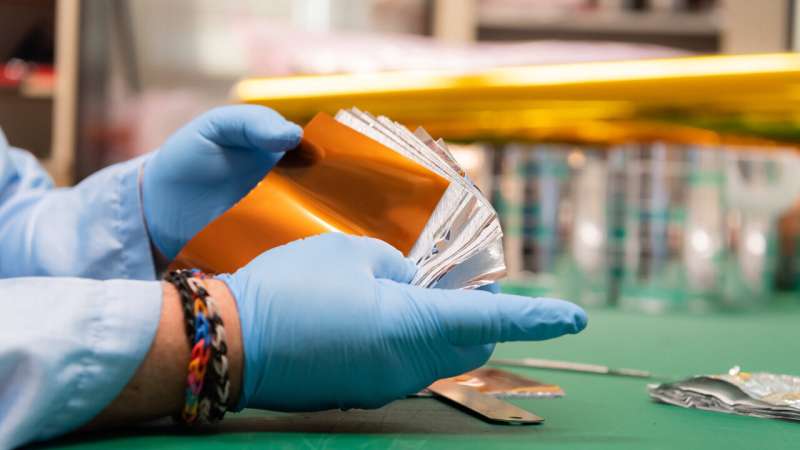
Multi-layer insulation (MLI) is the reason that satellites often look as though they've been covered in shiny Christmas wrapping.
Satellite surfaces are sheathed in MLI made up of layers of very thin, metal-coated plastic film, along with low-conducting 'spacer' material such as silk, nylon or glass-fiber netting.
In the airlessness of space, objects can be hot and cold at the same time, especially if one side is in sunshine and another is in shade. In such conditions, thermal radiation is the main driver of temperature change (rather than convection or conduction), and reflective MLI serves to minimize it.
Thermal control specialists aim to maintain the temperature of the satellite within set limits, to keep electronic and mechanical parts working optimally and to prevent any temperature-triggered structural distortion.
Placing MLI blankets on a satellite body is a skilled art in itself, with complex shapes needing to be created to fit around around edges or joints.
Explore further
NASA's Lucy in the cleanroom
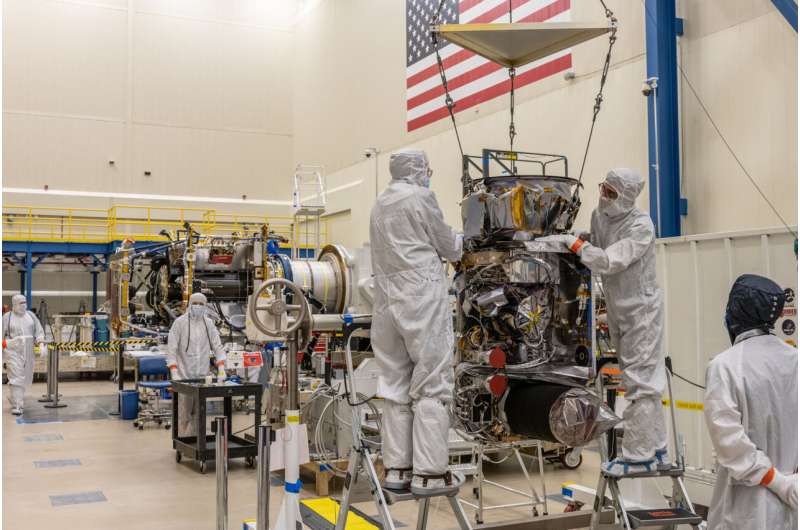
L'Ralph is one of the Lucy spacecraft's three primary science instruments. The L'Ralph instrument is a multicolor camera which will gather information on the surface composition of the Trojan asteroids, including organics. The L'Ralph camera sits atop the spacecraft's Instrument Pointing Platform (IPP) that's used to aim Lucy's instruments in a specific direction—seen here in the clean room at Lockheed Martin in Denver, Colorado, in late January 2021.
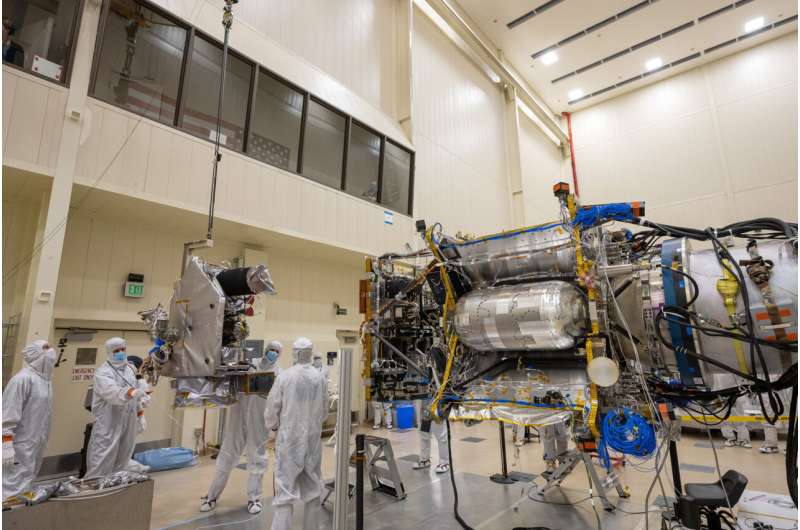
Throughout its production, the Lucy spacecraft is maneuvered into different positions to accommodate the integration and test of various elements. The spacecraft is seen here in February 2021 on its rotation fixture in the Lockheed Martin clean room in Denver Colorado, as its Instrument Pointing Platform (left) with three core instruments was installed.
Explore further
Space junk: Houston, we have a problem

When we think of space, we think big and empty but when it comes to Earth's orbit, it's cluttered with millions of pieces of garbage that we call space junk.
The junk—or space debris—is made up of uncontrollable human-made items that remain in orbit long after they've served their original purpose. The scale of debris ranges from the very large including discarded stages from rocket and satellite launches, through to smaller metal pieces such as nuts and bolts, all the way down to particles such as paint flakes.
At its smallest, the space junk may only be one millimeter in size, but there are thousands of pieces bigger than a pizza box causing problems.
According to the latest European Space Agency statistical modeling, there are approximately 34,000 objects greater than 10 centimeters in orbit, but up to 128 million items between one millimeter and one centimeter floating around.

2 Russian crew do spacewalk at International Space Station

NASA Selects 2 Missions to Study ‘Lost Habitable’ World of Venus
 NASA has selected two new missions to Venus, Earth’s nearest planetary neighbor.
 Satellite operators meet 120 MHz C-band clearing target

TAMPA, Fla. — Satellite operators have cleared a portion of C-band in a key step toward giving the spectrum to U.S. wireless companies in December.
Work has now started on installing filters on ground antennas across the United States, so wireless operators can use the lower 120 MHz of C-band for 5G without interfering with satellite broadcast customers.
Air Force to further study use of commercial rockets to deliver cargo around the world

WASHINGTON — The U.S. Air Force plans to further study the potential use of commercial rockets to transport cargo around the world.
According to Air Force budget documents, a project named “rocket cargo” has been selected as one of the Air Force’s so-called Vanguard programs.
Rocket Lab continues to study “complex” Electron failure

WASHINGTON — Rocket Lab said June 2 that it is continuing to study the “complex failure” on its most recent Electron launch, even after receiving approval from the Federal Aviation Administration to resume launches.
The company said in a statement that while the FAA’s Office of Commercial Space Transportation authorized the company to resume launches under its existing license, the company is continuing to investigate the cause of the May 15 launch failure of an Electron rocket carrying two BlackSky imaging satellites.


