

New government funding helps UK companies lead the way for future Moon missions
 In what will be the world's first commercial servicing of its kind, Surrey Satellite Technology Ltd (SSTL), Inmarsat and MDA UK are among those who won contracts with the European Space Agency (ESA), worth just over 2 million pounds in total, to shape the infrastructure for future lunar exploration.
NASA plans to return to the Moon by 2024 and, working with ESA and other partners, intends
In what will be the world's first commercial servicing of its kind, Surrey Satellite Technology Ltd (SSTL), Inmarsat and MDA UK are among those who won contracts with the European Space Agency (ESA), worth just over 2 million pounds in total, to shape the infrastructure for future lunar exploration.
NASA plans to return to the Moon by 2024 and, working with ESA and other partners, intends China's Zhurong rover moves onto Martian surface to begin scientific operations
 The Chinese Martian rover Zhurong moved from its landing platform onto the surface of the Red Plane at 10:40 am Saturday, starting its exploration around the landing site, according to the China National Space Administration.
The administration said in a statement on Saturday afternoon that according to data sent back to the ground control, the rover's deployment was carried out safely and
The Chinese Martian rover Zhurong moved from its landing platform onto the surface of the Red Plane at 10:40 am Saturday, starting its exploration around the landing site, according to the China National Space Administration.
The administration said in a statement on Saturday afternoon that according to data sent back to the ground control, the rover's deployment was carried out safely and 
Space Force looking to build new radar sites to track objects in high orbits

WASHINGTON — The U.S. Space Force next month will solicit industry bids for deep-space radar sensors that can track active satellites and debris in high orbits above 22,000 miles.
One or more contractors will be selected to develop prototype concepts for the Deep Space Advanced Radar Concept (DARC), a project started by the U.S.
Air Force unveils exoskeleton to aid aerial ports in lifting
 An exoskeleton, worn by U.S. Air Force aerial porters to assist in lifting objects with reduced strain, will make its debut at Travis Air Force Base, Calif., the branch announced on Wednesday.
The device, designed by Arizona State University and the Air Force Life Cycle Management and Air Mobility Command, will be used in an official capacity for the first time this week.
The Aer
An exoskeleton, worn by U.S. Air Force aerial porters to assist in lifting objects with reduced strain, will make its debut at Travis Air Force Base, Calif., the branch announced on Wednesday.
The device, designed by Arizona State University and the Air Force Life Cycle Management and Air Mobility Command, will be used in an official capacity for the first time this week.
The Aer SES Government Solutions provides medium earth orbit satellite services for combatant command
 SES Government Solutions, a wholly-owned subsidiary of SES, in close partnership with a key U.S. Government customer, designed, developed and fielded an O3b Medium Earth Orbit (MEO) reachback capability to provide mission-critical communications for a key combatant command.
The awarded task order for USD 11.8 million is against the single-award USD 516.7 million Blanket Purchase Agreement
SES Government Solutions, a wholly-owned subsidiary of SES, in close partnership with a key U.S. Government customer, designed, developed and fielded an O3b Medium Earth Orbit (MEO) reachback capability to provide mission-critical communications for a key combatant command.
The awarded task order for USD 11.8 million is against the single-award USD 516.7 million Blanket Purchase Agreement NASA additively manufactured rocket engine passes cold spray, hot fire tests
 NASA is partnering with Aerojet Rocketdyne to advance 3D printing technologies, known as metal additive manufacturing, and its capabilities for liquid rocket engines in landers and on-orbit stages/spacecraft.
The Robotic Deposition Technology (RDT) team, led out of NASA's Marshall Space Flight Center in Huntsville, Alabama, is designing and manufacturing innovative and lightweight combusti
NASA is partnering with Aerojet Rocketdyne to advance 3D printing technologies, known as metal additive manufacturing, and its capabilities for liquid rocket engines in landers and on-orbit stages/spacecraft.
The Robotic Deposition Technology (RDT) team, led out of NASA's Marshall Space Flight Center in Huntsville, Alabama, is designing and manufacturing innovative and lightweight combusti First leap for beam-hopping constellation
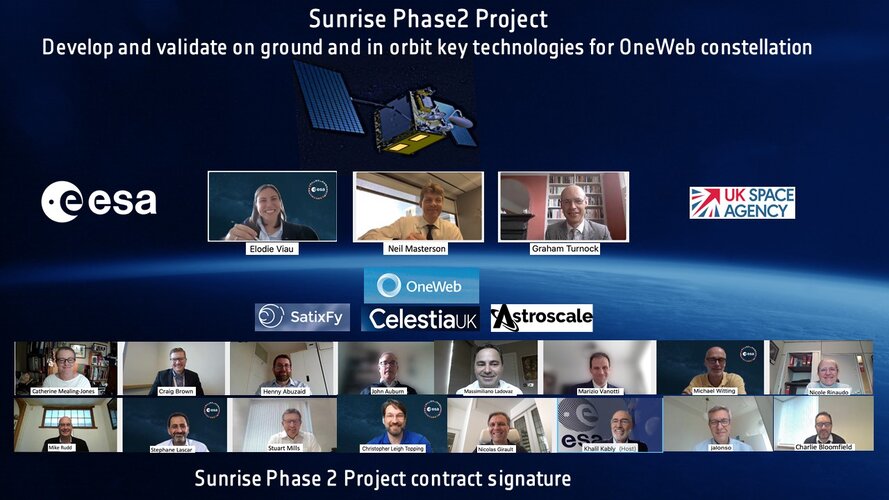
Broadband satellites that can be completely repurposed while in orbit have just taken a leap forwards.
Cost and schedule overruns continue to grow for NASA programs

WASHINGTON — NASA suffered increasing cost overruns on its major programs again in 2020, a problem a new report says will be exacerbated by the pandemic.
The annual report by the Government Accountability Office (GAO) on major NASA programs, published May 20, found that costs of those programs grew by more than $1 billion in 2020, the fifth year in a row overall costs increased.
NASA rocket mission studying escaping radio waves
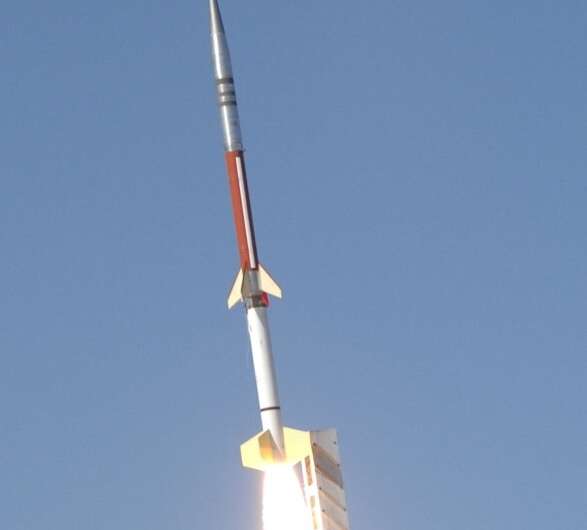
A NASA rocket mission, launching May 26, 2021, will study radio waves that escape through the Earth's ionosphere impacting the environment surrounding GPS and geosynchronous satellites, such as those for weather monitoring and communications.
Launching from NASA's Wallops Flight Facility, a Terrier-Improved Malemute suborbital sounding rocket will carry the Vlf trans-Ionospheric Propagation Experiment Rocket, or VIPER. The mission is scheduled for 9:15 p.m., Wednesday, May 26. The launch window is 9:15 p.m. to midnight EDT and the backup days are May 27-28. The launch may be visible in the mid-Atlantic region.
VIPER is studying very low frequency radio, or VLF, waves that are produced by both natural (e.g. lightning) and artificial means. During the day these waves are trapped or absorbed by the Earth's ionosphere. At night, however, some of the waves escape through the ionosphere and accelerate electrons in the Van Allen Radiation Belt.
"At night, the lower layers of the ionosphere are much less dense, and more of the VLF can leak through, propagate along the Earth's magnetic field lines, and end up interacting with the high-energy electrons trapped in the Van Allen Radiation Belts," said Dr.


