

NASA's Europa Clipper gets set of super-size solar arrays

The largest spacecraft NASA has ever built for planetary exploration just got its "wings"—massive solar arrays to power it on the journey to Jupiter's icy moon Europa.
NASA's Europa Clipper spacecraft recently got outfitted with a set of enormous solar arrays at the agency's Kennedy Space Center in Florida. Each measuring about 46½ feet (14.2 meters) long and about 13½ feet (4.1 meters) high, the arrays are the biggest NASA has ever developed for a planetary mission.
FAA pauses Falcon 9 launches to investigate failed booster landing


Guetlein outlines U.S. Space Force vision for ‘allied by design’ space systems


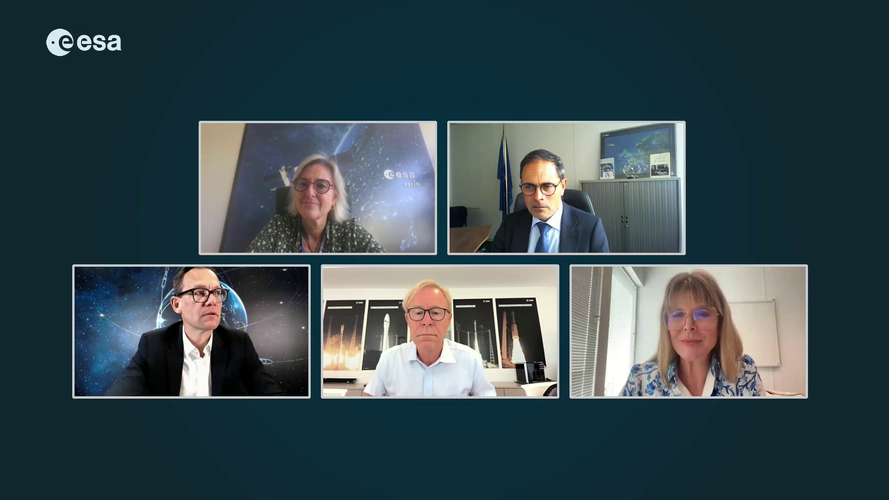
Sentinel-2C pre-launch media briefing
 Video:
00:52:00
Video:
00:52:00
The Copernicus Sentinel-2C satellite is set for liftoff on 4 September on the last Vega rocket from Europe’s Spaceport in Kourou, French Guiana.
This recording is of a media briefing held on 29 August 2024 to offer journalists the possibility to learn more about the Sentinel-2 mission and the last flight of Vega, Europe’s nimble rocket specialising in launching small scientific and Earth observation spacecraft such as to sun-synchronous polar orbits, following the Sun.
The Sentinel-2 mission is based on a constellation of two identical satellites, Sentinel-2A and Sentinel-2B, flying in the same orbit but 180°
Galactic Energy launches six satellites with third sea launch


Shikha Ganguly, L3Harris Technologies – Leading Women in Space


International consortium with NASA reveals hidden impact of spaceflight on gut health

Scientists have uncovered how spaceflight profoundly alters the gut microbiome, revealing previously unknown effects on host physiology that could shape the future of long-duration space missions.
Led by University College Dublin (UCD) and McGill University, Canada, in collaboration with NASA and an international consortium, the research offers the most detailed profile to date of how space travel impacts the gut microbes we carry into space.
Published in npj Biofilms and Microbiomes, the study used advanced genetic technologies to examine changes in the gut microbiome, colons, and livers of mice aboard the International Space Station (ISS) over three months.
The findings reveal significant shifts in specific bacteria and corresponding changes in host gene expression associated with immune and metabolic dysfunction commonly observed in space, offering new insights into how these changes may affect astronaut physiology during extended missions.
Dr. Emmanuel Gonzalez, McGill University, and first author of the study, said, "Spaceflight extensively alters astronaut physiology, yet many underlying factors remain a mystery.
What if you flew your warp drive spaceship into a black hole?
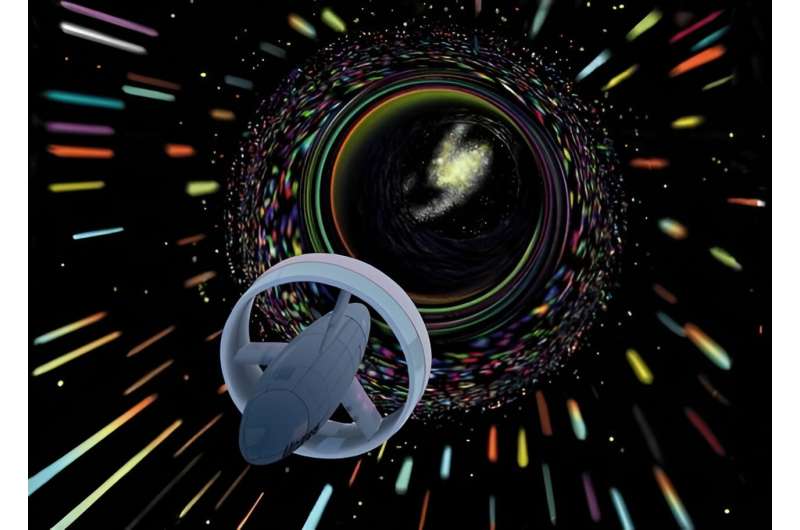
Warp drives have a long history of not existing, despite their ubiquitous presence in science fiction. Writer John Campbell first introduced the idea in a science fiction novel called Islands of Space.
These days, thanks to Star Trek in particular, the term is very familiar. It's almost a generic reference for superliminal travel through hyperspace. Whether or not warp drive will ever exist is a physics problem that researchers are still trying to solve, but for now, it's theoretical.
Recently, two researchers looked at what would happen if a ship with warp drive tried to get into a black hole. The result is an interesting thought experiment. It might not lead to starship-sized warp drives but might allow scientists to create smaller versions someday.
Astronauts stranded in space: Unexpected eight-month stay highlights risks of space exploration
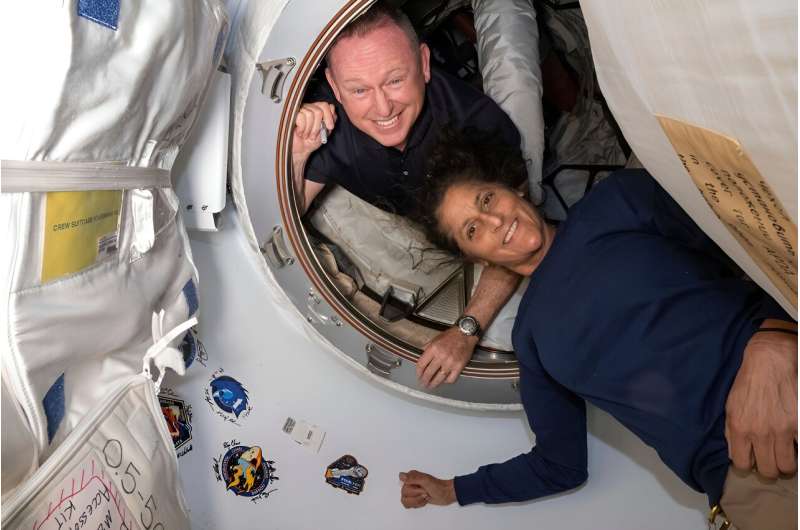
Astronauts Butch Wilmore and Suni Williams took off for the International Space Station in June. The test flight aboard Boeing's Starliner was supposed to last a week, but they have yet to return.
Helium leaks and issues with the control thrusters were discovered with the spacecraft, making a safe return to Earth impossible, according to NASA.
Instead, the pair will return to Earth with the crew of an upcoming SpaceX mission, which means they will not be back until February.
But a weeklong trip turning into an eight-month journey is par for the course when it comes to space exploration, Northeastern University experts say.
New Horizons spacecraft measurements shed light on the darkness of the universe

Just how dark is deep space? Astronomers may have finally answered this long-standing question by tapping into the capabilities and distant position of NASA's New Horizons spacecraft, by making the most precise, direct measurements ever of the total amount of light the universe generates.
More than 18 years after launch and nine years after its historic exploration of Pluto, New Horizons is more than 5.4 billion miles (7.3 billion kilometers) from Earth, in a region of the solar system far enough from the sun to offer the darkest skies available to any existing telescope—and to provide a unique vantage point from which to measure the overall brightness of the distant universe.


