




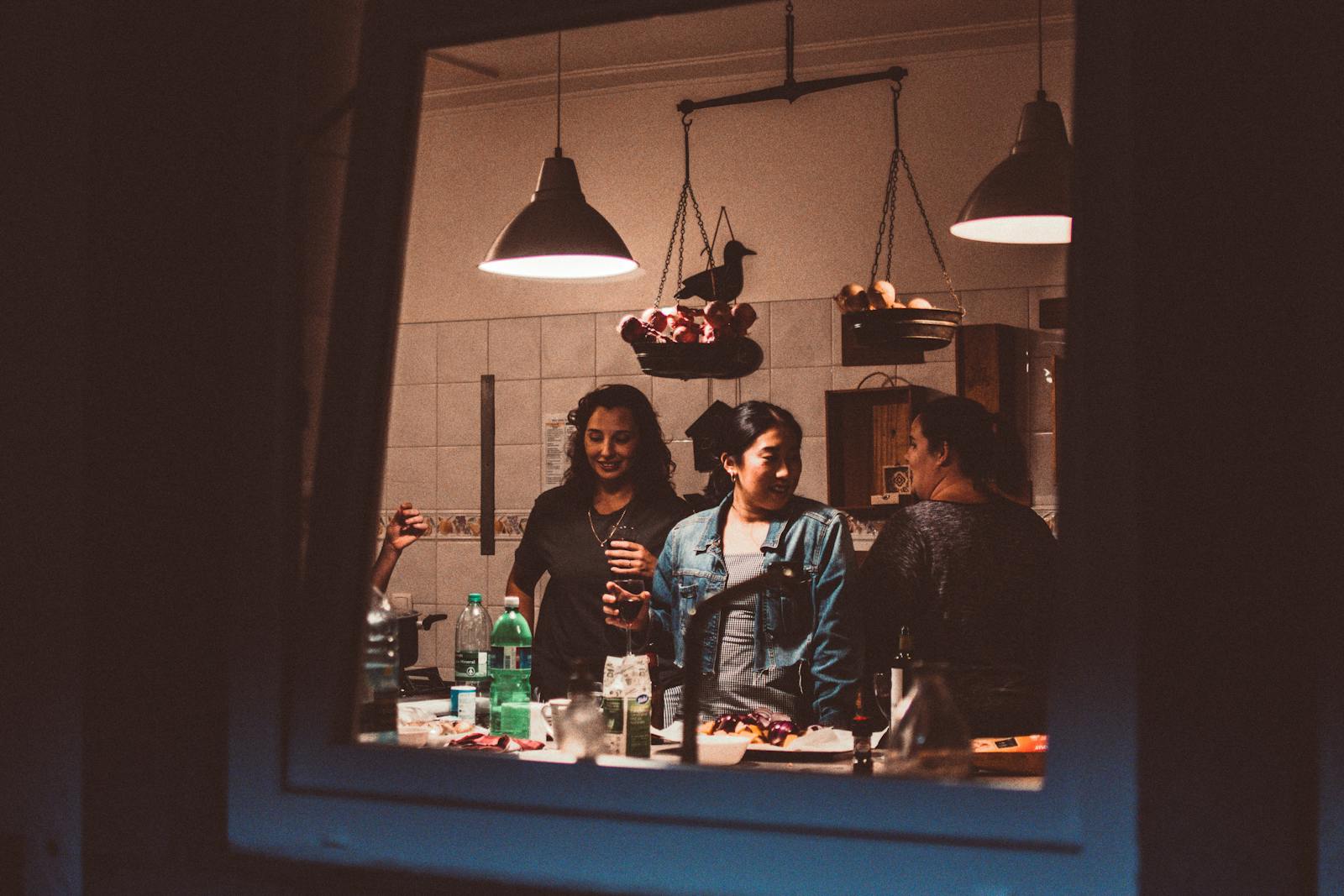
The kitchen at 9:47pm has a particular quality of quiet. The dishwasher hums. Someone’s leftover plate sits on the counter because they meant to come back for it. The light over the sink is the only one still on, and the person standing under it is mentally drafting tomorrow’s grocery list while answering a sibling’s text about a parent’s upcoming appointment. They have not sat down in four hours. Nobody has noticed.
This is the geography of being the dependable one.
Every family has one. The person who remembers the cardiologist’s number, the cousin’s allergy, the date the lease renews. The one who answers the phone on the first ring because something might be wrong, and if it is, they’ll know what to do.
I spend most of my working hours analyzing space policy — budgets, agreements, the slow institutional machinery of how Washington decides what gets built and what doesn’t. But the same instinct that draws me to institutional dynamics keeps pulling me toward this quieter institution. The family is also a system. It also distributes labor unevenly. It also has power centers, protected interests, and people whose contributions get treated as overhead rather than work.
The job nobody applied for
The role usually starts early. A child reads the room well, learns that competence earns warmth, and quietly understands that being easy is a form of love. By thirty, that child is the family’s project manager. By forty-five, they are its emotional infrastructure. The work is invisible because it never breaks loudly enough to be noticed.
What looks like temperament is often training. The dependable one isn’t naturally calmer than everyone else. They’ve simply rehearsed steadiness so long it became indistinguishable from who they are.
And here is where the trouble starts. When steadiness becomes identity, the people around you stop asking whether you need anything. Your reliability becomes the weather. Nobody thanks the weather.
What the research actually says about this exhaustion
The exhaustion isn’t imagined. A 2025 caregiving study cited by Otsuka found that nearly half of family caregivers reported anxiety, depression, or other mental health challenges in the past year. The American Psychological Association data referenced in that same reporting shows that between 40 and 70 percent of caregivers display symptoms of depression compared to non-caregivers. These aren’t soft numbers. They describe a population running on reserves that have been quietly drained for years.
And the work itself is enormous. Research from Columbia University’s Mailman School of Public Health, also cited in the Otsuka piece, estimates that over 44 million family caregivers in the United States provide the equivalent of $873.5 billion worth of unpaid labor annually. That figure should change how we talk about families. It rarely does. In policy terms, $873.5 billion is roughly thirty-five times NASA’s annual budget. We treat one of those numbers as a serious national line item and the other as the natural background of family life.
The newer Pew Research analysis on family caregiving in an aging America documents how this load is intensifying as populations get older and adult children take on coordination roles for parents who are themselves still caring for someone. The dependable one is now often dependable across two generations at once.
The misreading at the center of it all
Families do not usually mistake the dependable person’s steadiness for indifference on purpose. They mistake it because the alternative is uncomfortable. If your sister is fine, you don’t have to wonder whether you’ve been a good sibling. If your daughter is handling it, you don’t have to ask whether she’s handling too much.
Steadiness is interpreted as sufficiency. The logic is almost mathematical. She isn’t asking for help, therefore she doesn’t need it. He always picks up, therefore picking up costs him nothing. The reliable one is read as a closed system that produces care without requiring any.
This misreading is the engine of the whole problem.
The low-effort family and the over-functioner
Recent reporting has described a dynamic where one family member does most of the emotional and logistical work while others remain disengaged. One person plans the holidays, remembers the birthdays, mediates the conflicts, and checks in after the doctor’s appointment. Everyone else participates inconsistently and assumes access whenever they want it. Clinical psychologists describe this as a system where one person takes on excessive responsibility while others disengage, creating an imbalanced dynamic that depletes the over-functioner.
People settle into roles that maintain the system’s equilibrium, even when the equilibrium is bad for them. The peacemaker keeps the peace because the peace would collapse without them. So they keep paying for it. This is the same pattern you see in any institution where one office quietly absorbs the work that nobody else wants to claim. The work gets done, the system looks functional from the outside, and the people inside know exactly who is carrying it.
The people who check in on everyone else have often gone years without being checked in on themselves. Being needed can become a substitute for being known. Both observations point at the same wound from different angles.
Why the dependable one rarely asks
Asking is dangerous when your value in the family has been pegged to your competence. If you ask, you might be told no. If you’re told no, you have to confront the possibility that the relationships you’ve maintained for years have only been able to flow in one direction. That confrontation is usually more frightening than the exhaustion itself.
So the dependable one keeps a quiet ledger. They notice who calls, who shows up, who remembers. They rarely cash the ledger in. The ledger is for them — a private account of evidence that one day they may need to explain to themselves what happened.
Rest, for this person, would mean letting something drop. Letting something drop would mean someone else might have to pick it up. And the unspoken fear is that nobody will. The belief that rest must be earned is what keeps tired people working through weekends they’ll never get back, and the dependable one applies that same logic to family with even less mercy than they apply it to work.
The specific shape of the exhaustion
It is not the exhaustion of a hard week. It is the exhaustion of having been on call for two decades. Studies on caregiver burden in chronic illness contexts — including research summarized by Nature on hemodialysis caregivers — show a consistent inverse correlation between the demands placed on caregivers and their own quality of life. The longer the caregiving lasts, the further the caregiver’s own well-being recedes. The body keeps the score even when the family doesn’t.
Research on mothers of children with congenital conditions, including a study published in the European Journal of Human Genetics on caregiver burden and stigma in cleft lip and palate cases, has found that psychological resilience mediates the relationship between perceived stigma and caregiver burden. Translation: the people who appear to be coping best are often the ones who have learned to absorb the most before showing it. Resilience, measured this way, can be both a protective factor and the very thing that lets a family keep over-relying on a person.
That’s the cruel mechanism. The more capable you are at carrying it, the longer everyone else gets to assume it isn’t heavy.

The cost compounds quietly
The compounding happens in places that don’t show up in conversation. Sleep gets thinner. Friendships get neglected because there’s no time left to maintain them after maintaining everyone else. Hobbies become aspirational. The dependable one starts to notice they can’t remember the last time they wanted something purely for themselves, without it being attached to a logistical purpose.
One of the things I’ve learned from years of watching how policy actually lands on people — and from being married to an immigration lawyer who sees it up close every day — is that there is almost always a gap between the rule on paper and the cost in practice. The rule says everyone in the family contributes. The practice is that the labor of that contribution is distributed unevenly enough that one person is doing the work of three, and the system depends on her not naming it.
Research on family dynamics in crisis settings — like the Frontiers study on family dynamics and child wellbeing in Rohingya refugee camps — shows that when adult caregivers are depleted, the cost cascades downward into the next generation’s emotional security. The dependable one isn’t only paying for themselves. They’re paying for what the next generation will inherit as normal.
What changes when the question finally lands
The turning point is rarely dramatic. It is usually a small moment — a missed thank-you, a sibling’s casual comment, a parent assuming yet again that of course she’ll handle it. And the dependable one, washing a dish at 9:47pm, suddenly hears the question with full clarity: why is it always me?
That question, once asked, cannot be unasked. It begins a slow re-evaluation that the family will almost certainly resist. Pulling back will be read as coldness. Asking for reciprocity will be called dramatic. The system is designed to protect itself from the very change that would make it healthier.
But the question is the start. Boundaries arrive next, and they arrive uncomfortably. The people who finish every task but can’t remember the last time they felt proud of themselves are running on a fuel that eventually burns the engine. The dependable one is running on that fuel. The reckoning is what running out feels like.
What the family could do, if it wanted to
The fix isn’t complicated. It’s just rare. Families that want to stop exhausting their dependable member have to do three uncomfortable things.
First, they have to ask. Specifically. Not ‘are you okay’ delivered as a formality, but questions that genuinely probe what the person has been carrying unseen. The dependable one has been trained for years to say I’m fine. Getting past that takes more than one question.
Second, they have to redistribute. Real redistribution, not gestures. Someone else handles the parents’ Medicare paperwork this year. Someone else hosts the holiday. The dependable one is allowed to be a guest in her own family for a while, and the family has to absorb the discomfort of doing things less perfectly than she would have.
Third, they have to thank her in language that doesn’t include the words ‘you’re so good at this.’ That phrase, however well-meant, is what assigned her the role in the first place. Better to say: I see how much this has cost you. I’m sorry I didn’t see it sooner.
What the dependable one might consider
If you are the dependable one in your family, the work isn’t to become unreliable. It’s to stop confusing your reliability with your worth. The two were braided together early, and untangling them takes time. The casting happens early too — a child gets read as the easy one, the one who doesn’t need much because he seems to manage, and that reading can harden into something carried into adulthood without ever being chosen.
Steadiness is not the same as not needing anything. The people who love you should be able to tell the difference. If they can’t yet, that is information — not about your value, but about the limits of what the relationship has been asked to do.
The kitchen light is still on. The dishwasher is still humming. But sometime soon, maybe, you sit down before the list is finished. You leave the plate on the counter. You let someone else notice it in the morning. The family survives. You discover that some of what you thought was holding the world together was actually just holding you in place.
Photo by Ron Lach on Pexels