
Juice’s lunar-Earth flyby: all you need to know LINK

Juice’s lunar-Earth flyby: all you need to know
Make the most of ESA’s Industry Space Days 2024

Participants of ESA’s Industry Space Days (ISD 2024) share insights and tips on how to make the most of this space technology business event on 18–19 September at ESA-ESTEC in Noordwijk, The Netherlands.
New report examines Space Force agency’s ambitious satellite network program


Sierra Space conducts second full-scale burst test of inflatable module


From Concordia to the Moon
 Image:
Concordia is a research station in Antarctica that places you farther away from humankind than even the International Space Station. Every year, ESA sponsors a medical doctor to spend a year, or "winterover," at Concordia station. This year, our medical doctor is Jessica Kehala Studer, who is seen in this picture gazing at the Moon and the vast expanse of Antarctica. Around May, the Sun dips below the horizon for the last time, and the crew experiences four months of total darkness, with temperatures dropping to –80°C in winter.
The station serves as an analogue for space, mirroring the
How Europe’s biggest rocket came to be: Ariane 6 montage
 Video:
00:08:21
Video:
00:08:21
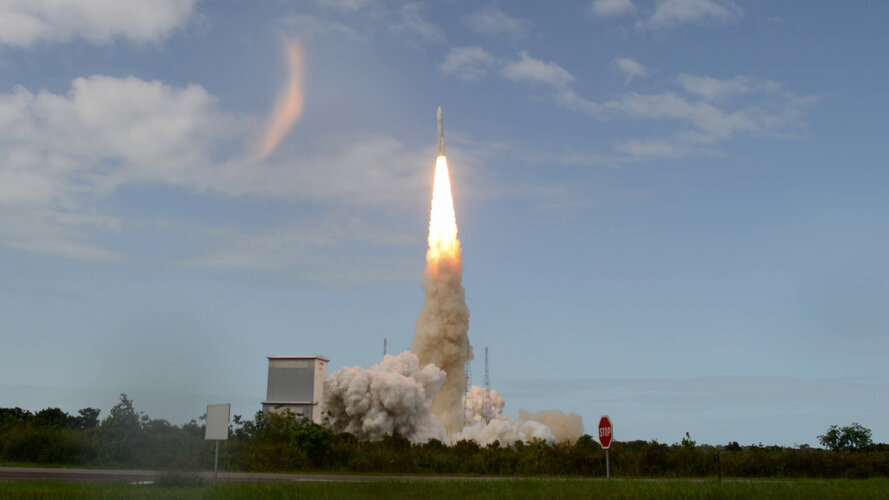
The first half of 2024 saw hundreds of people across Europe building, cajoling, shipping, lowering, integrating, securing and protecting the precious pieces and parts that came together to create Ariane 6 – Europe’s new heavy-lift rocket.
Huge engines, boosters and outer shells met tiny screws, electrical boards and masses of supercooled fuel. All this came together at Europe’s Spaceport in French Guiana, for the spectacular first launch of Ariane 6 on 9 July 2024, restoring Europe’s access to space.
Get a glimpse at the teamwork, skill and care that went into this moment over many months, in this montage
Pentagon’s Office of Strategic Capital seeks input on new loan program for critical technologies


Space-trekking muscle tests drugs for microgravity-induced muscle impairment
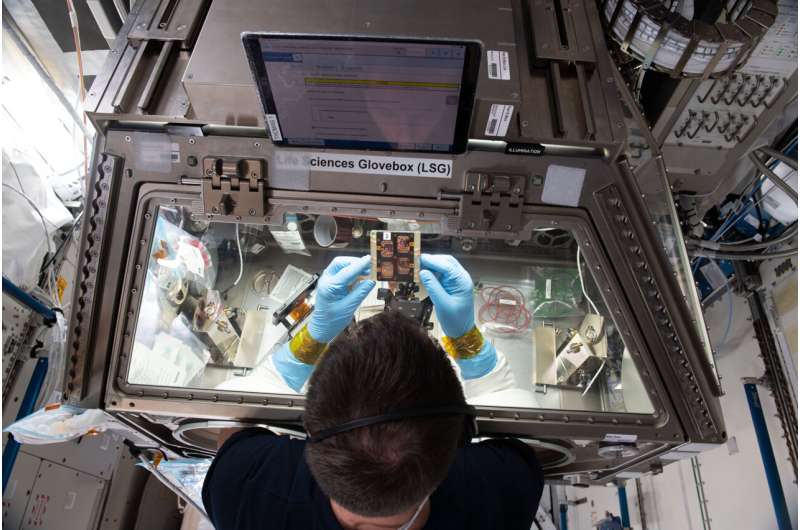
A gentle rumble ran under Ngan Huang's feet as a rocket carrying her research—live, human muscle cells grown on scaffolds fixed on tiny chips—lifted off, climbed, and disappeared into the sky to the International Space Station National Laboratory. These chips would help Huang better understand muscle impairment, often seen in astronauts and older adults, and test drugs to counter the condition.
Now, the results are back. Reporting in a study published July 25 in Stem Cell Reports, Huang's team showed that space-traveling muscle had metabolic changes that indicate impaired muscle regeneration and gene activities associated with age-related muscle loss called sarcopenia. But drug treatment partially prevented microgravity's adverse effects.
"Space is a really unique environment that accelerates qualities associated with aging and also impairs many healthy processes," says Huang, an associate professor at Stanford University.
"Astronauts come back with muscle atrophy, or a reduction of muscle function, because the muscle isn't being actively used in the absence of gravity.
Akima lands $480 million Space Force contract to modernize Satellite Control Network