


NASA's massive moon booster arrives at Kennedy Space Center
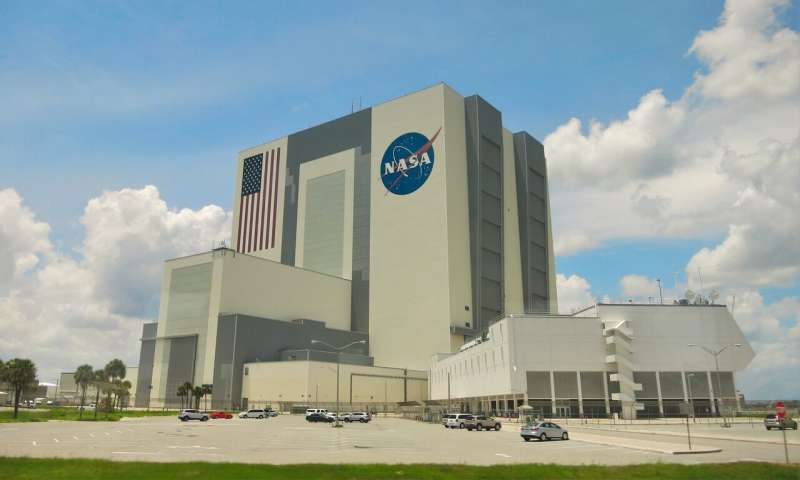
It's still covered up in what looks like the world's largest PEZ dispenser, but the core stage booster for NASA's Space Launch System rocket for the Artemis II moon mission arrived by barge to Florida on Tuesday.
The 212-foot-long tank still sits hidden within NASA's Pegasus barge with its ridged, football-field-length silver dome protecting the Boeing-built hardware that cost more than $1 billion to manufacture. The barge is docked at KSC's Turn Basin after completing the 900-mile trip from NASA's Michoud Assembly Facility in New Orleans. Plans are to haul the stage over to the neighboring Vehicle Assembly Building on Wednesday.
It still has months of checkouts ahead while lying on its side before it will go vertical to be stacked alongside the two solid rocket boosters from Northrop Grumman that remain stored in segments at the nearby Rotation, Processing and Surge Facility. Stacking won't begin until at least September, said Artemis II Mission Manager Matthew Ramsey.
"It takes six to eight weeks to fully stack the booster segments, and the core stage will go after that," he said.
Lunar exploration ground sites will enhance the Near Space Network's communications services
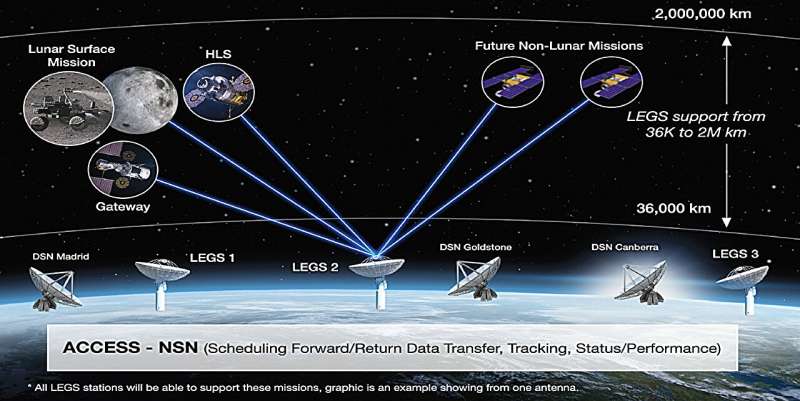
NASA's LEGS can do more than help Earthlings move about the planet. Three Lunar Exploration Ground Sites, or LEGS, will enhance the Near Space Network's communications services and support of NASA's Artemis campaign.
NASA's Space Communications and Navigation (SCaN) program maintains the agency's two primary communications networks—the Deep Space Network and the Near Space Network, which enable satellites in space to send data back to Earth for investigation and discovery.
Using antennas around the globe, these networks capture signals from satellites, collecting data and enabling navigation engineers to track the mission. For the first Artemis mission, these networks worked in tandem to support the mission as it completed its 25-day journey around the moon.
Opinion: If we want to settle on other planets, we'll have to use genome editing to alter human DNA
When considering human settlements on the moon, Mars and further afield, much attention is given to the travel times, food and radiation risk. We'll undoubtedly face a harsh environment in deep space and some thinkers have been pointing to genome editing as a way to ensure that humans can tolerate the severe conditions as they venture further into the solar system.
In January, I was fortunate to attend a much-anticipated debate between astronomer royal Lord Martin Rees and Mars exploration advocate Dr. Robert Zubrin. The event at the British Interplanetary Society took on the topic of whether the exploration of Mars should be human or robotic.
In a recent book called The End of Astronauts, Lord Rees and co-author Donald Goldsmith outline the benefits of exploration of the solar system using robotic spacecraft and vehicles, without the expense and risk of sending humans along for the ride.
Orbital Insight wins NGA contract for maritime surveillance in Indo-Pacific region


Review concludes proposed NASA budget cuts would end Chandra


EarthCARE’s multispectral imager puts clouds into context
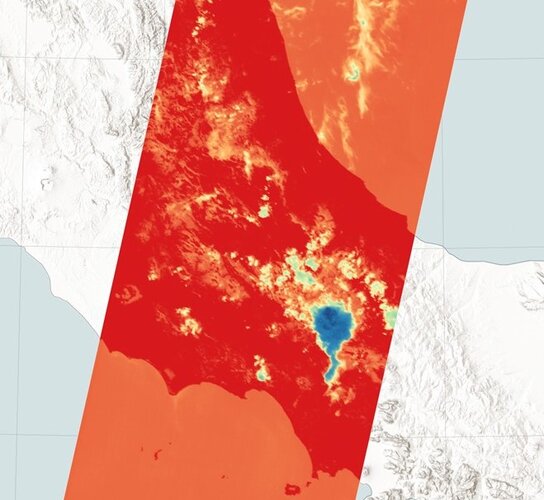
Launched less than two months ago, ESA’s EarthCARE satellite has already returned images from two of its four instruments. Now, it has also delivered the first images from its multispectral imager, showcasing various types of clouds and cloud temperatures worldwide. This instrument is set to add valuable context to the data from EarthCARE’s other instruments.
Chinese lunar probe finds water in Moon samples
 A Chinese lunar probe found traces of water in samples of the Moon's soil, scientists have said, as the country pushes its ambitious space programme into high gear.
The Chang'e-5 rover completed its mission in 2020, returning to Earth with rock and soil samples from the Moon.
The lunar samples "revealed the presence of trace water", the group of scientists from Chinese universities wrote
A Chinese lunar probe found traces of water in samples of the Moon's soil, scientists have said, as the country pushes its ambitious space programme into high gear.
The Chang'e-5 rover completed its mission in 2020, returning to Earth with rock and soil samples from the Moon.
The lunar samples "revealed the presence of trace water", the group of scientists from Chinese universities wrote Stellar magnetism may influence exoplanet habitability
 The pursuit of discovering life beyond our solar system has heightened interest in Earth-like planets within the habitable zone of their stars. However, the habitability of these exoplanets is affected by more than just their distance from the star.
A new study by Rice University's David Alexander and Anthony Atkinson broadens the definition of a habitable zone to include the star's magnet
The pursuit of discovering life beyond our solar system has heightened interest in Earth-like planets within the habitable zone of their stars. However, the habitability of these exoplanets is affected by more than just their distance from the star.
A new study by Rice University's David Alexander and Anthony Atkinson broadens the definition of a habitable zone to include the star's magnet Solar storm may cause northern lights to be visible from New York to Idaho
 A solar storm could bring the northern lights to the northern United States this week, the National Oceanic Atmospheric Administration said.
The NOAA's Space Weather Prediction Center issued a G2 geomagnetic storm watch for early Wednesday.
It said the northern lights or aurora borealis, as the phenomenon is known in the Northern Hemisphere, could become visible above "some north
A solar storm could bring the northern lights to the northern United States this week, the National Oceanic Atmospheric Administration said.
The NOAA's Space Weather Prediction Center issued a G2 geomagnetic storm watch for early Wednesday.
It said the northern lights or aurora borealis, as the phenomenon is known in the Northern Hemisphere, could become visible above "some north