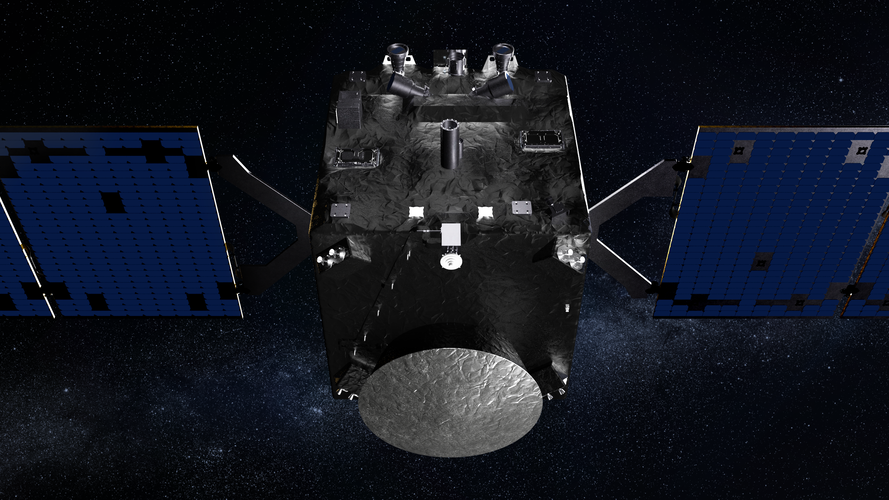
Swarm begins offering commercial satellite data service
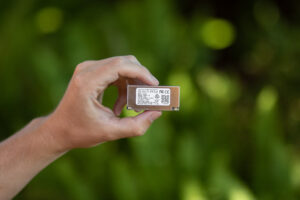
SAN FRANCISCO – With 81 miniature satellites in orbit, internet-of-things startup Swarm announced the start of its commercial data service.
“Swarm is now live commercially,” Ben Longmier, Swarm co-founder and chief technology officer, told SpaceNews. “We have a bunch of commercial customers on the network.
Thales Alenia selected to build Telesat’s broadband constellation
WASHINGTON — Canadian satellite operator Telesat announced Feb. 9 it has selected Thales Alenia Space to manufacture 298 satellites for a broadband network in low-Earth orbit.
Telesat also announced that its constellation, named Lightspeed, will start offering services in 2023.
Super-Earth atmospheres probed at Sandia's Z machine

The huge forces generated by the Z machine at Sandia National Laboratories are being used to replicate the gravitational pressures on so-called "super-Earths" to determine which might maintain atmospheres that could support life.
Astronomers believe that super-Earths—collections of rocks up to eight times larger than Earth—exist in the millions in our galaxy.
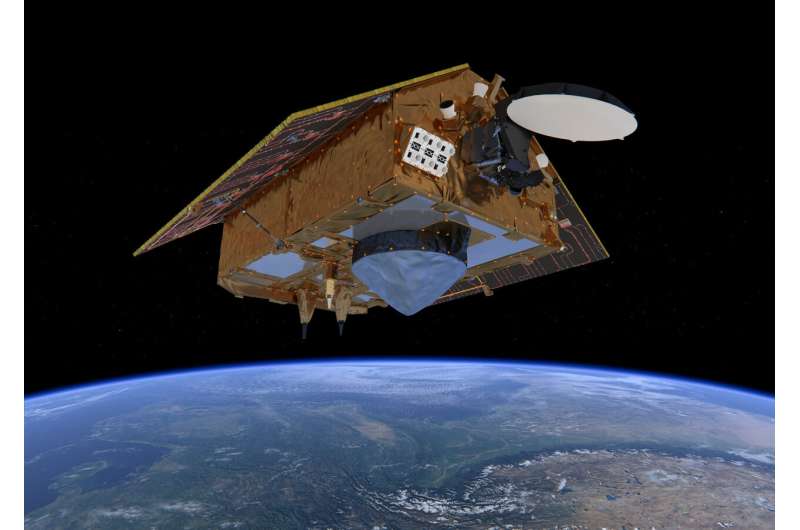
Sentinel-6 passes in-orbit tests with flying colors
Six ways satellites make the world a better place

Almost 3,000 operational spacecraft orbit our Earth. This number is growing constantly, thanks to cheaper materials and smaller satellites.
Having this many satellites in orbit can create problems, including space junk and the way they change our view of the night sky. But satellites provide a vital service.
Many people are familiar with GPS, which helps us navigate. Some may know satellites provide crucial data for our weather forecasts. But satellites affect our lives in many different ways—and some of these may surprise you.
1. Spending money
Whether you pay for your morning coffee using a contactless payment, Google Pay, or even with cash withdrawn from an ATM, none of it would be possible without satellites. In fact, all financial transactions—from multimillion pound stock market transactions, to your monthly Netflix subscription – rely on satellite location and timing services for security.
Global navigation satellite systems orbit about 20,000km above the surface of the Earth and continually communicate with phones and computers to tell them precisely where they are and what time it is.
Jupiter's Trojan asteroids offer surprises
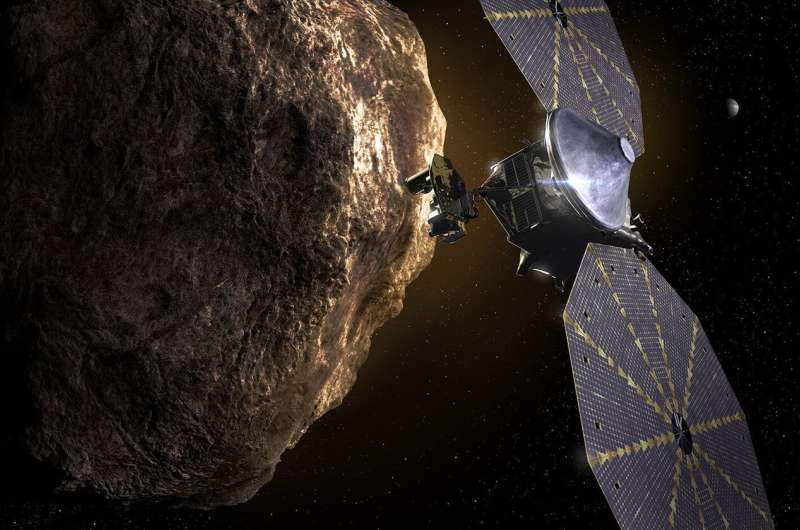
A new study out this month suggests that Jupiter's Trojan asteroids may be more peculiar than previously thought. The Trojan asteroids are rocky objects which orbit the sun just ahead of and just behind the gas giant, in gravitational sweet spots known as Lagrange points. The swarm ahead of Jupiter, known as the L4 (Greek) group, is slightly larger than the L5 (Trojan) swarm behind, but until now, astronomers believed that there was otherwise little differentiation between the two swarms. The paper released this month appears to change that.
The research team, using data from the Asteroid Terrestrial-impact Last Alert System (ATLAS) based in Hawaii, has discovered unexpected variations in the shape of the Trojans. This new study suggests that objects in the L4 population are actually more elongated than those in the L5 population, on average.
Why does this matter? Well, the difference "may imply a different collisional evolution within each cloud," the paper suggests. The L4 swarm's larger population means objects within it have had had more opportunities to collide with one another. As one Trojan slams into another, larger objects are worn down or broken into smaller pieces.
Amazon Web Services sees role as technology enabler for space industry

WASHINGTON — Amazon Web Services is keeping its sights on the space sector. The cloud computing giant provides ground infrastructure for companies to process and analyze data from satellites, and is now looking to attract new customers by offering more customized services such as cloud-based satellite operations and mission control.
SpaceX sees strong demand for smallsat rideshare launch services
WASHINGTON — SpaceX is seeing strong demand for its dedicated smallsat rideshare missions, a program that is putting pricing pressure on small launch vehicle developers.
During a panel discussion at the 2021 SmallSat Symposium Feb. 9, a SpaceX official said the company has two more dedicated rideshare missions scheduled this year after its Falcon 9 Transporter-1 launch Jan.
Eutelsat awarded €100m contract for next-gen European navigation overlay service

JOHANNESBURG — The European GNSS Agency, GSA, has awarded a €100 million ($121 million) contract to Eutelsat Communications to develop and operate the agency’s next-generation EGNOS satellite navigation overlay service.
The European Geostationary Navigation Overlay Service (EGNOS) is used to improve the performance and accuracy of U.S.
Hope enters orbit around Mars
WASHINGTON — The United Arab Emirates’ first Mars mission, Hope, successfully entered orbit around the planet Feb. 9.
Hope completed a 27-minute burn of its main thrusters, slowing the spacecraft down enough to enter an initial “capture” orbit around Mars, at 10:57 a.m.