
As new probes reach Mars, here's what we know so far from trips to the red planet

Three new spacecraft are due to arrive at Mars this month, ending their seven-month journey through space.
The first, the United Arab Emirates' Hope Probe, should have made it to the red planet this week. It will stay in orbit and study its atmosphere for one complete Martian year (687 Earth days).
China's Taiwen-1 mission also enters orbit this month and will begin scouting the potential landing site for its Mars rover, due to be deployed in May.
If successful, China will become the second country to land a rover on Mars.
These two missions will join six orbiting spacecraft actively studying the red planet from above:
NASA's Mars Odyssey, Mars Reconnaissance Orbiter (MRO) and MAVEN OrbiterEurope's Mars ExpressIndia's Mars Orbiter Mission (MOM)the European and Russian partnership ExoMars Trace Gas Orbiter.
The oldest active probe—Mars Odyssey—has been orbiting the planet for 20 years.
The third spacecraft to reach Mars this month is NASA's Perseverance rover, scheduled to land on February 18.
Image: Proba-V's plus one
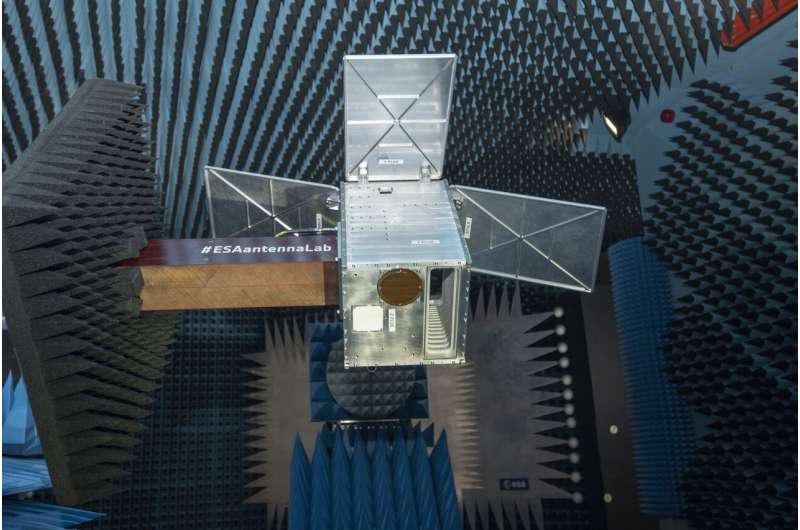
This satellite mockup, seen during antenna testing, shows the shape of ESA's new Proba-V Companion CubeSat, which is due for launch at the end of this year.
The mission is a 12-unit CubeSat—a small, low-cost satellite built up from standardized 10-cm boxes. It will fly a cut-down version of the vegetation-monitoring instrument aboard the Earth-observing Proba-V to perform experimental combined observations with its predecessor.
A pair of antennas for the CubeSat, mounted in this 'structural and thermal model' underwent testing at ESA's Compact Antenna Test Range at the ESTEC technical center in the Netherlands.
"The white patch is a directional high-data rate antenna, needed to downlink large amounts of imagery to users," explains Xavier Collaud of Aerospacelab in Belgium, developing the mission for ESA. "Then the brown patch is an omnidirectional antenna, that—combined with a similar antenna on the other side—allows the reception and transmission of lower-data rate signals in any direction, enabling the control of the mission.
"These antennnas are commercial off the shelf equipment, allowing the building up of small satellites in an affordable, modular manner.
ExoMars discovers new gas and traces water loss on Mars

Sea salt embedded in the dusty surface of Mars and lofted into the planet’s atmosphere has led to the discovery of hydrogen chloride – the first time the ESA-Roscosmos ExoMars Trace Gas Orbiter has detected a new gas. The spacecraft is also providing new information about how Mars is losing its water.
NASA Study: To Find an Extraterrestrial Civilization, Pollution Could Be the Solution
 If there’s an advanced extraterrestrial civilization inhabiting a nearby star system, we might be able to detect it using its own atmospheric pollution, according to new NASA research.
 NASA to use commercial launch vehicle for Europa Clipper

WASHINGTON — NASA is no longer considering launching the Europa Clipper mission on the Space Launch System, deciding instead to launch the spacecraft on a commercial rocket it will procure in the next year.
Op-ed | Don’t call it a bubble, more investment in space launch is a good thing

There has been a flurry of speculation recently that too much investment is being poured into risky launch ventures, creating a speculative bubble in the launch services sector. Critics, government consultants, and even some military industry leaders have suggested that the government step in to redirect private investment to a more suitable direction.
Maxar executive: Smallsat industry deserves credit for pushing innovation
WASHINGTON — Technological advances in small satellites are helping improve spacecraft designs and pushing the industry to take more risks, Jim McClelland, vice president of mission architecture at Maxar Technologies, said Feb. 10 at the SmallSat Symposium.
“It’s been a very exciting transformation of the industry,” he said.
Letter to the Editor: Fostering open architecture and partnership on space-based missile warning
In a February 1, 2021 SpaceNews article titled, “An open system for missile-warning satellite data is in the works but faces challenges,” a number of assertions were made that were factually incorrect, misleading and taken out of context about Lockheed Martin’s role in our nation’s premiere missile warning systems, including the Space-Based Infrared System (SBIRS), the Next Generation Overhead Persistent Infrared (Next Gen OPIR) system and the missile warning mission’s next generation ground control system, the Future Operationally Resilient Ground Evolution (FORGE) MDP (Mission Data Processing) and Enterprise Ground Services (EGS).
Virgin Orbit considering moves into adjacent markets

WASHINGTON — With its first successful launch in the books, Virgin Orbit is considering ways it can expand into adjacent markets, including supporting ventures developing satellite systems.
During a keynote presentation at the SmallSat Symposium Feb.
DoD grapples with how to bring in new space technology to military systems

WASHINGTON — The U.S. military has built “very exquisite” satellites that operate for decades and is now looking to transition to a different space architecture that takes advantage of emerging technologies, Steve Butow, director of the Defense Innovation Unit’s space portfolio, said Feb.