


A navigation odyssey
Friday, 28 August 2026 07:58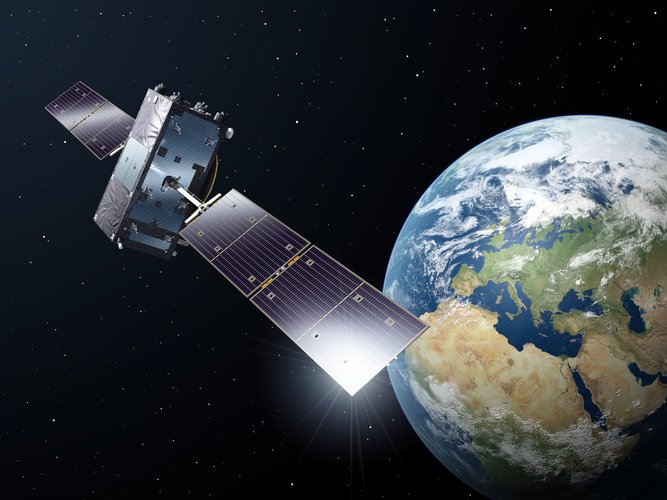
Homer’s The Odyssey chronicles Odysseus’s journey home to Ithaca after the Trojan War. A distance of approximately 530 km as the crow flies, yet it takes Odysseus ten years and countless adventures to arrive—without his crew or his boat. What could Odysseus’s journey have looked like if he had modern-day satellite navigation systems, such as Galileo, at his disposal?
Media invitation: FLEX and Copernicus Sentinel-3C online media briefings
Friday, 28 August 2026 07:00Press Release N° 44–2026
Media representatives are invited to join online media briefings in several languages ahead of the launch of the FLEX and Copernicus Sentinel-3C satellites on a Vega-C rocket (flight VV30).
MTG-I2 completes Europe’s latest weather trio
Thursday, 27 August 2026 19:48
The second Meteosat Third Generation Imager satellite (MTG-I2) has been launched on board Ariane 6, flight VA270, from Europe’s Spaceport in French Guiana. It will complete the first family of MTG satellites, delivering data for weather forecasting over Europe and northern Africa with unprecedented quality, quantity and frequency.
The electronics ‘under the hood’ of space networking
Thursday, 27 August 2026 13:50
In this episode, SpaceNews’ Mike Gruss interviews Jeff Janicik, founder and chairman of Innoflight.

MTG-I2 ready for launch on Ariane 6
Thursday, 27 August 2026 06:00
The Meteosat Third Generation Imager2 satellite (MTG-I2) has been encapsulated inside the Ariane 6 fairing and is in place on its launch pad. It is scheduled to lift off on Thursday evening, 27 August, from Europe’s Spaceport in French Guiana.
Watch live: BepiColombo begins its arrival at Mercury
Thursday, 27 August 2026 04:17
After eight years, the ESA/JAXA BepiColombo mission is about to enter its Mercury Arrival Phase. On 3 September 2026, ESA’s Mercury Transfer Module (MTM) will separate from BepiColombo’s two science orbiters – the first major step in one of the most operationally challenging planetary arrival sequences ever attempted by ESA.
The European Space Agency (ESA) will livestream the critical milestone from 13:45 CEST. Tune in and witness the first step of one of the most complex phases of the mission, live from ESA mission control.
Join ESA's livestream on YouTube here!
LatConnect 60 and Phi Earth Partner to Connect Space and Soil
Thursday, 27 August 2026 00:54
RTX’s Blue Canyon Technologies introduces new spacecraft mission enabler
Wednesday, 26 August 2026 15:12
LAFAYETTE, Colo. (August 26, 2026) — Small satellite manufacturer and mission services provider Blue Canyon Technologies, part of RTX’s (NYSE: RTX) Raytheon business, has unveiled its latest spacecraft subsystem, the […]
The threat environment and processing at the edge
Wednesday, 26 August 2026 13:29
In this episode, SpaceNews’ Mike Gruss interviews FrontGrade CTO Lorne Graves.
MTG-I2 ready for launch
Wednesday, 26 August 2026 10:00 Video:
00:00:31
Video:
00:00:31
The Meteosat Third Generation-Imager2 (MTG-I2) satellite, is ready for launch on board an Ariane 6 launcher from Europe’s Spaceport in French Guiana. Lift off is scheduled for 27 August 2026 at 22:10 CEST (17:10 local time).
MTG-I2 is part of the MTG constellation for Eumetsat – two are already in orbit. It will produce images for weather forecasting in Europe in unprecedented detail. This mission provides completely new data products and capabilities for European weather services, especially suited to short-term forecasting of severe weather events.
Second spacewalk completed for Sophie Adenot
Wednesday, 26 August 2026 07:40
ESA astronaut Sophie Adenot and NASA astronaut Anil Menon successfully completed US EVA-98 at 20:57 CEST on Tuesday 25 August. It was Sophie’s second spacewalk, and the 32nd conducted by a European astronaut.
Propulsion is having a moment
Tuesday, 25 August 2026 18:59
In this episode, SpaceNews Mike Gruss interviews Kevin Lausten, CEO of Morpheus Space, at the 2026 Small Satellite Conference in Salt Lake City, Utah.
Space Angel secures $1.75m WA Government backing to advance Western Australian spaceport plans
Tuesday, 25 August 2026 13:00
Cutting-edge infrared space telescope Roman set to launch
Tuesday, 25 August 2026 12:00
The NASA-led Nancy Grace Roman Space Telescope is set to launch on 30 August 2026 at 07:26 EDT / 12:26 BST / 13:26 CEST from NASA’s Kennedy Space Center in Florida, USA.
With its wide field of view and advanced optical design, the Roman telescope will conduct detailed scans of the sky in visible to near-infrared light. In doing so, Roman will help reveal the nature of dark energy and dark matter and find new exoplanets.