

Chinese rocket for space station mission arrives at launch site
 China's Long March-7 Y3 rocket, which will launch the cargo craft of China's space station, has arrived at its launch site in southern China's Hainan Province.
The rocket, alongside the Tianzhou-2 cargo craft that has already been transported to the Wenchang Spacecraft Launch Site, will be assembled and tested at the launch site, the China Manned Space Engineering Office (CMSEO) said on Mo
China's Long March-7 Y3 rocket, which will launch the cargo craft of China's space station, has arrived at its launch site in southern China's Hainan Province.
The rocket, alongside the Tianzhou-2 cargo craft that has already been transported to the Wenchang Spacecraft Launch Site, will be assembled and tested at the launch site, the China Manned Space Engineering Office (CMSEO) said on Mo Orbital Sidekick finalizes $16 million round led by Temasek
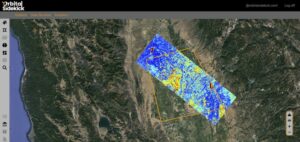
SAN FRANCISCO — Orbital Sidekick announced a $16 million Series A funding round April 13 led by Singapore investment giant Temasek that clears the way for the company to complete development of its first constellation of hyperspectral imaging satellites.
Blue Origin to perform dress rehearsal for crewed New Shepard flights
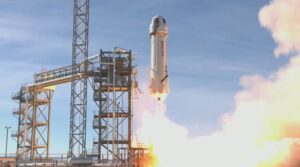
WASHINGTON — A test flight of Blue Origin’s New Shepard suborbital vehicle, scheduled for as soon as April 14, will be a dress rehearsal for long-awaited crewed flights.
Blue Origin said April 12 that it will perform “astronaut operational exercises” before and after the flight of the vehicle at the company’s West Texas test site.
Space Development Agency issues new request for information from satellite vendors

WASHINGTON — The Pentagon’s Space Development Agency wants to hear from satellite manufacturers about their capabilities to support the agency’s plans to deploy a large network of spacecraft in low-Earth orbit.
SDA in a request for information issued April 10 asks companies that intend to compete for an upcoming contract to confirm that they will be able to meet specific technical requirements.
DARPA selects Blue Origin, Lockheed Martin to develop spacecraft for nuclear propulsion demo

WASHINGTON — The Defense Advanced Research Projects Agency selected Blue Origin and Lockheed Martin to develop competing spacecraft concepts for a demonstration of nuclear thermal propulsion, the agency announced April 12.
Under a program called DRACO, short for demonstration rocket for agile cislunar operations, DARPA wants to demonstrate nuclear thermal propulsion technology — using a nuclear reactor to heat up rocket fuel to generate thrust.
MEV-2 servicer successfully docks to live Intelsat satellite
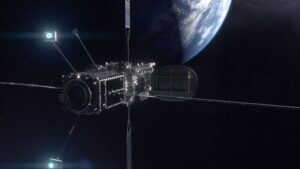
TAMPA, Fla. — Northrop Grumman’s MEV-2 satellite servicer successfully docked April 12 with Intelsat’s in-orbit 10-02 spacecraft.
The maneuver was completed at 1:34 p.m. Eastern, marking the first time a satellite servicer has docked with an in-service commercial satellite in geosynchronous orbit (GEO).
Atlantic Council calls for U.S. and allies to lead global efforts on space security
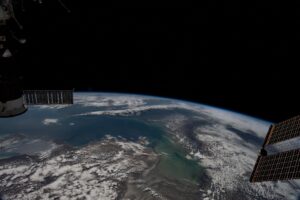
WASHINGTON — The Atlantic Council, an international security think tank, released a 100-page report that calls on the United States and allies to advocate for new global rules for safe activities in outer space.
L3Harris and Raytheon win contracts to define future geostationary imagers

SAN FRANCISCO – L3Harris Technologies and Raytheon Intelligence & Space won NASA contracts to carry forward studies of next-generation imagers for the National Oceanic and Atmospheric Administration (NOAA) Geostationary and Extended Orbits (GEO-XO) satellites.
The one-year, firm-fixed price contracts worth about $6 million apiece set the stage for the two weather sensor leaders to compete to build infrared and visible-imaging instruments for the NOAA satellites to follow the Geostationary Operational Environmental Satellite R (GOES-R) series.
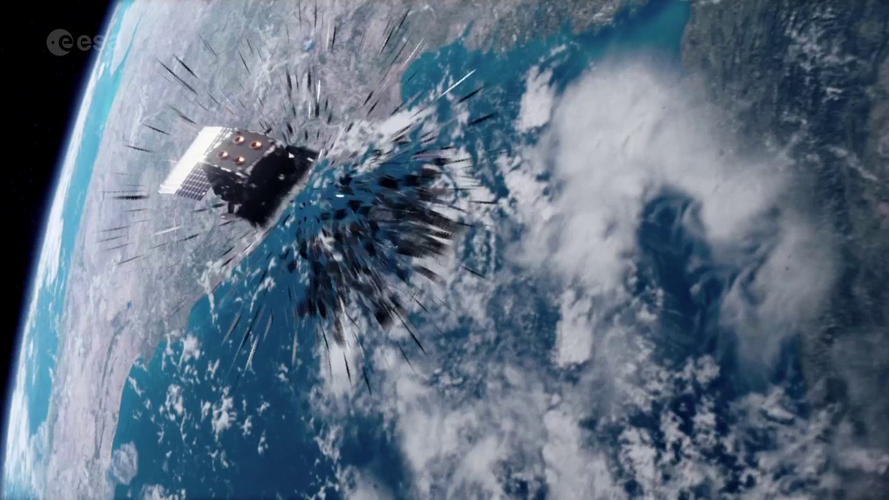
Space Debris
 Video:
00:04:15
Video:
00:04:15
On 20 April 2021, ESA will host the 8th European Conference on Space Debris from Darmstadt, in Germany. Scientists, engineers, industry experts and policy makers will spend the virtual four day conference discussing the latest issues surrounding space debris. They will exchange the latest research, try to come up with solutions for potential problems and define the future direction of any necessary action.
There are currently over 129 million objects larger than a millimetre in orbits around Earth. These range from inactive satellites to flakes of paint. But no matter how small the item of debris, anything travelling up
First results from Fermilab's Muon g-2 experiment strengthen evidence of new physics
 The long-awaited first results from the Muon g-2 experiment at the U.S. Department of Energy's Fermi National Accelerator Laboratory show fundamental particles called muons behaving in a way that is not predicted by scientists' best theory, the Standard Model of particle physics. This landmark result, made with unprecedented precision, confirms a discrepancy that has been gnawing at researchers


