




There is a man named Thomas who sat three desks away from me for almost four years at a newsroom in midtown Manhattan. We went to lunch perhaps forty times. I knew his wife’s name, his daughter’s soccer schedule, his position on the Oxford comma, the exact face he made when an editor killed a lede he loved. I did not know, until the week he quit, that he had been quietly terrified every single morning that he was about to be found out as a fraud. He told me this over a farewell drink, laughing in a way that wasn’t laughing. I had sat beside his fear for four years and never seen it.
I think about Thomas a lot. I think about him because the workplace is where most adults now spend the majority of their waking, conscious, verbal hours, and because the emotional physics of that space is one of the strangest human arrangements we’ve ever built. You share coffee, deadlines, small jokes, the weather. You do not share the thing underneath.
The architecture of professional proximity
Working alongside someone is a form of intimacy. It just isn’t the form we usually mean when we use that word. You learn another person’s rhythms, their tells, the exact pitch their voice takes when a client call is going badly. You can often predict, with unsettling accuracy, what they will order, say, or wear. This is real knowledge. It is also, frequently, a kind of high-resolution surface.
Psychologists who study workplace attachment describe this as a particular relational category, distinct from both friendship and kinship. A recent theoretical integration of attachment and self-regulation in the workplace argues that colleagues function as secondary attachment figures — stable presences we calibrate ourselves around — without ever crossing into the zone where genuine vulnerability is exchanged. You rely on them. You do not confide in them.
The interesting question is why.
What fear looks like when it wears a blazer
Fear at work rarely announces itself. It shows up as the colleague who over-prepares for every meeting. The one who laughs a half-beat too early. The one who never, under any circumstances, takes the first bite at the team lunch. The one who corrects small factual errors with a little too much relief in their voice.
The people who always correct others aren’t pedantic — they often grew up in homes where being precisely right was the only reliable form of safety. The office is full of these small tells, and most of us walk past them every day without registering what they are.
The psychodynamic view, articulated well in a recent Psychology Today essay on vulnerability and defense, is that most of us learned early that showing what we were afraid of was not safe. We built intellectualization, self-sufficiency, sarcasm, over-functioning. These defenses work. They work so well that, decades later, we deploy them automatically in rooms where nobody is threatening us, around people who might actually meet us if we let them.
The workplace is the place where these defenses look most like competence.
Why offices manufacture this specific kind of opacity
There are structural reasons vulnerability rarely happens between colleagues, and they are not character flaws. Work has consequences. What you reveal can be used. The person who hears that you’re terrified of public speaking may be the person who recommends you for the keynote, or doesn’t. The colleague who knows you’re struggling with your kid’s diagnosis is the colleague who might, later, be competing with you for a promotion.
Yale’s Amy Wrzesniewski, writing on how modern leaders are now expected to tend to employee wellbeing, notes that the boundary between supportive and intrusive is crossed the moment a leader inquires about personal details unrelated to work or makes assumptions about motives under the guise of caring. The same caution operates peer-to-peer. We know, without being told, that offering up fear is handing someone a piece of information about ourselves they did not ask for and may not want to carry.
So we perform steadiness. The performance is mostly unconscious. It is also remarkably effective.
The strange intimacy that forms anyway
And yet. Something does happen between people who work together for years, and it is not nothing. You develop a shared vocabulary. You witness each other’s small humiliations. You know which meetings broke which person. You have stood next to them during the bad quarter, the layoff round, the client who made them cry in the bathroom.
This is a kind of knowledge that close friends often don’t have. Your college roommate knows who you were at twenty-two. Your coworker knows who you are at 2:47 p.m. on a Wednesday when the quarterly numbers came in low. Both are real. They are not the same.
The philosopher-journalist in me wants to call this horizontal intimacy — the kind that spreads wide without going deep. It is the intimacy of having been present. Of having been in the same room when the thing happened. It is not the intimacy of having been told.
The fears that never get mentioned
What does a colleague of four years actually not know about you? In most cases: whether you wanted children and couldn’t have them. Whether your father drank. Whether you have, right now, a small tumor you haven’t told anyone about. Whether you’re in love with someone you shouldn’t be. Whether the confident voice you use in meetings is the same voice you use alone, or whether the alone-voice is much quieter and much more afraid.
Research suggests that the people who most need to name their fears are often the least able to. A 2023 review in Frontiers on emotion and decision-making describes how difficulties in recognizing and describing one’s own emotions correlate with a whole cascade of avoidant coping strategies. Stress eating. Over-working. The kinds of self-soothing that look, from the outside, like high functioning.
The colleague eating lunch at their desk for the fourth day running is not necessarily just busy.
Why this matters more than it used to
The modern office — and its hybrid and remote cousins — has absorbed a stunning share of what used to be community. In previous generations, adults had neighborhoods, congregations, unions, bowling leagues, extended family within driving distance. Now many of us have our coworkers and a group chat. The research on friendship among men, in particular, has documented how the workplace has become the primary site of adult male social contact, which means it is also the primary site of adult male loneliness.
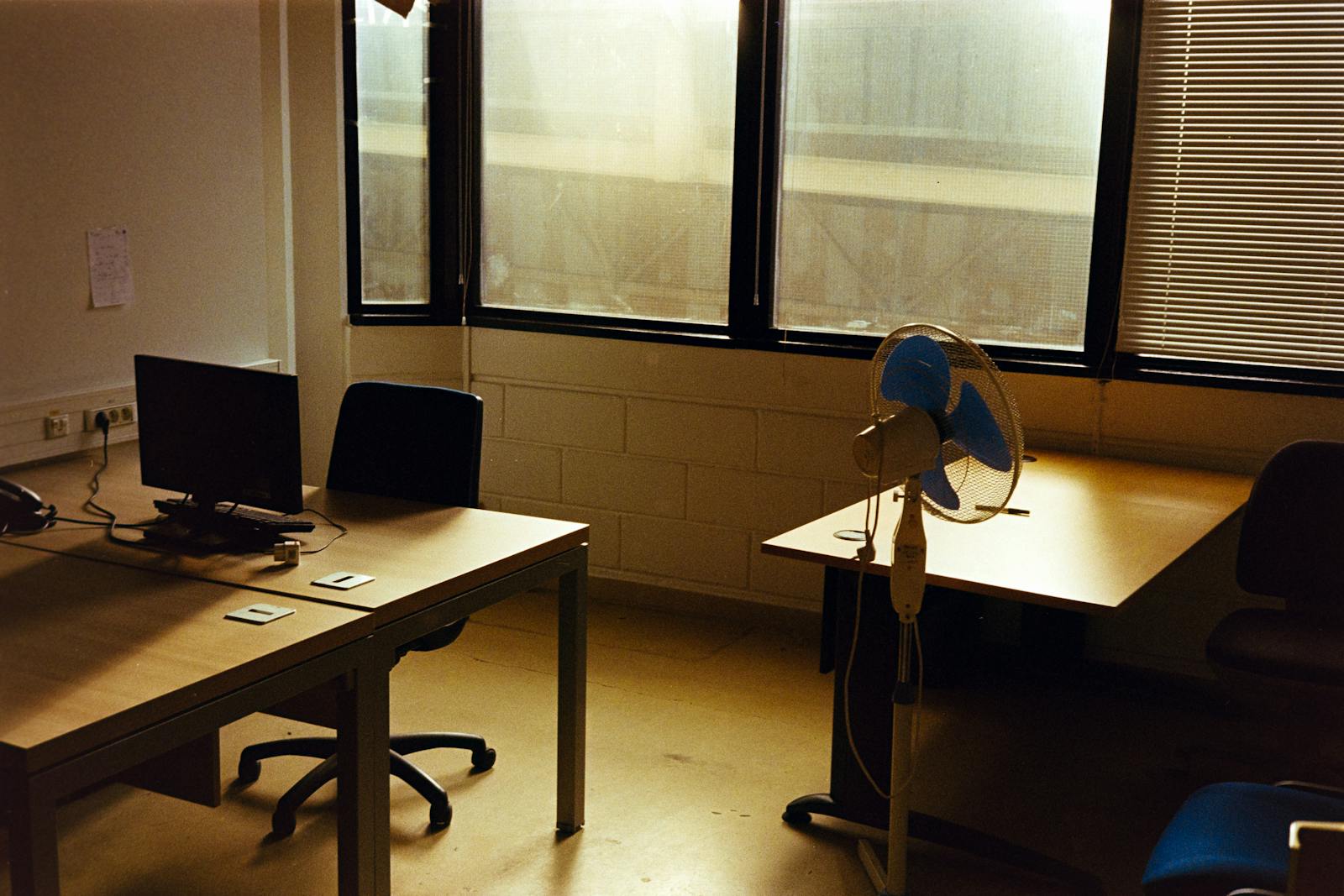
I wrote last week about the specific loneliness of proximity without presence — the nervous-system-level registration that you are near people who do not actually know you. The open-plan office is a factory for this feeling. You are surrounded all day. You are also, frequently, unknown all day. These are not contradictions. They are the same condition.
The moments the wall comes down
Something happens in crises. A parent dies. A kid gets sick. Someone’s marriage ends on a Thursday and they come in on Friday and cannot hold the face anymore. In those moments, the coworker-relationship briefly reorganizes itself. People say true things. They cry in conference rooms. They admit to being afraid.
And then, almost always, the wall reassembles. Within a week or two, the person who wept is back to asking about the weekend. The colleague who sat with them does not bring it up. There is a tacit agreement: that was an exception. We will not hold each other to what was said during it.
This is not cruelty. It is, in its way, a form of mercy. Most of us cannot sustain the level of exposure a real crisis creates. We need the surface back in order to keep functioning. The surface is what makes the office survivable.
But it does mean that the deepest thing you ever learn about a colleague is often something they told you once, under duress, in a moment you both agreed afterward to pretend hadn’t quite happened.
What the AI era is doing to this
There is a newer complication. As emotional labor migrates toward machines — chatbots that listen, AI companions that offer unconditional positive regard, generative systems people increasingly confide in — researchers have started asking what this does to our capacity for actual human vulnerability. A conceptual perspective in Frontiers on techno-emotional projection in human-AI relationships argues that the ease of being known by a machine may make the friction of being known by a person feel increasingly intolerable.
If you can tell ChatGPT you are afraid, and it responds warmly and forgets by morning, why would you ever risk telling the person across the desk, who will remember, who might use it, who might simply not know what to do?
The answer is the one that has always been the answer: because being known by a person, specifically, is the thing. It is not interchangeable with being heard by something that can’t hurt you. The whole reason vulnerability means anything is that the other party could have chosen otherwise. A machine cannot stay. A person can.
What we owe the people we work beside
I am not arguing that colleagues should confess their fears to each other. That is not what offices are for, and most of us would do it badly. The structural constraints are real. Professional vulnerability has consequences personal vulnerability does not.
But there is, I think, a smaller thing we could do. It is to notice that the person three desks over is also carrying something. To hold the knowledge that what you see of them is partial. To resist the deeply human tendency to mistake familiarity for understanding.
The colleague who always seems fine is not always fine. The one who never misses a deadline is not necessarily unafraid — they may be terrified in a direction that happens to produce punctuality. The one who makes the meeting lighter may be doing the hardest emotional work in the room and no one will ever thank them for it, because no one will ever know.
The people who apologize for everything aren’t weak — they learned that preemptive surrender was safer than finding out what happens when someone stays angry. Those patterns come from old rooms, old rules, long before this office existed. The colleague who over-apologizes in Slack learned that somewhere. You will probably never learn where.

The quiet form of respect
There is a version of care that doesn’t require confession. It is attention. It is the willingness to assume that the person next to you is larger than the slice of them you’ve been handed. It is not probing — Yale’s research is right that probing is its own violation — but it is also not flattening them into the role they play at work.
Thomas, the man three desks over, was a good writer and a reliable colleague and, it turned out, a person who woke up frightened most mornings for four years while I sat beside him and did not know. I don’t think I was supposed to know. I don’t think he wanted me to. But I wish I had at least held open, while we worked, the possibility that he might be carrying something I couldn’t see.
That is, maybe, the whole discipline of being a decent colleague over time. Not knowing. Not prying. Just refusing to believe that the surface is all of it.
The strange intimacy of the workplace is that you can spend a decade beside a person and never cross into the territory where their real fears live. That is not a failure. It is the shape of the relationship. The failure would be forgetting that the territory exists at all.
Photo by www.kaboompics.com on Pexels