

Space Force certifies Vulcan for national security launches

The U.S. Space Force has certified United Launch Alliance’s Vulcan Centaur rocket, allowing that vehicle to conduct national security missions.
Space Force budget squeeze: Saltzman worries about keeping pace with China amid cuts

“We are literally shrinking in resources as a Space Force,” Gen.
Rocket Lab launches eight OroraTech satellites

Rocket Lab launched eight satellites for a German company that is expanding its constellation to detect and track wildfires.
Partial solar eclipse in northern areas on Saturday
This request seems a bit unusual, so we need to confirm that you're human. Please press and hold the button until it turns completely green. Thank you for your cooperation!
Press and hold the button
If you believe this is an error, please contact our support team.
185.132.36.159 : deaad8e9-2066-4db6-a92f-07ad9e76
U.S. military prepares to award new commercial satcom deals

The Commercial Satellite Communications Office last week issued a final solicitation for bids for the Marine Enterprise Commercial Satellite Services (MECS2) contract
China launches new Tianlian data relay satellite to support human spaceflight

Farewell, Gaia! Spacecraft operations come to an end
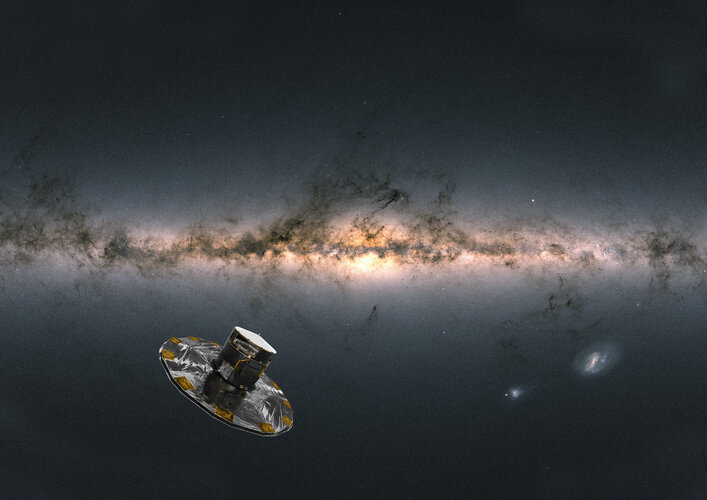
The European Space Agency (ESA) has powered down its Gaia spacecraft after more than a decade spent gathering data that are now being used to unravel the secrets of our home galaxy.
On 27 March 2025, Gaia’s control team at ESA’s European Space Operations Centre carefully switched off the spacecraft’s subsystems and sent it into a ‘retirement orbit’ around the Sun.
Though the spacecraft’s operations are now over, the scientific exploitation of Gaia’s data has just begun.
Webb spies a spiral through a cosmic lens
 Image:
Spying a spiral through a cosmic lens (Webb telescope image)
Image:
Spying a spiral through a cosmic lens (Webb telescope image) ESA’s Gaia spacecraft leaves for retirement orbit
 Video:
00:02:00
Video:
00:02:00
From 25 July 2014 to 15 January 2025, the Gaia space observatory performed high-precision measurements of nearly two billion stars from its Lissajous orbit around the L2 Lagrange point, 1.5 million km from Earth.
After 10.5 years of groundbreaking observations, Gaia’s cold gas supply for attitude control has been depleted. On 27 March 2025, Gaia will leave its Lissajous orbit and transition into a stable heliocentric orbit. Soon after, the spacecraft will be passivated, with its instruments and transmitters switched off.
While Gaia will no longer collect new data, its scientific mission is far from over! The team continues
Cygnus mission to ISS scrapped after finding spacecraft damage

NASA and Northrop Grumman will not launch a Cygnus cargo mission to the ISS in June as previously planned after discovering the spacecraft is damaged.


