

Researchers identify optimal human landing system architectures to land on the Moon
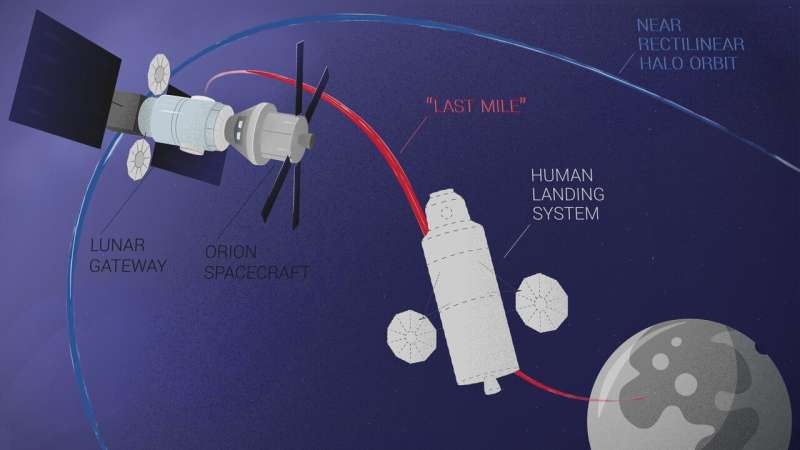
Researchers from Skoltech and the Massachusetts Institute of Technology have analyzed several dozen options to pick the best one in terms of performance and costs for the 'last mile' of a future mission to the Moon—actually delivering astronauts to the lunar surface and back up to the safety of the orbiting lunar station. The paper was published in the journal Acta Astronautica.
Ever since December 1972, when the crew of Apollo 17 left the lunar surface, humans have been eager to return to the Moon. In 2017, the US government launched the Artemis program, which intends to bring "the first woman and the next man" to the lunar south pole by 2024. The Artemis mission will use a new orbital platform, dubbed the Lunar Gateway, which is going to be a permanent space station from which reusable modules will bring astronauts back to the Moon. This new approach requires a reanalysis of the optimal landing approaches; the private companies contracted by NASA to design the reusable landing modules are conducting this research, but keeping their findings to themselves.
Space station crew to relocate Soyuz to make room for new crewmates
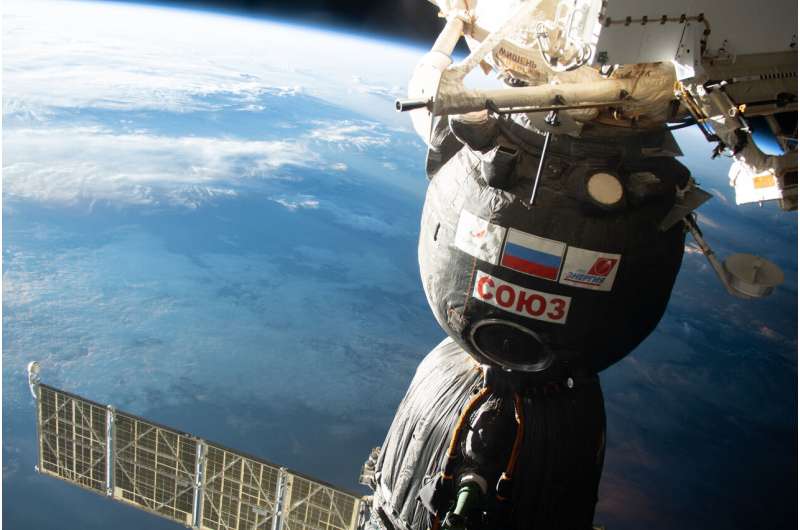
Three residents of the International Space Station will take a spin around their orbital neighborhood in the Soyuz MS-17 on Friday, March 19, relocating the spacecraft to prepare for the arrival of the next set of crew members.
NASA astronaut may have extended stay on ISS
WASHINGTON — A NASA astronaut flying to the International Space Station in April could spend up to a year on the station, an extended stay that he said he was “enthusiastic” about.
NASA announced March 9 that Mark Vande Hei would fly on the Soyuz MS-18 mission to the space station, launching April 9.
The March Council edition of ESA Impact is online

The March Council edition of ESA Impact is online
With SpaceX, ISS enters 'Golden Age' But what comes next
 After 20 years of continuous habitation, the International Space Station has entered its "Golden Age" and is abuzz with activity - thanks in large part to the return of US rocket launches via commercial partner SpaceX.
But though the near- future of this symbol of post-Cold War cooperation is assured, NASA wants to begin disengaging by the end of the decade, leaving a gap that the private s
After 20 years of continuous habitation, the International Space Station has entered its "Golden Age" and is abuzz with activity - thanks in large part to the return of US rocket launches via commercial partner SpaceX.
But though the near- future of this symbol of post-Cold War cooperation is assured, NASA wants to begin disengaging by the end of the decade, leaving a gap that the private s NASA to Host Virtual Symposium Exploring Rise of Commercial Space
 From activities in low-Earth orbit to NASA's Artemis program, the commercial space industry has emerged as an innovator in areas of space access, commerce, and exploration. In an effort to address the growth of commercial space over the past decades and inform the relationship between government and industry for the future, NASA will host a virtual event Wednesday, March 17, through Friday, Marc
 Uncovering exotic molecules of potential astrochemical interest
 Looking at the night sky, one's thoughts might be drawn to astrochemistry. What molecules inhabit the vast spaces between the stars? Would we see the same molecules that surround us here on Earth? Or would some of them be more exotic--something rarely observed or even unknown?
Recent research by a multinational team led by Prof. Robert Koos from the Institute of Physical Chemistry of the P
Looking at the night sky, one's thoughts might be drawn to astrochemistry. What molecules inhabit the vast spaces between the stars? Would we see the same molecules that surround us here on Earth? Or would some of them be more exotic--something rarely observed or even unknown?
Recent research by a multinational team led by Prof. Robert Koos from the Institute of Physical Chemistry of the P Launch Vehicle and Missile Ascent Trajectories
 Almost all launch vehicles and large missiles liftoff from the ground in the vertical direction and continue toward some objective. For space launch systems the objective is achieving orbit through the use of ascent trajectories that are usually optimized for weather and mission conditions in order to maximize performance while maintaining conservative safety margins.
The actual shape of a
Almost all launch vehicles and large missiles liftoff from the ground in the vertical direction and continue toward some objective. For space launch systems the objective is achieving orbit through the use of ascent trajectories that are usually optimized for weather and mission conditions in order to maximize performance while maintaining conservative safety margins.
The actual shape of a Airbus pioneers first satellite factory in space
 Airbus has been selected by the European Commission to study spacecraft manufacturing in space through the Horizon 2020 Programme. The PERIOD (PERASPERA In-Orbit Demonstration) project focuses on satellite assembly and manufacturing in orbit. This A/B1 phase study contract, worth 3 million euro, will last two years, with the objective to continue with a demonstrator in orbit.
The "orbital
Airbus has been selected by the European Commission to study spacecraft manufacturing in space through the Horizon 2020 Programme. The PERIOD (PERASPERA In-Orbit Demonstration) project focuses on satellite assembly and manufacturing in orbit. This A/B1 phase study contract, worth 3 million euro, will last two years, with the objective to continue with a demonstrator in orbit.
The "orbital Whispers from the dark side: What can gravitational waves reveal about dark matter?
 The NANOGrav Collaboration recently captured the first signs of very low-frequency gravitational waves. Prof. Pedro Schwaller and Wolfram Ratzinger analyzed the data and, in particular, considered the possibility of whether this may point towards new physics beyond the Standard Model. In an article published in the journal SciPost Physics, they report that the signal is consistent with both a ph


