

TrustPoint wins SpaceWERX contracts for alternative PNT


EarthCARE profiles atmospheric particles in detail

Launched in May, ESA’s EarthCARE satellite has been making waves, with the first images from three of its scientific instruments already delivered. Now, the spotlight is firmly on the atmospheric lidar, the most advanced of the satellite’s four instruments.
This cutting-edge sensor has captured detailed 20 km-high vertical profiles of atmospheric aerosols – tiny particles and droplets from natural sources like wildfires, dust, and sea spray, and from human activities like industrial emissions or burning of wood – and clouds across various regions of the globe.
Axiom Space and Nokia partner to develop high-speed wireless communications for spacesuits


Can AI detect anomalies in orbital astrodynamics? Managing a complex challenge

New data on radiation show missions to Jupiter's moon Europa are possible
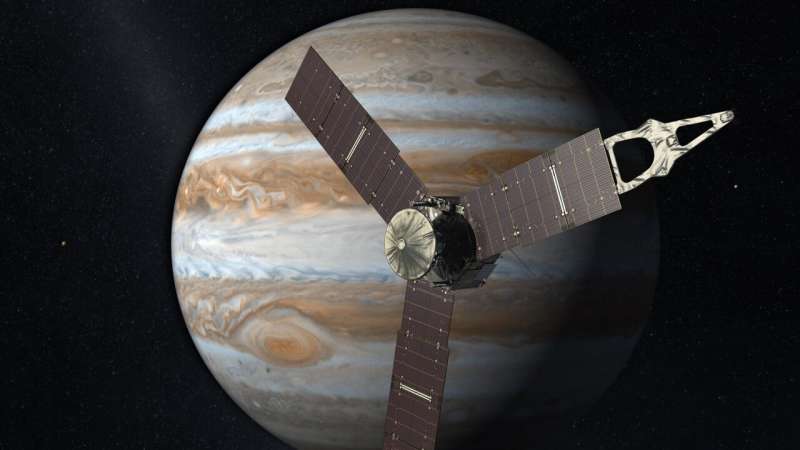
Scientists from NASA's Juno mission have developed the first complete 3D radiation map of the Jupiter system, including characterizing the intensity of the high-energy particles near the orbit of the icy moon Europa, and how the radiation environment is sculpted by the smaller Jovian moons orbiting near Jupiter's rings.
The work relies on data collected by Juno's star camera Advanced Stellar Compass (ASC) designed and built by Technical University of Denmark, and Stellar Reference Unit (SRU), which was built by Leonardo, S.p.A. in Florence, Italy. The two datasets complement one another, helping Juno scientists characterize the radiation environment at different energies.
Voyager Space joins Spaceport Nova Scotia development as key technical partner
 Maritime Launch Services (Cboe CA: MAXQ, OTCQB: MAXQF) has announced the selection of Voyager Space (Voyager) as the first Owner Authorized Representative (OAR) for the next phase of Spaceport Nova Scotia's development. Voyager will provide technical support for the launch facility's infrastructure.
This partnership underscores the growing collaboration between Canada and the United States
Maritime Launch Services (Cboe CA: MAXQ, OTCQB: MAXQF) has announced the selection of Voyager Space (Voyager) as the first Owner Authorized Representative (OAR) for the next phase of Spaceport Nova Scotia's development. Voyager will provide technical support for the launch facility's infrastructure.
This partnership underscores the growing collaboration between Canada and the United States Mars and Lunar propellant production plans face complexity challenges
 NASA's ongoing efforts to develop in situ propellant production (ISPP) technologies for the Moon and Mars involve a balance between complex engineering and practical execution. These technologies, which aim to generate fuel on the lunar and Martian surfaces using local resources, could reduce the need to transport propellants from Earth, but present significant challenges in both design and powe
 New Antimatter Nucleus Discovery Sets Heaviest Record Yet
 Scientists at the Relativistic Heavy Ion Collider (RHIC) have identified the heaviest antimatter nucleus ever observed. This exotic antinucleus, named antihyperhydrogen-4, is composed of four antimatter particles: an antiproton, two antineutrons, and an antihyperon. The discovery comes from an analysis of six billion particle collisions performed at RHIC, a facility designed to recreate conditio
 The evolution of the Trappist-1 planetary system
 Planets are bodies that orbit a star and have sufficient gravitational mass that they form themselves into roughly spherical shapes that, in turn, exert gravitational force on smaller objects around them, such as asteroids and moons. For most of human history, the only planets our ancestors knew of were those they could see in the night sky. But in the last 30 years, telescopes sensitive enough
 Citizen scientists confirm new warm Jovian-class exoplanet
 Two teams of dedicated amateur astronomers, supported by NASA, have successfully confirmed the existence of a new exoplanet, a "warm Jupiter," using their backyard telescopes.
The teams, known as UNITE (UNISTELLAR Network Investigating TESS Exoplanets) and Exoplanet Watch, combined their efforts to validate the discovery of this exoplanet, which is now designated as TIC 393818343 b (also k
Two teams of dedicated amateur astronomers, supported by NASA, have successfully confirmed the existence of a new exoplanet, a "warm Jupiter," using their backyard telescopes.
The teams, known as UNITE (UNISTELLAR Network Investigating TESS Exoplanets) and Exoplanet Watch, combined their efforts to validate the discovery of this exoplanet, which is now designated as TIC 393818343 b (also k 


