

Friday, 23 August 2024 02:06
NASA adds three companies to launch services contract for smallsat missions


Published in
News
Thursday, 22 August 2024 21:46
Mynaric’s manufacturing woes threaten to delay production of U.S. military satellites


Published in
News
Thursday, 22 August 2024 20:02
Amazon expands Kennedy Space Center facility to accelerate satellite deployments


Published in
News
Friday, 23 August 2024 06:40
NASA will decide Saturday if Boeing's new capsule is safe enough to fly 2 astronauts back from space
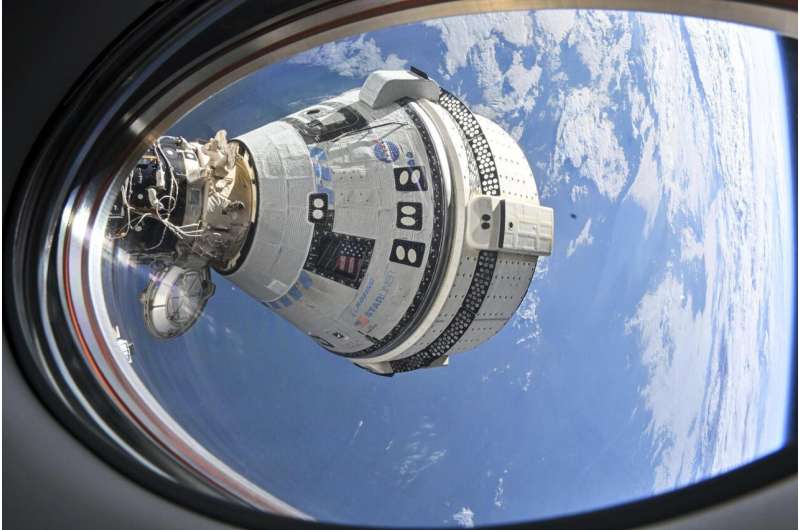
NASA said Thursday it will decide this weekend whether Boeing's new capsule is safe enough to return two astronauts from the International Space Station, where they've been waiting since June.
Published in
News
Friday, 23 August 2024 08:23
Sentinel-2C sealed in the Vega rocket fairing

As preparations continue to launch the Copernicus Sentinel-2C satellite on 4 September, the team at Europe’s Spaceport in Kourou, French Guiana, has bid farewell to their precious satellite as it was sealed from view within the Vega rocket fairing.
Published in
News
Friday, 23 August 2024 04:30
HySpex Payloads Successfully Complete Key Diurnal Stratospheric Flight
Berlin, Germany (SPX) Aug 22, 2024
 Sceye, an aerospace company known for its expertise in material science and High-Altitude Platform Systems (HAPS), has announced the successful completion of a diurnal stratospheric flight, marking an important milestone toward achieving long-duration solar-powered flights.
The HAPS, launched from Sceye's New Mexico facility on August 15th at 7:36 AM MST, landed the next day at 12:21 PM MS
Sceye, an aerospace company known for its expertise in material science and High-Altitude Platform Systems (HAPS), has announced the successful completion of a diurnal stratospheric flight, marking an important milestone toward achieving long-duration solar-powered flights.
The HAPS, launched from Sceye's New Mexico facility on August 15th at 7:36 AM MST, landed the next day at 12:21 PM MS
Sceye, an aerospace company known for its expertise in material science and High-Altitude Platform Systems (HAPS), has announced the successful completion of a diurnal stratospheric flight, marking an important milestone toward achieving long-duration solar-powered flights.
The HAPS, launched from Sceye's New Mexico facility on August 15th at 7:36 AM MST, landed the next day at 12:21 PM MS
Published in
News
Friday, 23 August 2024 04:30
Potential seen for US-China space relations
Beijing (XNA) Aug 22, 2024
 China's recent retrieval of the first-ever samples from the far side of the moon has renewed talks about the possibilities of the United States and China joining in space-based research programs aimed at addressing global challenges, particularly climate change.
"The US and China each have very innovative space programs, and one area, for example, where the US and China could work together
China's recent retrieval of the first-ever samples from the far side of the moon has renewed talks about the possibilities of the United States and China joining in space-based research programs aimed at addressing global challenges, particularly climate change.
"The US and China each have very innovative space programs, and one area, for example, where the US and China could work together
China's recent retrieval of the first-ever samples from the far side of the moon has renewed talks about the possibilities of the United States and China joining in space-based research programs aimed at addressing global challenges, particularly climate change.
"The US and China each have very innovative space programs, and one area, for example, where the US and China could work together
Published in
News
Friday, 23 August 2024 04:30
AzurX Space Ventures and ICE Back Space Intelligence in Expanding Global Nature Mapping Dataset
London, UK (SPX) Aug 22, 2024
 Space Intelligence, a leader in high-precision nature mapping using satellite data, has announced the successful closing of its Series A funding round. This round was spearheaded by new investors AzurX Space Ventures (ASV) and included participation from Intercontinental Exchange, Inc. (NYSE: ICE).
The newly secured funding will be instrumental in expanding Space Intelligence's global fore
Space Intelligence, a leader in high-precision nature mapping using satellite data, has announced the successful closing of its Series A funding round. This round was spearheaded by new investors AzurX Space Ventures (ASV) and included participation from Intercontinental Exchange, Inc. (NYSE: ICE).
The newly secured funding will be instrumental in expanding Space Intelligence's global fore
Space Intelligence, a leader in high-precision nature mapping using satellite data, has announced the successful closing of its Series A funding round. This round was spearheaded by new investors AzurX Space Ventures (ASV) and included participation from Intercontinental Exchange, Inc. (NYSE: ICE).
The newly secured funding will be instrumental in expanding Space Intelligence's global fore
Published in
News
Friday, 23 August 2024 04:30
CropX and CNH Industrial Collaborate on API for Enhanced Precision Farming
Los Angeles CA (SPX) Aug 22, 2024
 CropX Ltd., a leading provider of digital agriculture solutions, and CNH Industrial N.V. (NYSE: CNH), a major player in agricultural machinery and technology, have introduced a new application programming interface (API) that integrates the CropX agronomic farm management system with equipment from Case IH and New Holland Agriculture. This new API facilitates the automated transfer of data from
CropX Ltd., a leading provider of digital agriculture solutions, and CNH Industrial N.V. (NYSE: CNH), a major player in agricultural machinery and technology, have introduced a new application programming interface (API) that integrates the CropX agronomic farm management system with equipment from Case IH and New Holland Agriculture. This new API facilitates the automated transfer of data from
Published in
News
Friday, 23 August 2024 04:30
Enhanced Dryland Monitoring Through Combined Remote Sensing Techniques
Los Angeles CA (SPX) Aug 22, 2024
 In dryland regions, where vegetation is scarce, scientists have developed advanced "external eyes" to monitor these vital ecosystems. Researchers at the U.S. Department of Agriculture (USDA) Agricultural Research Service (ARS) have introduced a new method that integrates high-frequency near-surface camera data with satellite imagery. This approach offers an improved way to monitor and manage dry
In dryland regions, where vegetation is scarce, scientists have developed advanced "external eyes" to monitor these vital ecosystems. Researchers at the U.S. Department of Agriculture (USDA) Agricultural Research Service (ARS) have introduced a new method that integrates high-frequency near-surface camera data with satellite imagery. This approach offers an improved way to monitor and manage dry
Published in
News


