

A European lander could return an ice core for a fraction of the cost of Europa Clipper
Cost is a major driving factor in the development of space exploration missions. Any new technology or trick that could lower the cost of a mission makes it much more appealing for mission planners. Therefore, much of NASA's research goes into those technologies that enable cheaper missions.
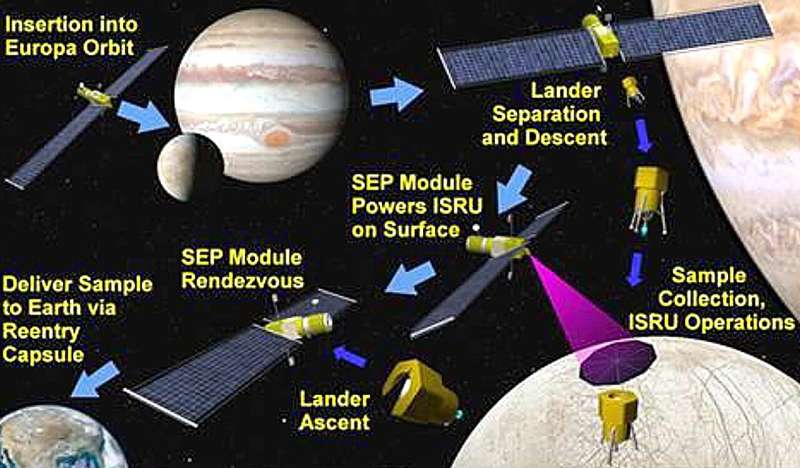
For example, a few years ago, NASA's Institute for Advanced Concepts (NIAC) supported a project by Michael VanWoerkom of ExoTerra Resource to develop a lander mission that could support a sample return from Europa. Let's examine what made that mission different from other Europa mission architectures.
The Nano Icy Moons Propellant Harvester (NIMPH) mission relies on three main advancements for one significant result: a 10x reduction in the overall mission cost. That reduced cost comes mainly from a single fact—the mission's weight has dropped below the threshold where it can be launched by an Atlas V rather than the SLS, as similar missions would require.
New startup seeks to tackle space weather challenges


NASA CubeSats launch as commercial rideshares
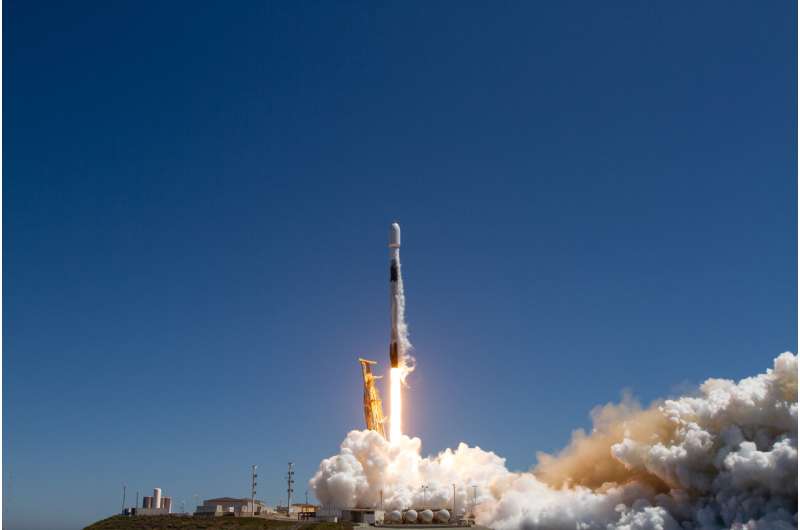
A pair of CubeSats from NASA's Pathfinder Technology Demonstrator, or PTD, series lifted off on SpaceX's Transporter-11 rideshare mission at 11:56 a.m. PDT Friday, August 16, from Vandenburg Space Force Base in California.
The two small satellites, PTD-4 and PTD-R, will help advance NASA's efforts to validate novel technologies and increase small spacecraft capabilities in order to shape the future of space exploration and technology.
PTD-4 will demonstrate a high-power, low-volume deployable solar array with an integrated antenna, while PTD-R will focus on testing simultaneous ultraviolet and short-wave infrared optical sensing from space for the first time via two 85-mm aperture monolithic telescopes mounted side-by-side.
SpaceX sends 22 Starlink satellites into orbit using new first stage booster
 SpaceX debuted a new Falcon 9 first stage booster as it launched a batch of Starlink satellites on Tuesday morning.
The Falcon 9 lifted off from the Cape Canaveral Space Launch Complex in Florida at about 9:20 a.m. EDT, near the end of the launch window, as weather conditions improved. The rocket was carrying 22 Starlink satellites.
Lifting off with a new first stage, the Falcon
SpaceX debuted a new Falcon 9 first stage booster as it launched a batch of Starlink satellites on Tuesday morning.
The Falcon 9 lifted off from the Cape Canaveral Space Launch Complex in Florida at about 9:20 a.m. EDT, near the end of the launch window, as weather conditions improved. The rocket was carrying 22 Starlink satellites.
Lifting off with a new first stage, the Falcon 


SpaceX rolls out new booster for Cape Canaveral launch
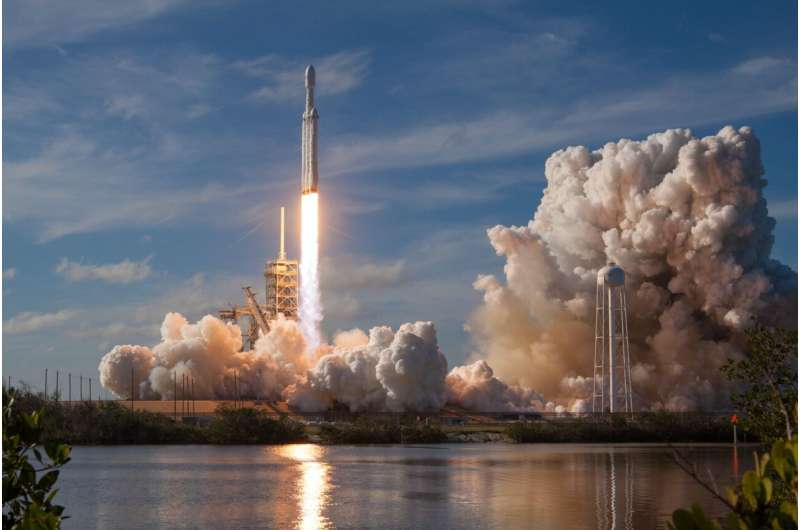
SpaceX launches lately have been pushing the record envelope for booster reflight, but a Starlink launch Tuesday morning rolled out a brand new first stage.
A Falcon 9 rocket carrying 22 of the company's internet satellites lifted off at 9:20 a.m. from Cape Canaveral Space Force Station's Space Launch Complex 40.
Shiny and white, the booster was missing the telltale signs of having been flown before, as boosters are normally covered with black carbon scoring. This was the first launch of the booster, which is targeted to be used to support the Crew-9 human spaceflight next month for launch No. 2.
It made a recovery landing downrange in the Atlantic on the droneship A Shortfall of Gravitas.
The company has four boosters that have completed at least 20 launches and landings, and is in the midst of a certification process to get them up to 40 each.
This was the 59th launch from the Space Coast from all providers in 2024. SpaceX has been responsible for all but four, with 39 coming from SpaceX from Canaveral and the other 16 from SpaceX from neighboring KSC.
Planets Hold More Water in Their Interiors Than Previously Believed
 For years, scientists have modeled planets based on Earth's structure-an iron core, a silicate mantle, and surface water. This model has often been applied to exoplanets, or planets outside our solar system. However, "it is only in recent years that we have begun to realize that planets are more complex than we had thought," explains Caroline Dorn, Professor for Exoplanets at ETH Zurich.
E
For years, scientists have modeled planets based on Earth's structure-an iron core, a silicate mantle, and surface water. This model has often been applied to exoplanets, or planets outside our solar system. However, "it is only in recent years that we have begun to realize that planets are more complex than we had thought," explains Caroline Dorn, Professor for Exoplanets at ETH Zurich.
E Engineers conduct first in-orbit test of swarm satellite autonomous navigation
 In the future, teams of smaller satellites, referred to by scientists as a "swarm," may collaborate to offer enhanced accuracy, agility, and autonomy, replacing large, costly individual space satellites. Researchers at Stanford University's Space Rendezvous Lab are at the forefront of this development, having recently completed the inaugural in-orbit test of a prototype system that navigates a s


