Thursday, 28 October 2021 03:03
Searching for Earth 2 zoom in on a star
By Jim Shelton for Yale News
 New Haven CT (SPX) Oct 28, 2021
Astronomers searching for Earth-like planets in other solar systems have made a breakthrough by taking a closer look at the surface of stars.
A new technique developed by an international team of researchers - led by Yale astronomers Rachael Roettenbacher, Sam Cabot, and Debra Fischer - uses a combination of data from ground-based and orbiting telescopes to
New Haven CT (SPX) Oct 28, 2021
Astronomers searching for Earth-like planets in other solar systems have made a breakthrough by taking a closer look at the surface of stars.
A new technique developed by an international team of researchers - led by Yale astronomers Rachael Roettenbacher, Sam Cabot, and Debra Fischer - uses a combination of data from ground-based and orbiting telescopes to
New Haven CT (SPX) Oct 28, 2021
Astronomers searching for Earth-like planets in other solar systems have made a breakthrough by taking a closer look at the surface of stars.
A new technique developed by an international team of researchers - led by Yale astronomers Rachael Roettenbacher, Sam Cabot, and Debra Fischer - uses a combination of data from ground-based and orbiting telescopes to
Published in
News
Thursday, 28 October 2021 03:03
How to find hidden oceans on distant worlds? use chemistry
Pasadena CA (SPX) Oct 28, 2021
 A new study shows how the chemicals in an exoplanet's atmosphere can, in some cases, reveal whether or not the temperature on its surface is too hot for liquid water.
In our solar system, planets are either small and rocky (like Earth) or large and gaseous (like Neptune). But around other stars, astronomers have found planets that fall in between - worlds slightly larger than Earth but sma
A new study shows how the chemicals in an exoplanet's atmosphere can, in some cases, reveal whether or not the temperature on its surface is too hot for liquid water.
In our solar system, planets are either small and rocky (like Earth) or large and gaseous (like Neptune). But around other stars, astronomers have found planets that fall in between - worlds slightly larger than Earth but sma
A new study shows how the chemicals in an exoplanet's atmosphere can, in some cases, reveal whether or not the temperature on its surface is too hot for liquid water.
In our solar system, planets are either small and rocky (like Earth) or large and gaseous (like Neptune). But around other stars, astronomers have found planets that fall in between - worlds slightly larger than Earth but sma
Published in
News
Thursday, 28 October 2021 03:03
Getting NASA data to the ground with lasers
Greenbelt MD (SPX) Oct 28, 2021
 NASA launches satellites, rovers, and orbiters to investigate humanity's place in the Milky Way. When these missions reach their destinations, their science instruments capture images, videos, and valuable insights about the cosmos. Communications infrastructure in space and on the ground enables the data collected by these missions to reach Earth. Without ground stations to receive it, the extr
NASA launches satellites, rovers, and orbiters to investigate humanity's place in the Milky Way. When these missions reach their destinations, their science instruments capture images, videos, and valuable insights about the cosmos. Communications infrastructure in space and on the ground enables the data collected by these missions to reach Earth. Without ground stations to receive it, the extr
Published in
News
Thursday, 28 October 2021 03:03
A lab in the sky: Physics experiment in Earth's atmosphere could help improve GPS performance
Strathclyde UK (SPX) Oct 28, 2021
 The Earth's atmosphere has been used as a 'laboratory' to carry out a physics experiment, in research collaboration involving the University of Strathclyde which could help to improve the performance of GPS.
The study displays a new method of remotely monitoring the plasma in the ionosphere and of controlling wave modes in a way which could help GPS make better calculations in the face of
The Earth's atmosphere has been used as a 'laboratory' to carry out a physics experiment, in research collaboration involving the University of Strathclyde which could help to improve the performance of GPS.
The study displays a new method of remotely monitoring the plasma in the ionosphere and of controlling wave modes in a way which could help GPS make better calculations in the face of
The Earth's atmosphere has been used as a 'laboratory' to carry out a physics experiment, in research collaboration involving the University of Strathclyde which could help to improve the performance of GPS.
The study displays a new method of remotely monitoring the plasma in the ionosphere and of controlling wave modes in a way which could help GPS make better calculations in the face of
Published in
News
Thursday, 28 October 2021 03:03
AiRANACULUS awarded Phase II NASA contract for Advanced Space Communications System
Chelmsford, MA (SPX) Oct 28, 2021
 AiRANACULUS, a private, Massachusetts-based technology company providing early stage research, development, prototyping and consulting services, announced it has been awarded a Phase II NASA Small Business Innovation Research contract for development of an advanced space communications system to support upcoming missions to the Moon and Mars.
Under the new contract, AiRANACULUS will demons
AiRANACULUS, a private, Massachusetts-based technology company providing early stage research, development, prototyping and consulting services, announced it has been awarded a Phase II NASA Small Business Innovation Research contract for development of an advanced space communications system to support upcoming missions to the Moon and Mars.
Under the new contract, AiRANACULUS will demons
AiRANACULUS, a private, Massachusetts-based technology company providing early stage research, development, prototyping and consulting services, announced it has been awarded a Phase II NASA Small Business Innovation Research contract for development of an advanced space communications system to support upcoming missions to the Moon and Mars.
Under the new contract, AiRANACULUS will demons
Published in
News
Thursday, 28 October 2021 03:03
NEOM Tech and Digital Holding Company and OneWeb sign $200m JV for satellite network
Riyadh, Saudi Arabia (SPX) Oct 28, 2021
 NEOM Tech and Digital Holding Company - the first holding company to be established as a subsidiary of NEOM - and OneWeb, the global communications network powered from space, have signed a $200 million (SAR 750m) joint venture agreement to bring high-speed satellite connectivity to NEOM, Saudi Arabia and the wider Middle East and neighboring East African countries.
The partnership will se
NEOM Tech and Digital Holding Company - the first holding company to be established as a subsidiary of NEOM - and OneWeb, the global communications network powered from space, have signed a $200 million (SAR 750m) joint venture agreement to bring high-speed satellite connectivity to NEOM, Saudi Arabia and the wider Middle East and neighboring East African countries.
The partnership will se
NEOM Tech and Digital Holding Company - the first holding company to be established as a subsidiary of NEOM - and OneWeb, the global communications network powered from space, have signed a $200 million (SAR 750m) joint venture agreement to bring high-speed satellite connectivity to NEOM, Saudi Arabia and the wider Middle East and neighboring East African countries.
The partnership will se
Published in
News
Wednesday, 27 October 2021 19:58
OneWeb and Saudi Arabia create $200 million connectivity joint venture
Satellite broadband startup OneWeb and a company backed by Saudi Arabia’s sovereign wealth fund have signed a $200 million joint venture, with exclusive rights to distribute the network’s capacity in targeted Middle East regions.
Published in
News
Thursday, 28 October 2021 09:06
Lunar Lander in Dubai
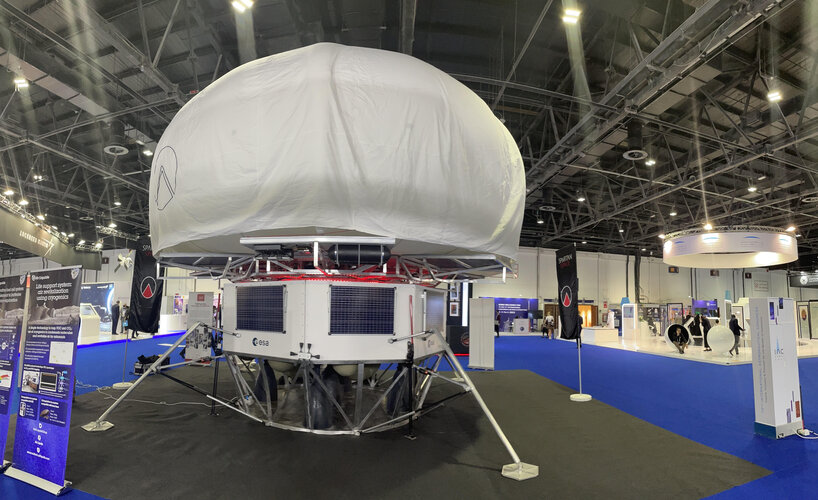 Image:
Lunar Lander in Dubai
Image:
Lunar Lander in Dubai
Published in
News
Thursday, 28 October 2021 07:53
Towards the detection of the nanohertz gravitational-wave background
Munich, Germany (SPX) Oct 28, 2021
 The European Pulsar Timing Array (EPTA) is a scientific collaboration bringing together teams of astronomers around the largest European radio telescopes, as well as groups specialized in data analysis and modelling of gravitational-wave (GW) signals. It has published a detailed analysis of a candidate signal for the since-long sought gravitational-wave background (GWB) due to in-spiraling super
The European Pulsar Timing Array (EPTA) is a scientific collaboration bringing together teams of astronomers around the largest European radio telescopes, as well as groups specialized in data analysis and modelling of gravitational-wave (GW) signals. It has published a detailed analysis of a candidate signal for the since-long sought gravitational-wave background (GWB) due to in-spiraling super
Published in
News
Thursday, 28 October 2021 07:53
Researchers find standing waves at edge of earth's magnetic bubble
Greenbelt MD (SPX) Oct 26, 2021
 Earth sails the solar system in a ship of its own making: the magnetosphere, the magnetic field that envelops and protects our planet. The celestial sea we find ourselves in is filled with charged particles flowing from the Sun, known as the solar wind. Just as ocean waves follow the wind, scientists expected that waves traveling along the magnetosphere should ripple in the direction of the sola
Earth sails the solar system in a ship of its own making: the magnetosphere, the magnetic field that envelops and protects our planet. The celestial sea we find ourselves in is filled with charged particles flowing from the Sun, known as the solar wind. Just as ocean waves follow the wind, scientists expected that waves traveling along the magnetosphere should ripple in the direction of the sola
Published in
News