Poland signs Artemis Accords
Poland has joined the U.S.-led Artemis Accords for space exploration, hoping to use the agreement as a means of enhancing space cooperation between the two nations.
Crew-3 say cheese
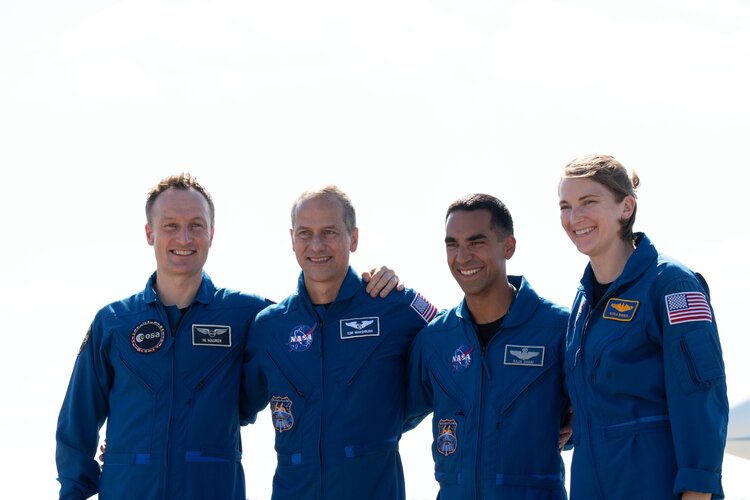 Image:
ESA astronaut Matthias Maurer and his NASA crew mates Raja Chari, Thomas Marshburn and Kayla Barron are all smiles as they arrive at NASA’s Kennedy Space Center in Florida, USA on 26 October 2021.
Collectively, the astronauts make up Crew-3 and will travel to the International Space Station on the SpaceX Crew Dragon spacecraft “Endurance”. The first launch opportunity for Crew-3 is 07:21 CET (06:21 GMT, 02:21 EDT) Sunday 31 October 2021, with a backup date of 3 November.
The Dragon will dock with the Space Station 22 hours after launch, allowing for a short overlap with the Crew-2 members who
‘ESA Champions’ award initiative launched

Whether you are hosting a YouTube channel about space or volunteering to speak at your local school, we want to recognise and reward your passion and advocacy for space.
Euclid spacecraft integration
 Video:
00:00:19
Video:
00:00:19
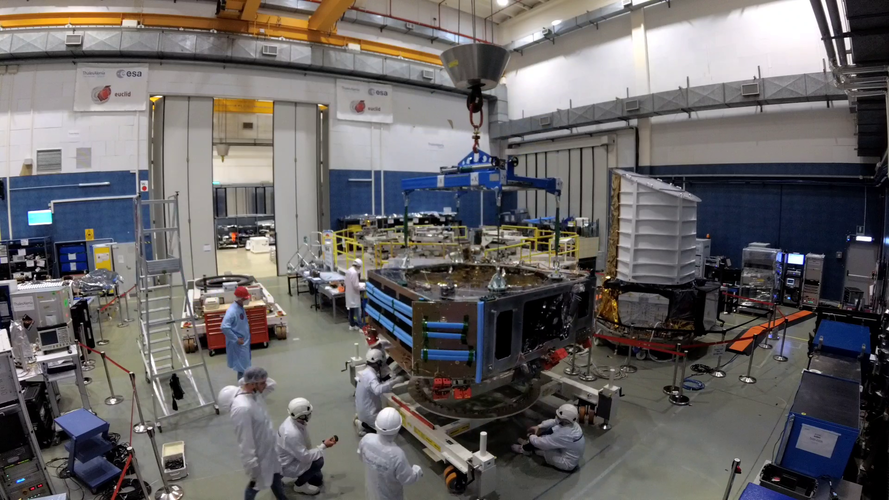
The Euclid payload and service module are currently at Thales Alenia Space in Torino, Italy, where they will be integrated to form the final, finished spacecraft.
In this video Euclid’s service module is being transferred onto a support near the payload module, in order to prepare it for further integration activities.
Euclid is ESA’s mission to map the geometry of the Universe and better understand the mysterious dark matter and dark energy.
US-South Korea joint space drills to focus on space situational awareness

“What we urgently need is ‘eyes’ to look at what’s happening in outer space,” said ROK Air Force Col. Park Ki-tae, inaugural chief of the air force’s Space Operations Center, during the Seoul International Aerospace and Defense Exhibition 2021.
China sets new national launch record with Kuaizhou-1A mission
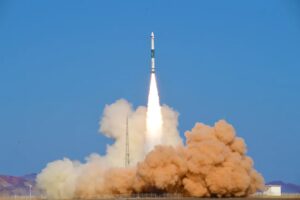
China set a new national record for orbital launches in a calendar year with the launch of a commercial remote sensing satellite on a Kuaizhou-1A solid rocket Wednesday.
Making Martian rocket biofuel on Mars
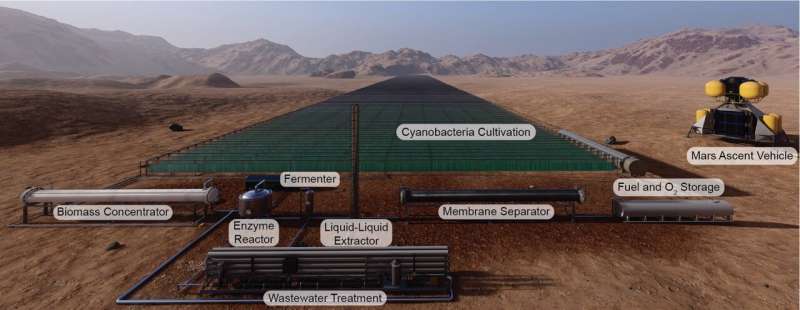
Researchers at the Georgia Institute of Technology have developed a concept that would make Martian rocket fuel, on Mars, that could be used to launch future astronauts back to Earth.
The bioproduction process would use three resources native to the red planet: carbon dioxide, sunlight, and frozen water. It would also include transporting two microbes to Mars. The first would be cyanobacteria (algae), which would take CO2 from the Martian atmosphere and use sunlight to create sugars. An engineered E. coli, which would be shipped from Earth, would convert those sugars into a Mars-specific propellant for rockets and other propulsion devices. The Martian propellant, which is called 2,3-butanediol, is currently in existence, can be created by E. coli, and, on Earth, is used to make polymers for production of rubber.
Physics experiment in Earth's atmosphere could help improve GPS performance
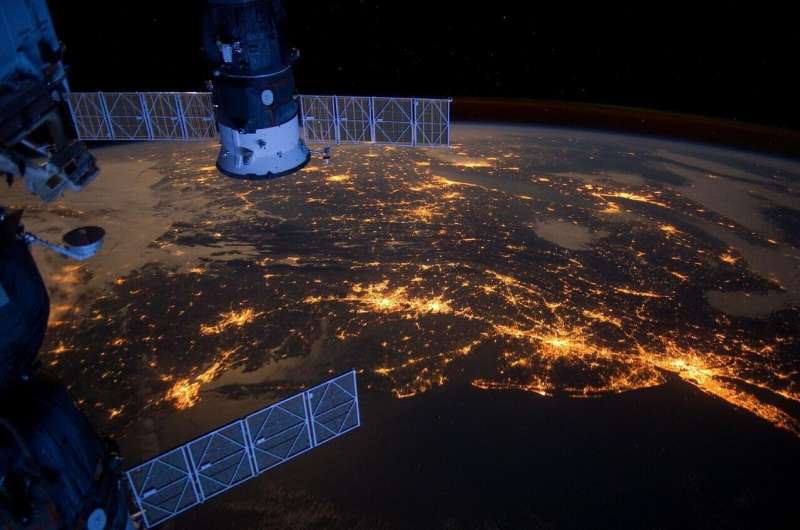
The Earth's atmosphere has been used as a 'laboratory' to carry out a physics experiment, in research collaboration involving the University of Strathclyde which could help to improve the performance of GPS.
The study displays a new method of remotely monitoring the plasma in the ionosphere and of controlling wave modes in a way which could help GPS make better calculations in the face of extreme space weather.
The researchers conducted a controlled radar wave experiment by injecting radio waves into the ionosphere, at slightly different frequencies.
The returned signal was then recorded and analyzed. The researchers found that plasma waves were excited in the ionosphere and non-linear waves were mixed, leading to a wide spectrum of non-linear frequencies in the returned signal.
Plasma in the ionosphere plays a significant role in reflecting and modifying radio waves used for communication and radio navigation systems such as GPS, but the accuracy of these can be affected by 'space weather' events such as solar storms.
The experiment was carried out at the EISCAT facility near Tromsø, Norway and the research has been published in the journal Nature Communications.
Boeing takes $185 million charge because of Starliner delays
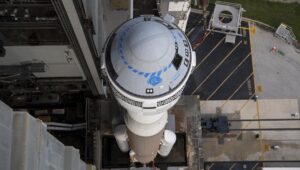
Boeing announced Oct. 27 it is taking an additional $185 million charge against its earnings to cover the costs to get its CST-100 Starliner commercial crew vehicle flying again.
Space startups selected for accelerator program in New Mexico

A new accelerator program funded by the Air Force Research Laboratory and the U.S. Space Force announced Oct. 27 it has selected six U.S. and international startups for its first cohort.