
After debris concerns, SpaceX to shift Dragon capsule landings from Florida to California
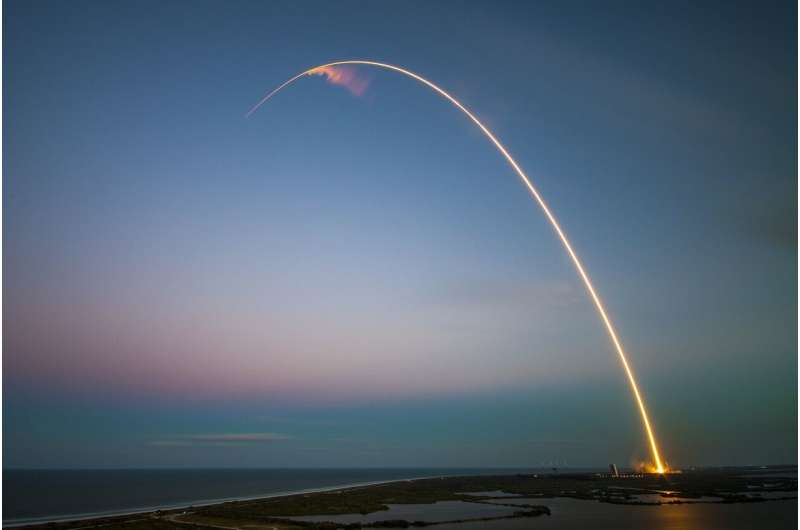
Evidence of debris stemming from return trips of SpaceX Dragon spacecraft has prompted the company to shift future landing operations from Florida to California.
The move was announced Friday during NASA's press conference previewing the upcoming Crew-9 mission to the International Space Station, and it won't take effect until 2025 after Crew-9 has returned.
"After five years of splashing down off the coast of Florida, we've decided to ship Dragon recovery operations back to the West coast," said Sarah Walker, SpaceX's director of Dragon mission management.
This includes both cargo and crew versions of its spacecraft.
At issue is the trunk portion of the Dragon capsule that is discarded before reentry and splashdown. Initially, the cargo version of Dragon made returns in the Pacific 21 times from 2011-2020, but when crew capability came online, SpaceX made the shift to allow for capsule landings off the coast of Florida either in the Atlantic or Gulf of Mexico.
Feeding that decision were models that predicted how the trunk portion would break up in Earth's atmosphere.
"SpaceX and NASA engineering teams used these industry-standard models to understand the trunk's breakup characteristics, and they predicted the trunk would fully burn up due to the high temperatures that are created by air resistance during that high speed reentry into Earth's atmosphere," Walker said.


Space is not the limit
 Image:
Space is not the limit
Image:
Space is not the limit Boeing takes additional $125 million loss on Starliner


Euclid Galaxy Zoo – help us classify the shapes of galaxies

Creating a Lunar Biorepository to protect Earth's biodiversity
 An international team of scientists has proposed a novel solution to safeguard the planet's biodiversity amid the growing extinction crisis: a biorepository on the Moon. Detailed in the journal BioScience, this plan aims to establish a passive, long-term storage facility for cryopreserved samples of the world's most endangered animal species.
Dr. Mary Hagedorn from the Smithsonian's Nation
An international team of scientists has proposed a novel solution to safeguard the planet's biodiversity amid the growing extinction crisis: a biorepository on the Moon. Detailed in the journal BioScience, this plan aims to establish a passive, long-term storage facility for cryopreserved samples of the world's most endangered animal species.
Dr. Mary Hagedorn from the Smithsonian's Nation Hera mission sparks new discoveries about target asteroids
 As ESA's Hera mission for planetary defense completes its pre-launch testing, its target asteroids have been revealed as intriguing small worlds. A special issue of Nature Communications this week features studies on the Didymos asteroid and its moon Dimorphos, based on close-range footage from NASA's DART spacecraft and images from the Italian Space Agency's LICIACube.
On September 26, 20
As ESA's Hera mission for planetary defense completes its pre-launch testing, its target asteroids have been revealed as intriguing small worlds. A special issue of Nature Communications this week features studies on the Didymos asteroid and its moon Dimorphos, based on close-range footage from NASA's DART spacecraft and images from the Italian Space Agency's LICIACube.
On September 26, 20 NASA partners with universities for soil-monitoring and optical comms CubeSats
 NASA's CubeSat Launch Initiative is set to send two CubeSats to the International Space Station (ISS) as part of the 21st Northrop Grumman commercial resupply mission.
CySat-1, developed by students from Iowa State University, will measure Earth's soil moisture from low Earth orbit using a software-defined radiometer. This radiometer processes analog radio signals through software, and stu
NASA's CubeSat Launch Initiative is set to send two CubeSats to the International Space Station (ISS) as part of the 21st Northrop Grumman commercial resupply mission.
CySat-1, developed by students from Iowa State University, will measure Earth's soil moisture from low Earth orbit using a software-defined radiometer. This radiometer processes analog radio signals through software, and stu Orbit and Viasat partner on advanced airborne satellite communication systems
 Orbit Communication Systems Ltd. (TASE: ORBI), a prominent provider of airborne communication solutions, has announced a key partnership with Viasat Inc., a global leader in satellite communications. This collaboration focuses on the engineering and supply of advanced satellite communication (SATCOM) Multi-Purpose Terminals (MPT) for airborne platforms, aiming to enhance performance and accessib