
ESA astronaut class of 2022: Astro Chat with John McFall
 Video:
00:24:06
Video:
00:24:06
John McFall, a member of the European astronaut reserve from the ESA astronaut class of 2022, brings a diverse background to his role. With experience as an orthopaedic and trauma surgeon and a former Paralympic sprinter, John is participating in the groundbreaking "Fly!" feasibility study. This initiative seeks to enhance our comprehension of the challenges posed by space flight for astronauts with physical disabilities, aiming to overcome these barriers. Tune in to discover more about John and the "Fly!" project.
This is Episode 9 of our ESA Explores podcast series, delving into everything you want to know about
Ariane 6 who makes what infographic
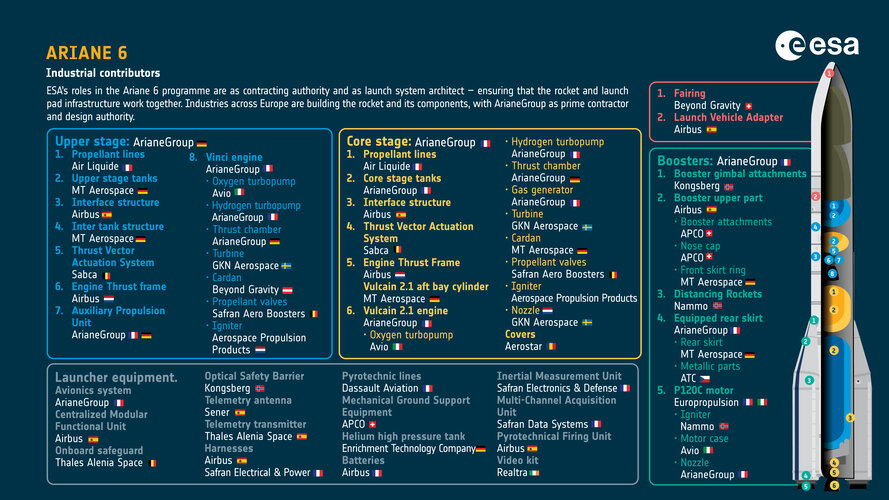 Image:
Ariane 6 who makes what infographic
Image:
Ariane 6 who makes what infographic 
Could we put data centers in space?
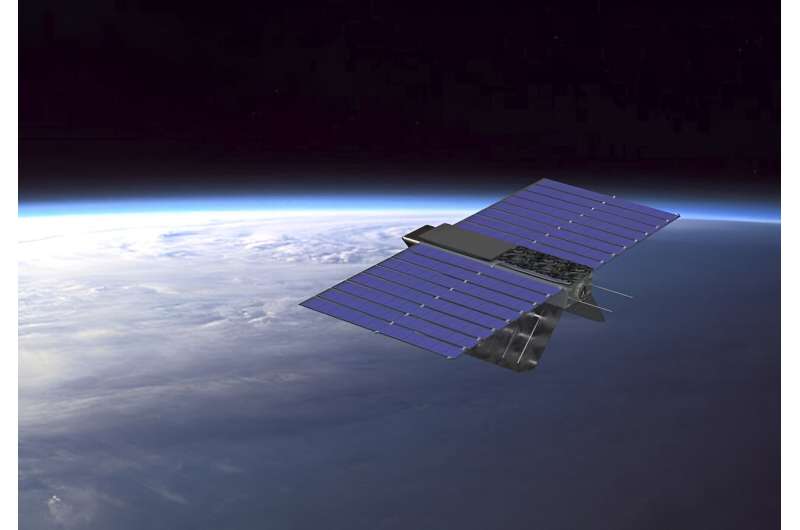
Artificial intelligence has taken the world by storm lately. It also requires loads of band-end computing capability to do the near-miraculous things that it does. So far, that "compute," as it's known in the tech industry, has been based entirely on the ground. But is there an economic reason to do it in space? Some people seem to think so, as there has been a growing interest in space-based data centers. Let's take a look at why.
Space-based data centers have several advantages over ground-based ones. The first and most obvious is the near-unlimited amount of space in space. Second, there are plenty of potential options for novel power and cooling technologies that can't exist back on Earth. Third, using a space-based data center as a relay point for information could cut down on lag in data transfer between continents. Let's look at each in turn.
One of the significant constraints for data centers is space—they require large amounts of it, and it is expensive in the areas where they are most needed (i.e.
U.S. Space Command ready for potential Russian satellite attack, general says


Skynopy raises funds for scalable ground station network

Europe aims to end space access crisis with Ariane 6’s inaugural launch


NASA calls off spacewalk for second time this month
 NASA canceled a spacewalk for the second time this month on Monday after reporting a coolant leak on the umbilical unit on one of the astronaut's spacesuits.
Astronaut Tracy Caldwell Dyson reported the leak on the suit's servicing and cooling umbilical unit, or SCU, just before she and Mike Barratt were set to walk outside the International Space Station at about 8:52 a.m., EDT. Both as
NASA canceled a spacewalk for the second time this month on Monday after reporting a coolant leak on the umbilical unit on one of the astronaut's spacesuits.
Astronaut Tracy Caldwell Dyson reported the leak on the suit's servicing and cooling umbilical unit, or SCU, just before she and Mike Barratt were set to walk outside the International Space Station at about 8:52 a.m., EDT. Both as Chang'e-6 to Return with Farside Moon Samples
 On June 25, China's Chang'e-6 (CE-6) lunar probe is set to return to Earth, carrying the first surface samples collected from the farside of the Moon. In anticipation of this event, scientists from the Institute of Geology and Geophysics at the Chinese Academy of Sciences are publishing their predictions for the materials that may be found in the CE-6 samples in the journal The Innovation.
 Two large asteroids to pass Earth in close succession
 Two large asteroids will safely pass Earth this week, coinciding with this year's Asteroid Day. Neither poses any risk to our planet, but one of them was only discovered a week ago, underscoring the need to enhance our detection capabilities for potentially hazardous objects.
Asteroid 2024 MK, measuring between 120 and 260 meters, was discovered on 16 June 2024. It will fly past Earth on 2
Two large asteroids will safely pass Earth this week, coinciding with this year's Asteroid Day. Neither poses any risk to our planet, but one of them was only discovered a week ago, underscoring the need to enhance our detection capabilities for potentially hazardous objects.
Asteroid 2024 MK, measuring between 120 and 260 meters, was discovered on 16 June 2024. It will fly past Earth on 2