

Double DRT for a Soliday: Sols 3964-3965:
 Earth planning date: Friday, September 29, 2023: Welcome to another weekend in Gale crater, Mars! As Abigail Knight described in Wednesday's blog, we elected not to drive last plan while we waited for the workspace imaging from Navcam and Mastcam to arrive on Earth. All went as expected and we received the necessary imaging to assess the terrain well enough for using our DRT on the beautiful lig
 Dust removal delayed: Sols 3962-3963
 Earth planning date: Wednesday, September 27, 2023: Our exploration of the light-and-dark-toned bands continues today as Curiosity has completed another successful drive and now has a promising block of light-toned bedrock in its latest workspace. With a thorough investigation of the compositions and textures within this region, we hope to identify what factors cause the differences between the
 Scientists prove that antimatter falls at the same rate as matter
 Early on in science classes all over the world, students drop diverse things to learn how gravity works and learn how outside forces might affect the rate of fall. But the science of falling goes well beyond the bowling ball and feather experiment. Einstein's theory of relativity is still being studied, applied and proven a multitude of ways today. For instance, the Antihydrogen Laser Physics Ap
 NASA selects four small explorer mission concept studies
 NASA has selected four small explorer missions to conduct concept studies. These studies aim to expand knowledge of the dynamics of the Sun and related phenomena, such as coronal mass ejections, aurora, and solar wind to better understand the Sun-Earth connection.
Any missions selected to move forward after the concept studies are conducted will join the current heliophysics mission fleet,
NASA has selected four small explorer missions to conduct concept studies. These studies aim to expand knowledge of the dynamics of the Sun and related phenomena, such as coronal mass ejections, aurora, and solar wind to better understand the Sun-Earth connection.
Any missions selected to move forward after the concept studies are conducted will join the current heliophysics mission fleet, German tech factory reveals antenna prototype-ngVLA will open a new window into the Universe
 Usually it's Octoberfest that draws a crowd to Germany this time of year. For hundreds of folks gathered at mtex antenna technology in Schkeuditz, it's a first look at a prototype radio telescope that may one day be part one of the world's largest and most sensitive radio telescopes in the world, the National Radio Astronomy Observatory's (NRAO) next generation Very Large Array (ngVLA). The prot
 Webb’s wide-angle view of the Orion Nebula is released in ESASky

New images of the Orion Nebula from the NASA/ESA/CSA James Webb Space Telescope have been included in ESA’s ESASky application, which has a user-friendly interface to visualise and download astronomical data.
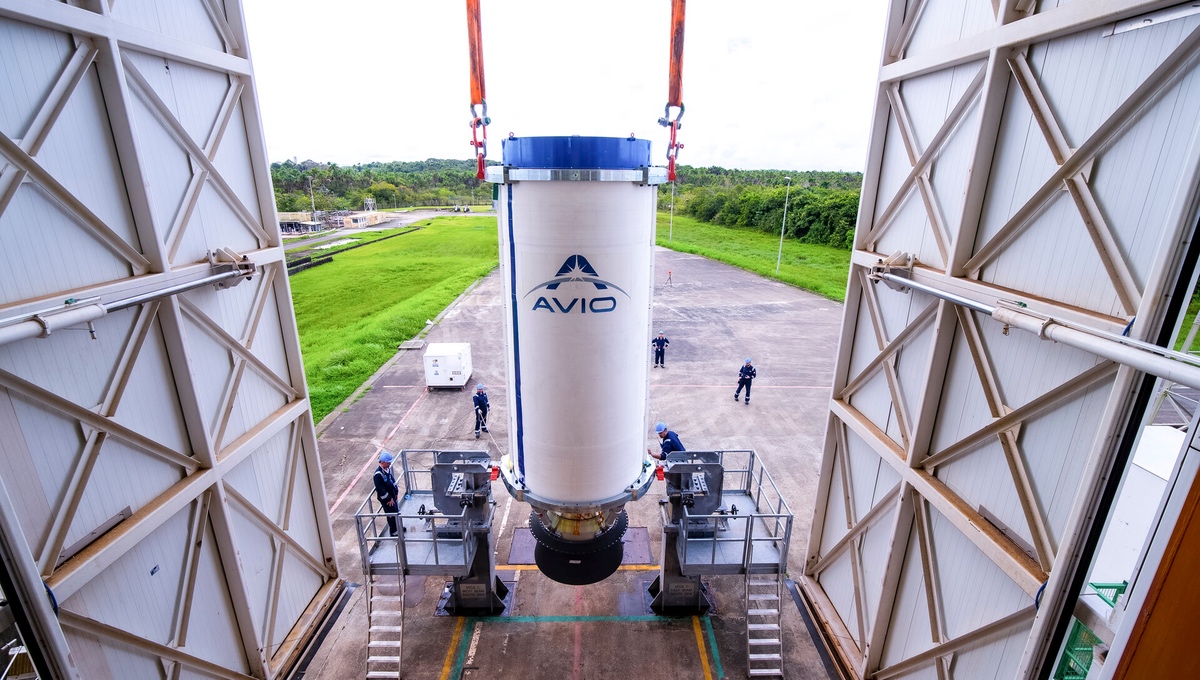
Media briefing: Findings of the Independent Enquiry Commission on Vega-C test
 Video:
00:42:00
Video:
00:42:00
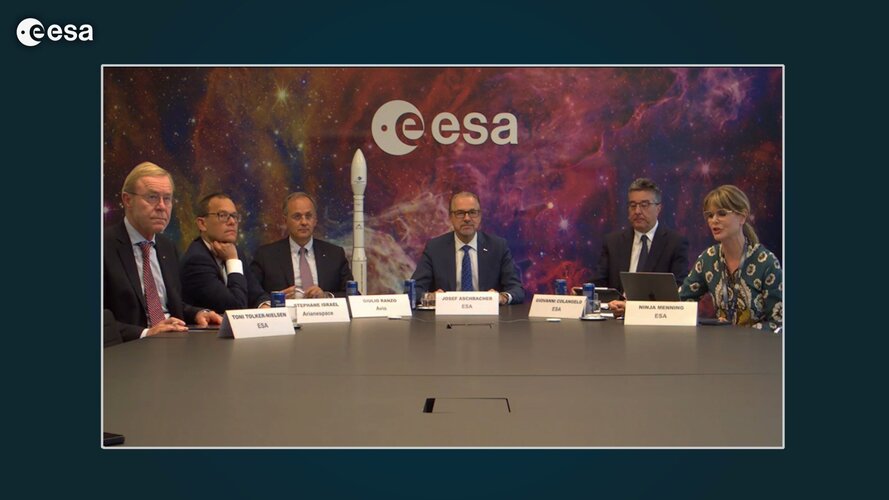
Media briefing on the findings of the Independent Enquiry Commission tasked with analysing the results of the static-firing test of the Vega-C Zefiro 40 motor, which took place on 28 June 2023.
The press briefing was held on 2 October 2023 with ESA Director General Josef Aschbacher presenting the results of the investigation, with ESA Inspector General and chair of the Independent Enquiry Commission Giovanni Colangelo; Avio CEO Giulio Ranzo, Arianespace CEO Stéphane Israël, and ESA’s Director of Space Transportation Toni Tolker-Nielsen.
During the briefing, ESA and its partners presented the findings of the enquiry commission, together with an
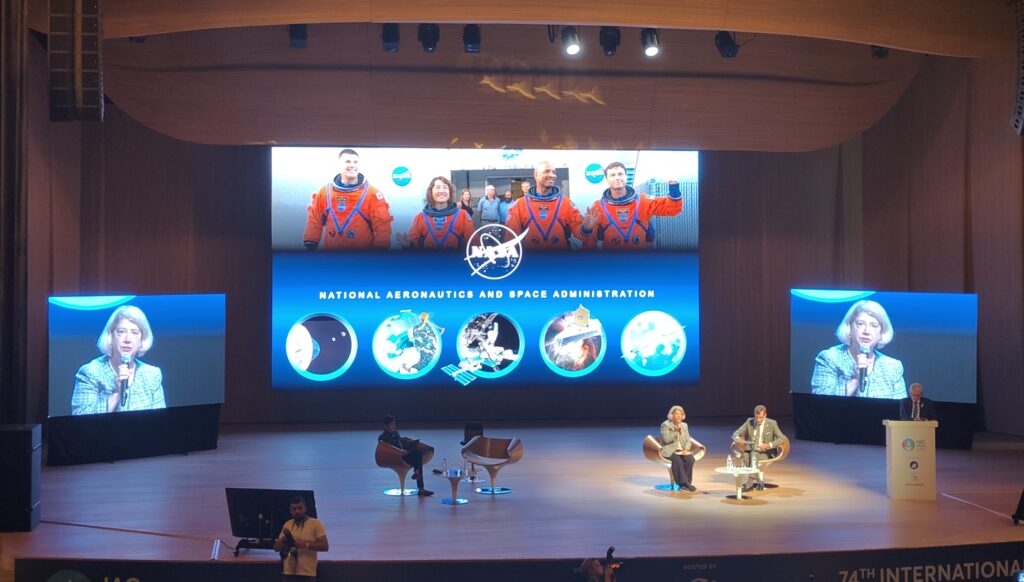
Heads of agencies update on crewed, robotic lunar plans
Massive low-Earth orbit communications satellites could disrupt astronomy
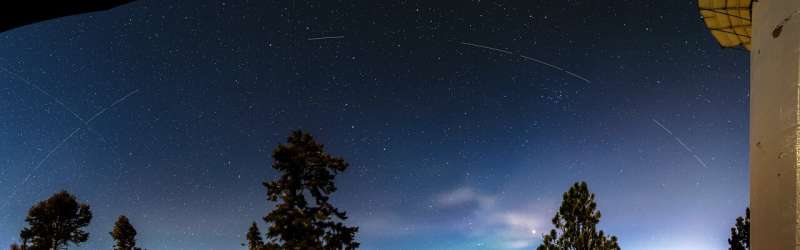
Observations of the BlueWalker 3 prototype satellite show it is one of the brightest objects in the night sky, outshining all but the brightest stars.
Astronomers have raised concerns that without mitigation, groups of large satellites could disrupt our ability to observe the stars from Earth and perform radio astronomy.
Several companies are planning "constellations" of satellites—groups of potentially hundreds of satellites that can deliver mobile or broadband services anywhere in the world.
However, these satellites need to be in "low-Earth" orbit and can be relatively large, so their potential to disrupt night-sky observations is a concern.
Now, an international team of scientists led by astronomers from the IAU Center for the Protection of the Dark and Quiet Sky from Satellite Constellation Interference (CPS) and including Imperial College London researchers, have published a paper in Nature assessing the detailed impact of the prototype BlueWalker 3satellite on astronomy.


