SpaceX engaged in legal battle with oil company for land to drill for gas
 The spat of land in question is located near SpaceX's Boca Chica launch site, which according to the company's CEO would be used exclusively for Starship super heavy-lift launch vehicles design for long-duration space missions.
SpaceX is locked in a legal battle with Dallas Petroleum Group, which claims ownership of some inactive wells sitting on the same 806-acre (326-hectare) piece of le
The spat of land in question is located near SpaceX's Boca Chica launch site, which according to the company's CEO would be used exclusively for Starship super heavy-lift launch vehicles design for long-duration space missions.
SpaceX is locked in a legal battle with Dallas Petroleum Group, which claims ownership of some inactive wells sitting on the same 806-acre (326-hectare) piece of le Compelling evidence of neutrino process opens physics possibilities
 The COHERENT particle physics experiment at the Department of Energy's Oak Ridge National Laboratory has firmly established the existence of a new kind of neutrino interaction. Because neutrinos are electrically neutral and interact only weakly with matter, the quest to observe this interaction drove advances in detector technology and has added new information to theories aiming to explain myst
 MDA appoints new VP of Satellite Systems
 MDA is pleased to welcome Amer Khouri as the company's new Vice President of Satellite Systems. As the leader for this business, Mr. Khouri will be responsible for all business area activities including successful execution of existing programs and the continued growth of MDA's Satellite Systems business, which is based in Montreal, Canada.
Mr. Khouri has an extensive 25-year career in gen
MDA is pleased to welcome Amer Khouri as the company's new Vice President of Satellite Systems. As the leader for this business, Mr. Khouri will be responsible for all business area activities including successful execution of existing programs and the continued growth of MDA's Satellite Systems business, which is based in Montreal, Canada.
Mr. Khouri has an extensive 25-year career in gen NASA, Rio De Janeiro Extend Disaster Preparedness Partnership
 NASA and the city of Rio de Janeiro have extended an agreement to support innovative and collaborative efforts to better understand, anticipate, monitor and respond to natural hazards and other impacts affecting the city. The collaboration leverages the unique attributes of NASA's satellite data and modeling frameworks and Rio de Janeiro's management and monitoring capabilities to improve awaren
 NASA may change MRO orbit to support Mars 2020
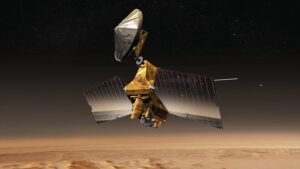
WASHINGTON — NASA is considering changing the orbit of one of its oldest Mars spacecraft, a move intended to support the Mars 2020 mission after landing but which could affect both its science and support of other missions.
NASA seeks input on Europa Clipper launch options

WASHINGTON — NASA has issued a request for information for launch services for its Europa Clipper mission, a sign the agency is taking advantage of language in a recent appropriations bill that allows it to consider alternatives to the Space Launch System.
ExoMars orbiter's 20,000th image
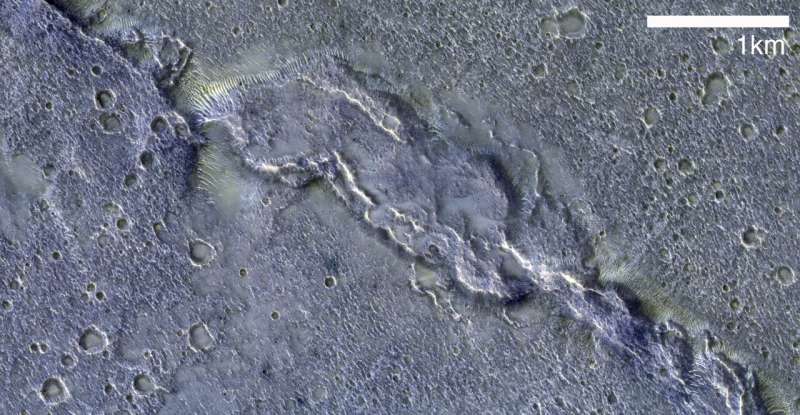
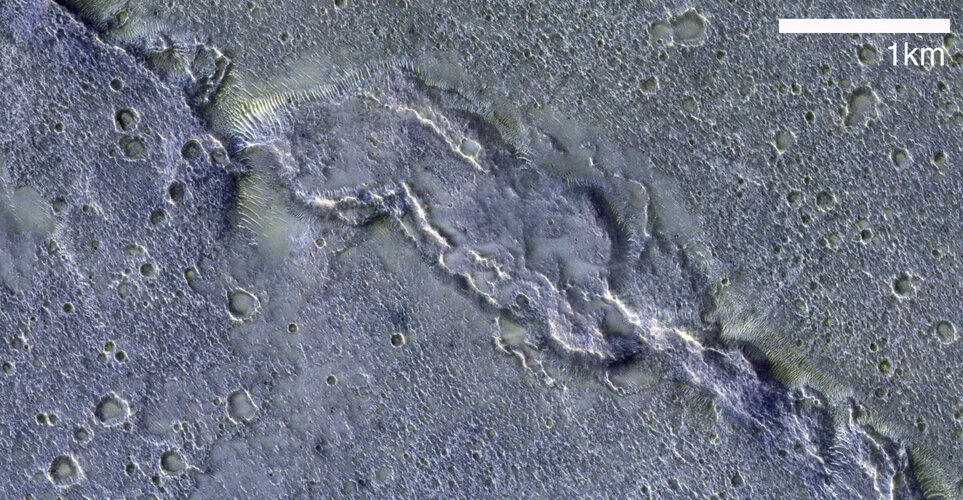
The CaSSIS camera onboard the ExoMars Trace Gas Orbiter has captured its 20,000th image of Mars.
The image, taken on 13 December 2020, features Solis Dorsum, a segment of a prominent wrinkle ridge system in a vast volcanic plateau, known as Tharsis. Wrinkle ridges are tectonic features that form in layered basalt lavas due to loading and flexure of the planet's crust and upper mantle. These tectonic stresses are caused by the planet's interior cooling and subsequent contraction.
The study of wrinkle ridges, and in particular their distribution and orientation, can reveal details of the complex and dynamic geological history of Mars.
The scale is indicated on the image. Download high-res PNG for the full image swath.
NASA's MAVEN continues to advance Mars science and telecommunications relay efforts
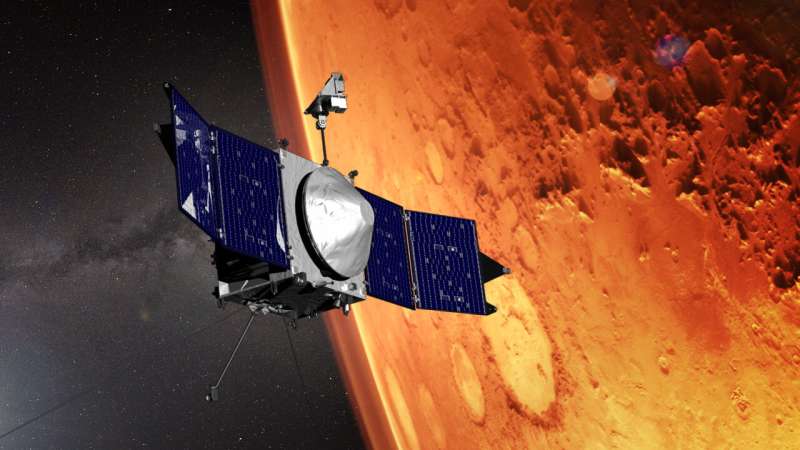
With a suite of new national and international spacecraft primed to explore the Red Planet after their arrival next month, NASA's MAVEN mission is ready to provide support and continue its study of the Martian atmosphere.
MAVEN launched in November 2013 and entered the Martian atmosphere roughly a year later. Since that time, MAVEN has made fundamental contributions to understanding the history of the Martian atmosphere and climate. A few science highlights include:
- Determination that the bulk of the Martian atmosphere has been lost to space through time, driving changes in the Mars climate and the ability to support life at the surface.
- Characterization of the mechanisms by which gas is stripped away from the atmosphere to space and of the role of solar storms hitting Mars in enhancing the escape rate.
- There is significant unexpected variability in the loss rate of hydrogen to space through the seasons, which has important implications for the history of water.
Week in images: 25 - 29 January 2021
Week in images: 25 - 29 January 2021
Discover our week through the lens
SpaceX vs NASA: Who will get us to the moon first? Here's how their latest rockets compare
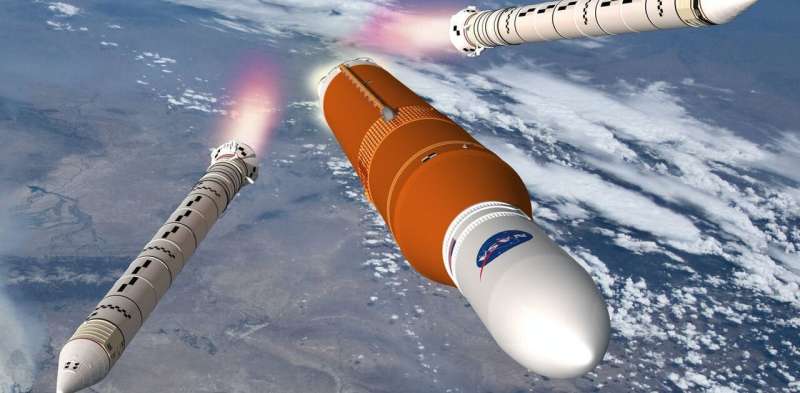
No one has visited the moon since 1972. But with the advent of commercial human spaceflight, the urge to return is resurgent and generating a new space race. NASA has selected the private company SpaceX to be part of its commercial spaceflight operations, but the firm is also pursuing its own space exploration agenda.
To enable flights to the moon and beyond, both NASA and SpaceX are developing new heavy lift rockets: SpaceX's Starship and NASA's Space Launch System.
But how do they differ and which one is more powerful?
Starship
Rockets go through multiple stages to get into orbit. By discarding spent fuel tanks while in flight, the rocket becomes lighter and therefore easier to accelerate. Once in operation, SpaceX's launch system will be comprised of two stages: the launch vehicle known as "BFR" (Big Falcon Rocket) and the Starship.
BFR is powered by the Raptor rocket engine, burning a combination of liquid methane and liquid oxygen.