

NASA's autonomous aircraft decision tech gets simulated urban test
 Cities are complicated places to fly. Tall buildings, local microclimates, high winds, and other factors present challenges - both known and unpredictable - for current and future air vehicles. But creating new air mobility solutions to move people and cargo will require addressing those challenges. And that's where NASA's Data and Reasoning Fabric (DRF) project can help.
DRF designs techn
Cities are complicated places to fly. Tall buildings, local microclimates, high winds, and other factors present challenges - both known and unpredictable - for current and future air vehicles. But creating new air mobility solutions to move people and cargo will require addressing those challenges. And that's where NASA's Data and Reasoning Fabric (DRF) project can help.
DRF designs techn Meet Carole Mundell, new Director of Science
 Video:
00:05:10
Video:
00:05:10
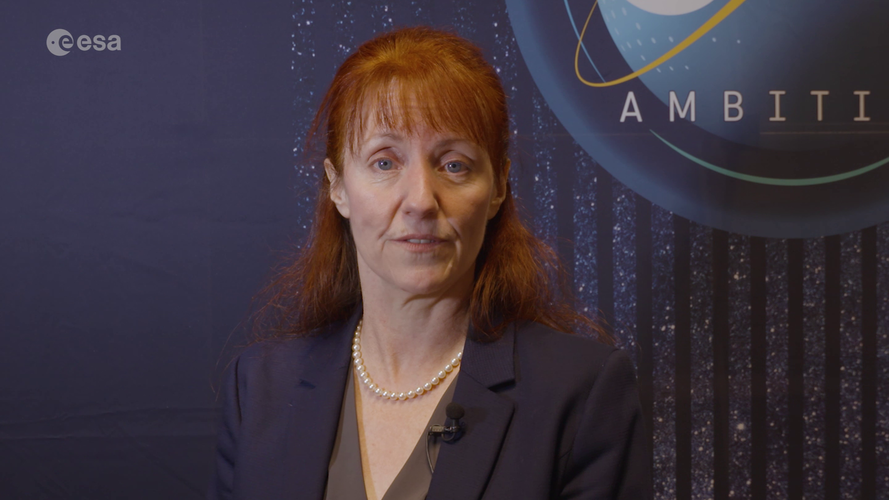
Carole Mundell is the new Director of Science, succeeding the current director Günther Hasinger.
Professor Mundell is an internationally renowned scientist with extensive experience in inclusive leadership, operational management, strategy and international science policy development.
She joined ESA from the University of Bath where she held the Hiroko Sherwin Chair in Extragalactic Astronomy, was founding Head of Astrophysics, and served as Head of the Department of Physics until becoming the first woman Chief Scientific Adviser at the UK’s Foreign and Commonwealth Office in 2018 and first Chief International Science Envoy in the Foreign, Commonwealth and Development Office until 2021.
Hubble captures movie of DART asteroid impact debris
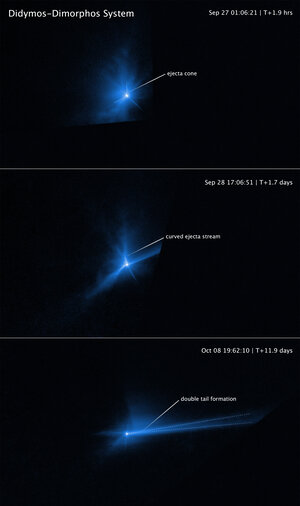
The NASA/ESA Hubble Space Telescope captured a series of photos of rapid changes to the asteroid Dimorphos when it was deliberately hit by a 545-kilogram spacecraft on 26 September 2022. The primary objective of the NASA mission, called DART (Double Asteroid Redirection Test), was to test our ability to alter the asteroid’s trajectory as it orbits its larger companion asteroid, Didymos. Though Dimorphos poses no threat to Earth, data from the mission could help inform researchers how to potentially change an asteroid’s path away from Earth, if ever necessary.
UK provisionally clears Viasat’s Inmarsat acquisition

The U.K. provisionally cleared Viasat’s plan to buy London-based Inmarsat March 1 after finding the deal would not substantially reduce competition for providing Wi-Fi on planes.
Virgin Galactic in final phases of return to flight

Virgin Galactic is in the final phases of returning its suborbital spaceplane to commercial service as it ramps up development of a next-generation vehicle.
Atom-scale scan of space materials
 Image:
Atom-scale scan of space materials
Image:
Atom-scale scan of space materials DoD interested in smartphone-to-satellite communications services

Emerging communications services that connect phones directly to satellites are attractive to military users that operate in locations where there is no cellular network connectivity
Rocket Lab reconsidering mid-air recovery of Electron boosters

Rocket Lab is reconsidering the use of mid-air recovery of Electron boosters as part of its efforts to reuse the vehicle.
Hansel and Gretel's breadcrumb trick inspires robotic exploration system for caves on Mars and beyond
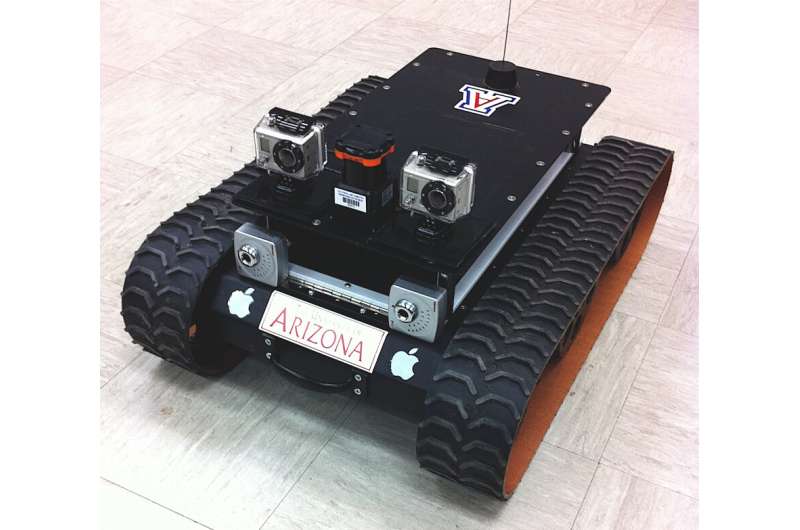
House hunting on Mars could soon become a thing, and researchers at the University of Arizona are already in the business of scouting real estate that future astronauts could use as habitats. Researchers in the UArizona College of Engineering have developed technology that would allow a flock of robots to explore subsurface environments on other worlds.
"Lava tubes and caves would make perfect habitats for astronauts because you don't have to build a structure; you are shielded from harmful cosmic radiation, so all you need to do is make it pretty and cozy," said Wolfgang Fink, an associate professor of electrical and computer engineering at UArizona.
SpaceX Dragon crew blasts off for International Space Station
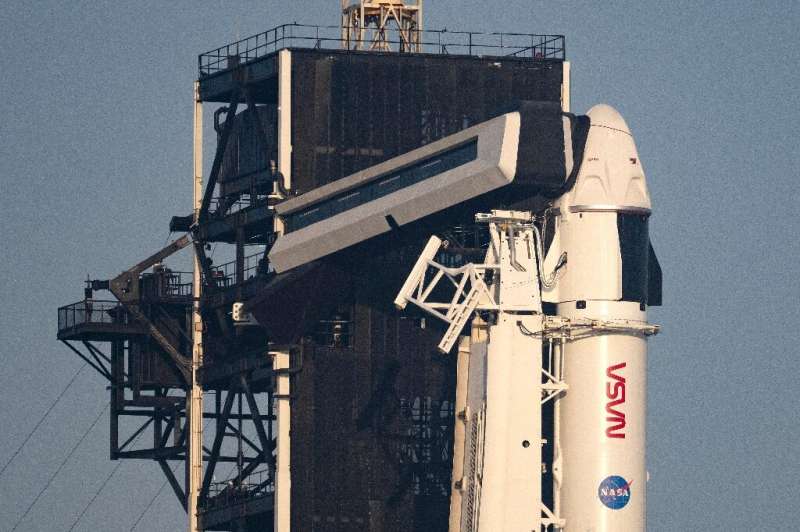
A SpaceX Falcon 9 rocket blasted off on Thursday to the International Space Station carrying two NASA astronauts, a Russian cosmonaut and the second Emirati to voyage to space.
The SpaceX Dragon Crew-6 mission launched at 12:34 am (0534 GMT) Thursday from Launch Complex 39A at NASA's Kennedy Space Center in Florida, a livestream of the launch showed.
The launch had been scrubbed on Monday just minutes before liftoff because of a clog in a filter that supplies ignition fluid to start the rocket engines.
"Congratulations to the NASA and SpaceX teams for another history-making mission to the International Space Station!" NASA Administrator Bill Nelson said in a statement.


