

Japan selects first new astronauts in 14 years to support Artemis program

Japan’s space agency JAXA said Feb.
SpaceX launches first upgraded Starlink satellites

SpaceX launched the first set of upgraded Starlink satellites for its second-generation constellation Feb.
Liquid nitrogen spray could clean up stubborn moon dust
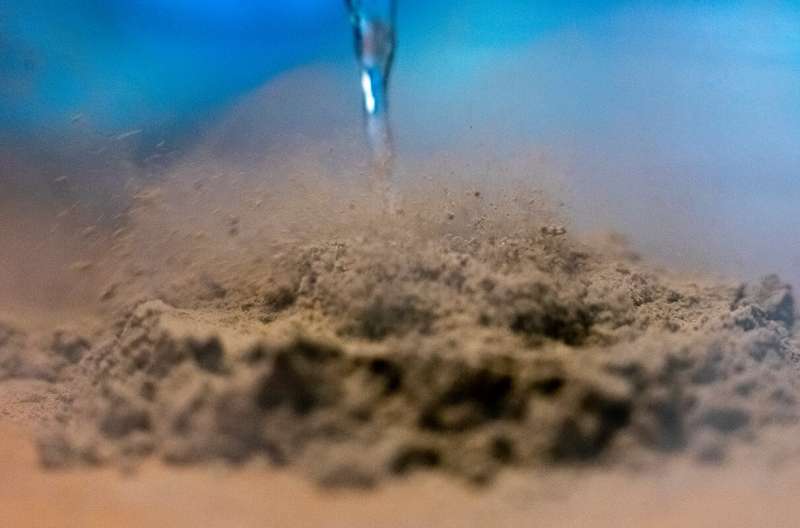
A liquid nitrogen spray developed by Washington State University researchers can remove almost all of the simulated moon dust from a space suit, potentially solving what is a significant challenge for future moon-landing astronauts.
The sprayer removed more than 98% of moon dust simulant in a vacuum environment with minimal damage to spacesuits, performing better than any techniques that have been investigated previously. The researchers report on their work in the journal, Acta Astronautica.
While people have managed to put men on the moon, they haven't figured out how to keep them clean there. Similar to the clingiest packaging peanuts, moon dust sticks to everything that it touches. Worse than the packing peanuts, the dust is composed of very fine particles that are the consistency of ground fiberglass.
"Moon dust is electrostatically charged, abrasive and gets everywhere, making it a very difficult substance to deal with," said Ian Wells, first author on the paper and a senior in WSU's School of Mechanical and Materials Engineering.
Industry group to examine potential security threats in cislunar space

The Space Information Sharing and Analysis Center, or Space ISAC, is forming a group to focus on the security threats the United States could face in cislunar space outside Earth orbit.
Blue Origin continues investigation into New Shepard anomaly

Nearly six months after an in-flight anomaly on a New Shepard suborbital mission, Blue Origin says it is still investigating the mishap and has no firm schedule for resuming launches.
Lux Semiconductors raises $2.3 million for microelectronics packaging technology

SAN FRANCISCO – Lux Semiconductors, a microelectronics startup with U.S. Air Force and Space Force awards, raised $2.3 million in seed funding.
Apple lends Globalstar $252 million for satellite-enabled iPhones

Globalstar said Feb. 28 that Apple is lending the company $252 million to help cover upfront costs for replenishing its low Earth orbit constellation.
ESA recruits – and not only astronauts. Apply now!
In 2023, ESA will be recruiting over 200 new colleagues to join our teams and support our mission of the peaceful exploration and use of space for the benefit of everyone. More than 30 vacancies have recently been published and many more will be coming soon, so if you are ready to take the next step in your career, this is your chance! Explore our vacancies and apply today.
Rocket Lab set for dual launch campaigns in Virginia and New Zealand
 Rocket Lab USA is preparing to launch two dedicated missions in March from the Company's launch sites in the United States and New Zealand - within days of each other. One Electron rocket is ready and in position at Rocket Lab Launch Complex 1 in New Zealand to deploy satellites for Spaceflight Inc. customer BlackSky (NYSE: BKSY), a real-time geospatial intelligence company. Meanwhile, a second
 SwRI researching ARM, RISC-V processors for faster spaceflight computers
 Southwest Research Institute is evaluating the next generation of fast and reliable microprocessors used in embedded spaceflight systems. During the IEEE Aerospace Conference March 4-11 in Big Sky, Montana, SwRI engineers will present a pair of research papers comparing legacy spaceflight computers to new technology that performs more complex tasks using less power.
"Conventional spaceflig
Southwest Research Institute is evaluating the next generation of fast and reliable microprocessors used in embedded spaceflight systems. During the IEEE Aerospace Conference March 4-11 in Big Sky, Montana, SwRI engineers will present a pair of research papers comparing legacy spaceflight computers to new technology that performs more complex tasks using less power.
"Conventional spaceflig 


