China launches crewed mission to Tiangong space station
 China launched the Shenzhou-15 spacecraft on Tuesday carrying three astronauts to its space station, where they will complete the country's first-ever crew handover in orbit, state news agency Xinhua reported.
The trio blasted off in a Long March-2F rocket at 11:08 pm (1508 GMT) from the Jiuquan launch centre in northwestern China's Gobi desert, Xinhua said, citing the China Manned Space A
China launched the Shenzhou-15 spacecraft on Tuesday carrying three astronauts to its space station, where they will complete the country's first-ever crew handover in orbit, state news agency Xinhua reported.
The trio blasted off in a Long March-2F rocket at 11:08 pm (1508 GMT) from the Jiuquan launch centre in northwestern China's Gobi desert, Xinhua said, citing the China Manned Space A Simple semiconductor solutions could boost solar energy generation and enable better space probes
 A 'simple' tweak to perovskite solar cells during the fabrication stage could help to unlock the untold potential of the renewable energy source, claims research from the University of Surrey.
Surrey's Advanced Technology Institute (ATI) has demonstrated that by precisely controlling the fabrication process, it is possible to regulate and reduce unwanted energy loss in perovskite solar pan
A 'simple' tweak to perovskite solar cells during the fabrication stage could help to unlock the untold potential of the renewable energy source, claims research from the University of Surrey.
Surrey's Advanced Technology Institute (ATI) has demonstrated that by precisely controlling the fabrication process, it is possible to regulate and reduce unwanted energy loss in perovskite solar pan SiriusXM orders pair of satellites to expand in Canada and Alaska
SiriusXM said Nov. 29 it has ordered two more satellites from Maxar Technologies to expand its radio broadcasting constellation.
The post SiriusXM orders pair of satellites to expand in Canada and Alaska appeared first on SpaceNews.
U.S. Space Command supports use of ‘responsive launch’ to deter China and Russia

Gen. James Dickinson, head of U.S. Space Command, said the U.S. military should take advantage of commercially available launch options and vehicles that can operate from multiple locations
UK firm to release GEO-compatible smartphone early next year

British handset maker Bullitt said Nov. 29 it will release a smartphone early next year capable of sending and receiving texts via satellites in geostationary orbit.
The post UK firm to release GEO-compatible smartphone early next year appeared first on SpaceNews.
Pentagon report: China’s space strategy shaped by technological change
The Pentagon in its 2022 report on China's military capabilities says the PLA continues to develop weapons for use against satellites in orbit
The post Pentagon report: China’s space strategy shaped by technological change appeared first on SpaceNews.
Japanese company aims to put first private lander on Moon, with UAE rover on board
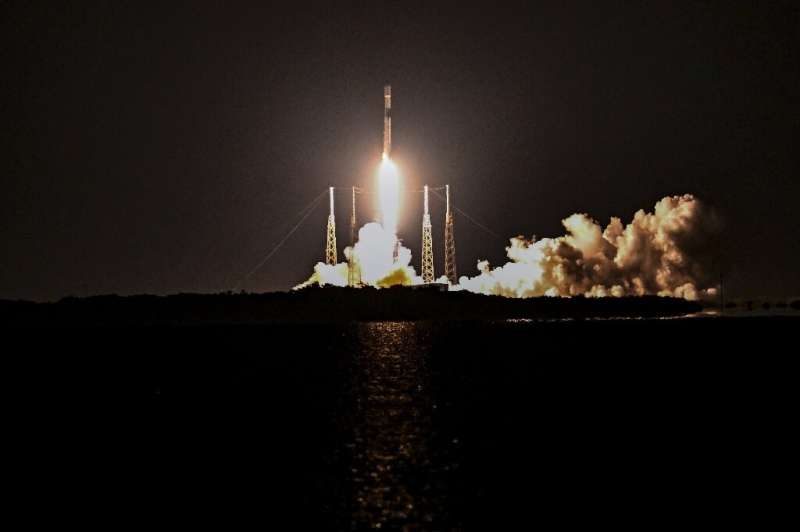
SpaceX is set Wednesday to launch the first private—and Japanese—lander to the Moon.
A Falcon 9 rocket is scheduled to blast off at 3:39 am (0839 GMT) from Cape Canaveral, Florida, with a backup date on Thursday.
Until now, only the United States, Russia and China have managed to put a robot on the lunar surface.
The mission, by Japanese company ispace, is the first of a program called Hakuto-R.
The lander would touch down around April 2023 on the visible side of the Moon, in the Atlas crater, according to a company statement.
Measuring just over 2 by 2.5 meters, it carries on board a 10-kilogram rover named Rashid, built by the United Arab Emirates.
Developing the low-energy ion spectrometer for the Chinese BeiDou-3 satellite
In our daily lives, we rely on weather forecasts to know whether it will rain tomorrow. The monitoring and prediction of space weather such as geomagnetic storms and substorms are also vital for the operation safety of satellites outside the atmosphere and the living conditions of astronauts in space. However, space weather is far more unpredictable than the weather on Earth, which depends on in-situ measurements of plasma parameters by satellites.
A research team, led by Prof. Wang Yuming and Prof. Shan Xu from the University of Science and Technology of China (USTC) of the Chinese Academy of Sciences, developed a low-energy ion spectrometer (LEIS) onboard a Chinese geosynchronous satellite, the BeiDou-3 satellite.
The LEIS is designed for measurement of the ion energy per charge distribution with good energy-, angular-, and temporal-resolutions, which is helpful for space weather monitoring and early warning. Recently, the scientific data acquired by the LEIS were published in Science China Technological Sciences.
Starting in 2012, the research team designed and realized the LEIS payload that meets the requirements of a magnetospheric mission. Through simulation and experimental tests, the LEIS payload had been valuated and calibrated, and it was finally finished in 2017.
Europa's plate tectonic activity is unlike Earth's
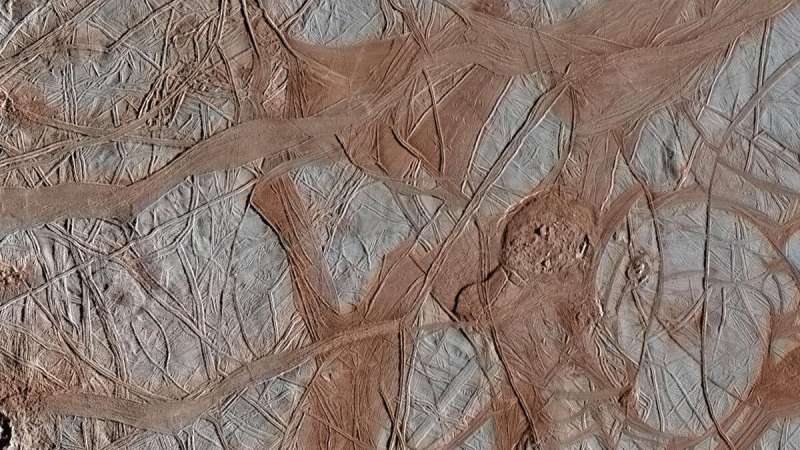
Plate tectonics represents a defining framework of modern geoscience, accounting for large-scale features on Earth's surface, such as mountains and valleys, as well as the processes that shape them, like volcanoes and earthquakes. Present-day plate tectonics have not been observed on any other world in the solar system, and evidence of past activity on planets such as Mars and Venus is circumstantial.
NASA's Juno mission spots two Jovian moons
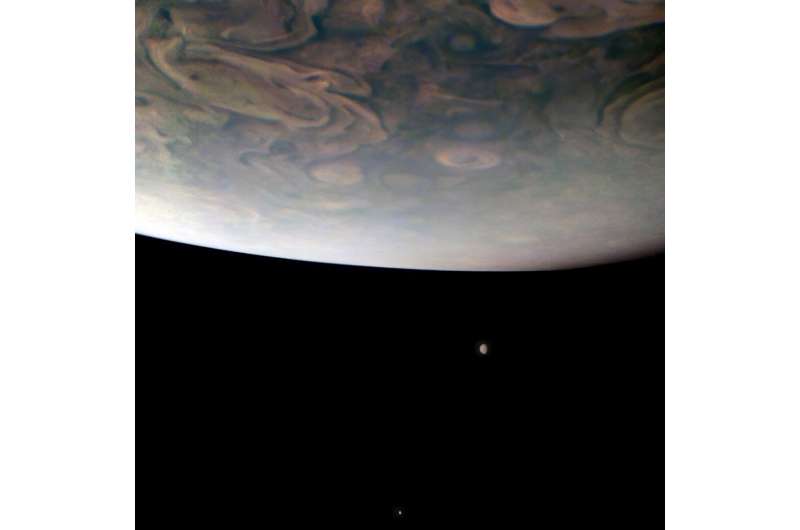
On Nov. 29, 2021, NASA's Juno mission completed its 38th close flyby of Jupiter. As the spacecraft sped low over the giant planet's cloud tops, its JunoCam instrument captured this look at two of Jupiter's largest moons.
In the foreground, hurricane-like spiral wind patterns called vortices can be seen spinning in the planet's north polar region. These powerful storms can be over 30 miles (50 kilometers) in height and hundreds of miles across.
Below Jupiter's curving horizon, two Jovian moons make an appearance: Callisto (below) and Io (above).
Juno will make close flybys of Io in December 2023 and February 2024, the first such close encounters with this intriguing moon in over two decades. Io is the most volcanic body in our solar system, and its eruptions leave a trail of material behind that both fills Jupiter's magnetosphere and creates a torus of gas and dust around Jupiter. During the flybys, Juno will study Io's volcanoes and geology, search for signs of a magma ocean, and investigate how Io interacts with Jupiter's giant magnetosphere.