New technique to determine age will open new era of planetary science
 The coming decade is expected to bring a veritable bonanza for the science of planets: space missions are scheduled to bring back samples of rock from the moon, Mars, the Martian moon of Phobos, and a primitive asteroid. And scientists say there is a new technique for determining the age of rocks, meteorites, and even artifacts, that could help open up a new era of discovery.
A group with
The coming decade is expected to bring a veritable bonanza for the science of planets: space missions are scheduled to bring back samples of rock from the moon, Mars, the Martian moon of Phobos, and a primitive asteroid. And scientists say there is a new technique for determining the age of rocks, meteorites, and even artifacts, that could help open up a new era of discovery.
A group with Webb offers never-before-seen details of early universe
 NASA's James Webb Space Telescope was specially designed to detect the faint infrared light from very distant galaxies and give astronomers a glimpse at the early universe. The nature of galaxies during this early period of our universe is not well known nor understood. But with the help of gravitational lensing by a cluster of galaxies in the foreground, faint background galaxies can be magnifi
 Solar Orbiter’s unprecedented view of the quiet corona
 Video:
00:01:27
Video:
00:01:27
The ESA-led Solar Orbiter mission has experienced its second close encounter with the Sun. It is delivering more stunning data, and at higher resolution than ever before.
The moment of closest approach took place on 12 October at 19:12 UTC (21:12 CEST), when Solar Orbiter was just 29% of the Earth’s distance from the Sun. This movie comes from 13 October, when the spacecraft’s Extreme Ultraviolet Imager (EUI) returned the highest resolution movie of the quiet corona ever taken with any instrument.
Each pixel on this movie spans 105 km on the surface of the Sun. This means that
U.S. national defense strategy calls for ‘resilient, redundant’ space networks

The unclassified version of the U.S. national defense strategy released by the Defense Department Oct. 27 forecasts a decades-long competition with China and lays out priorities for the military going forward.
As clock ticks on Amazon’s constellation, buying Starship launches not out of the question

Amazon VP Dave Limp said the availability of heavy-lift rockets to deploy Project Kuiper satellites is “a constrained resource."
The post As clock ticks on Amazon’s constellation, buying Starship launches not out of the question appeared first on SpaceNews.
As Artemis I launch nears, more Orions on horizon
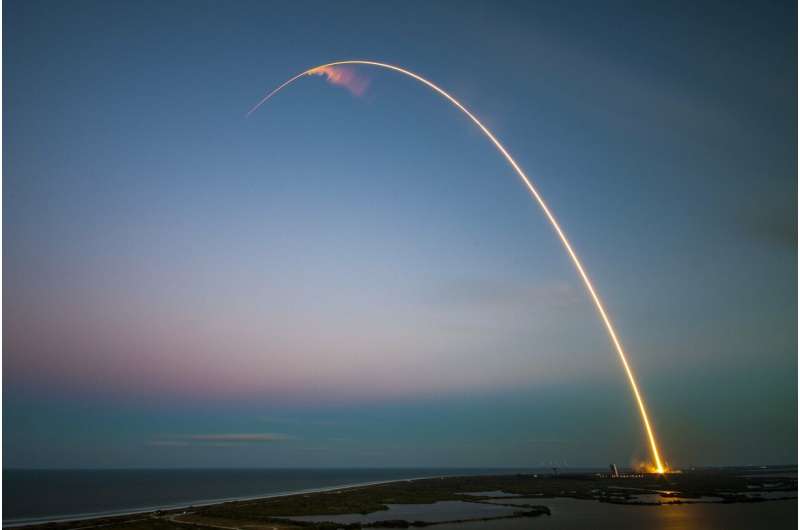
The Orion spacecraft could be on its first trip to the moon on the Artemis I mission in less than a month, but teams at Kennedy Space Center continue to prep the next capsules planned for human missions, the first of which could fly in just over 18 months.
Meanwhile Lockheed Martin, the capsule's prime contractor for the first five Artemis flights won a new NASA contract this month to build out another three spacecraft.
"This order includes spacecraft, mission planning and support, and takes us into the 2030s," said Lisa Callahan, vice president and general manager for Commercial Civil Space at Lockheed Martin. "We're on the eve of a historic launch kicking off the Artemis era and this contract shows NASA is making long-term plans toward living and working on the moon, while also having a forward focus on getting humans to Mars."
Artemis I is targeting its next launch attempt as early as Nov. 14. The flight will send the Space Launch System rocket topped with Orion from KSC's Launch Pad 39-B on a weeks-long mission that will have it orbit the moon several times and fly farther than, and return to Earth faster than any previous human-rated spacecraft.
Major Gomspace satellite customer withholding payments

Gomspace delayed the release of financial results Oct. 27 as the European smallsat maker tries to get a major commercial customer to pay its bills.
The post Major Gomspace satellite customer withholding payments appeared first on SpaceNews.
Russia escalates rhetoric on commercial satellites, calls them ‘legitimate targets for retaliation’

A Russian official said at a UN meeting that commercial space systems "may become a legitimate target for retaliation.”
The post Russia escalates rhetoric on commercial satellites, calls them ‘legitimate targets for retaliation’ appeared first on SpaceNews.
Scientists choose first Mars samples worthy of return to Earth
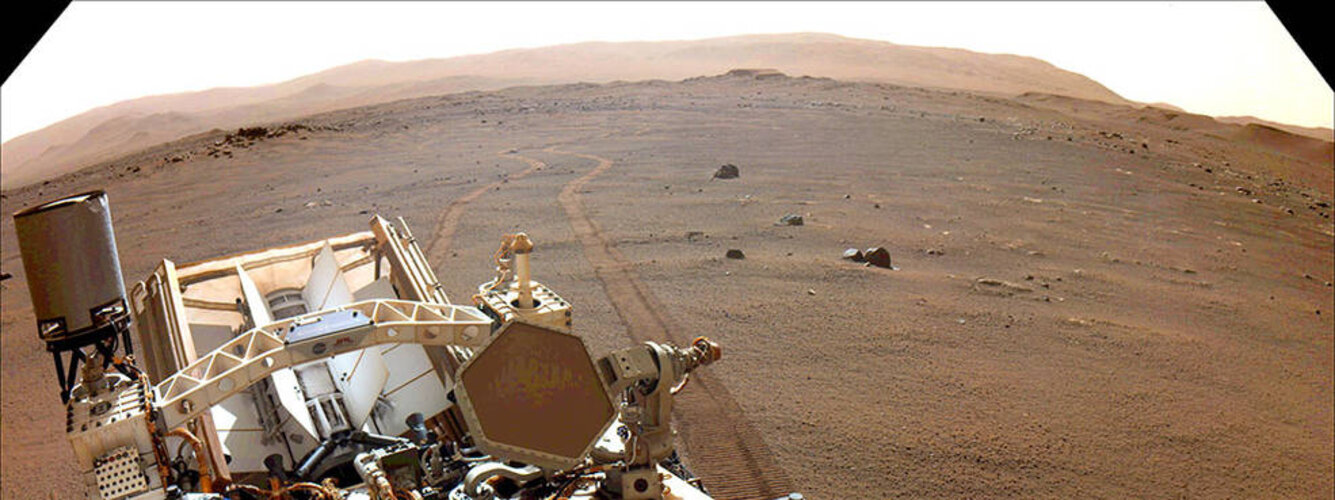
The first samples to be taken from Mars and sent to Earth will be sourced from Jezero Crater, where the Perseverance rover has been exploring the crater floor and nearby ancient delta. The location of an initial cache of samples, called Three Forks, is flat and free of obstacles – an ideal spot for a Mars Sample Return landing and pickup operations.
Mini-radar for asteroid CubeSat
 Image:
Mini-radar for asteroid CubeSat
Image:
Mini-radar for asteroid CubeSat