How scientists predict solar wind speed accurately using multimodality information
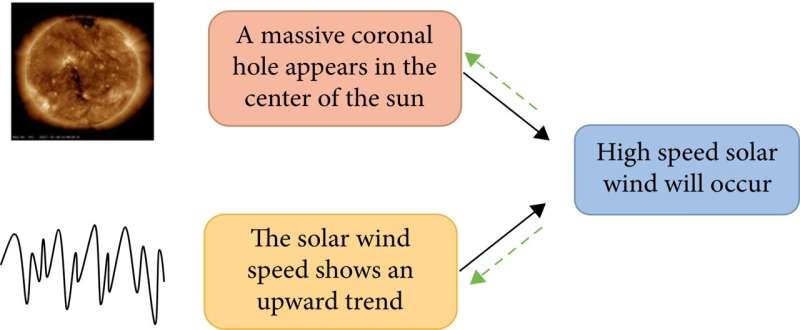
As more and more high-tech systems are exposed to the space environment, space weather prediction can provide better protection for these devices. In the solar system, space weather is mainly influenced by solar wind conditions. The solar wind is a stream of supersonic plasma-charged particles which will cause geomagnetic storms, affect short-wave communications, and threaten the safety of electricity and oil infrastructure when passing over the Earth.
Accurate prediction of the solar wind speed will allow people to make adequate preparations to avoid wasting resources. Most existing methods only use single-modality data as input and do not consider the information complementarity between different modalities.
Uncontrolled rocket reentries are a bigger problem than you think
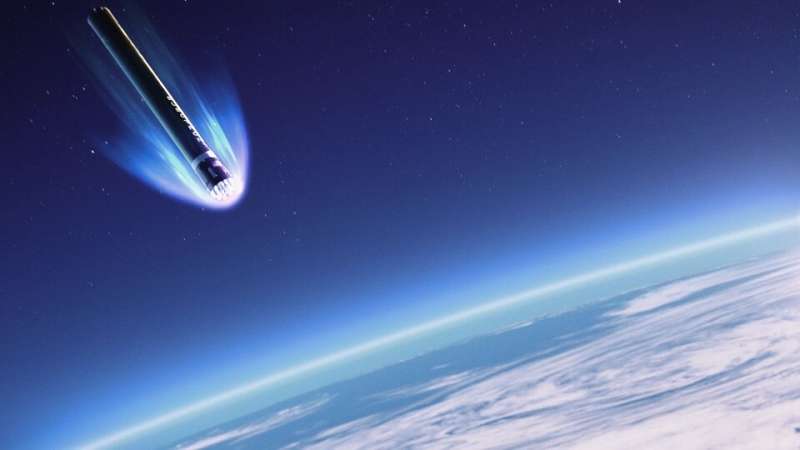
More than 60% of the launches in 2020 resulted in one or more rocket parts making an uncontrolled reentry into the atmosphere. While thankfully no one was hurt by that debris, with the expected rise in rocket launches over the coming decade the chances of a casualty are increasing. A new study paints the picture of how current methods of assessing risk are inadequate and new steps need to be taken.
Rocketry is a complex business. A typical lunch will usually require multiple stages to get the payload into orbit. Most of the time everything goes well, with the individual stages designed to either burn up in the atmosphere or end up on an escape trajectory away from the Earth. But in 2020 alone, 60% of the launches to low Earth orbit ended up with at least one significantly sized rocket part simply abandoned in an uncontrolled orbit.
New research facility houses largest plasma wind tunnel in the US
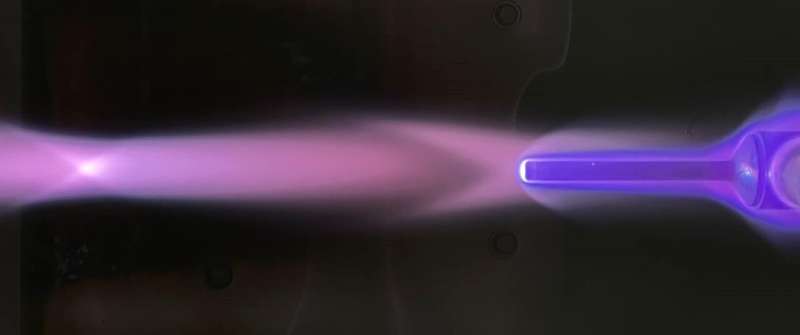
In hypersonic flight, an aircraft or spacecraft moves at least five times faster than the speed of sound—producing extreme heat that can push the craft beyond its physical limits. The difficulty and importance of protecting vehicles against those conditions were tragically illustrated in 2003 when slight damage to heat-shielding tiles caused the Space Shuttle Columbia to disintegrate while re-entering Earth's atmosphere.
A unique experimental facility at the University of Illinois Urbana-Champaign will help ensure that such a tragedy is never repeated—and enable unprecedented new adventures in space exploration.
The Plasmatron X is the largest inductively coupled plasma wind tunnel in the United States.
SDA slide reveals Tranche 0 optical terminal manufacturers
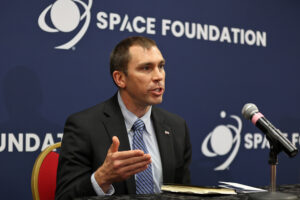
“I'm going to do competitions for every Tranche, every layer, every time and it's going to be full and open,” Space Development Agency director Derek Tournear said. “The only way we can do that is if I make sure all the satellites work together as a network.
NASA gives green light for space station spacewalks to resume
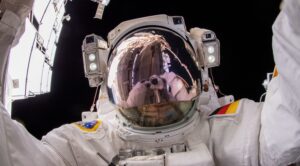
NASA is ready to resume spacewalks outside the International Space Station after completing an investigation of water found in a spacesuit during a spacewalk earlier this year.
The post NASA gives green light for space station spacewalks to resume appeared first on SpaceNews.
Inmarsat sale clears Australia’s foreign investment watchdog
Viasat said Oct. 18 it got the nod from Australia’s foreign investment regulator to take over Inmarsat, although the deal remains subject to regulatory approvals elsewhere.
The post Inmarsat sale clears Australia’s foreign investment watchdog appeared first on SpaceNews.
Canada to contribute satellite and instruments to NASA-led Earth science mission
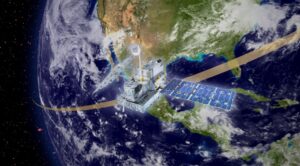
The Canadian government announced Oct. 18 it will fund development of a satellite and instruments for a NASA-led Earth science program.
The post Canada to contribute satellite and instruments to NASA-led Earth science mission appeared first on SpaceNews.
Webb takes a stunning, star-filled portrait of the Pillars of Creation
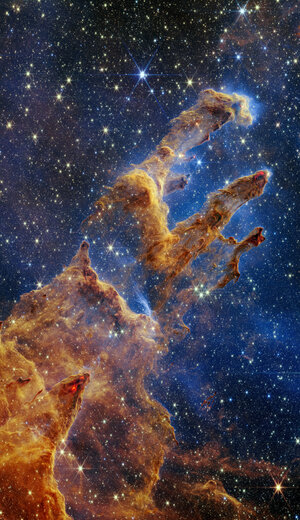
The NASA/ESA/CSA James Webb Space Telescope has captured a lush, highly detailed landscape – the iconic Pillars of Creation – where new stars are forming within dense clouds of gas and dust. The three-dimensional pillars look like majestic rock formations, but are far more permeable. These columns are made up of cool interstellar gas and dust that appear – at times – semi-transparent in near-infrared light.
Life may have thrived on early Mars, until it drove climate change that caused its demise
 If there ever was life on Mars - and that's a huge "if" - conditions during the planet's infancy most likely would have supported it, according to a study led by University of Arizona researchers. Dry and extremely cold, with a tenuous atmosphere, today's Mars is extremely unlikely to sustain any form of life at the surface. But 4 billion years ago, Earth's smaller, red neighbor may have been mu
 The UK is about to have its first space launch
 Virgin Orbit, a US company which provides launch services for satellites, has announced that the first orbital space mission from the UK will blast off from Cornwall. The rocket, which will carry nine satellites, along with a launch aircraft have been delivered by an RAF C-17 - a military, heavy-lift strategic transport plane.
This is primed to be a new phase for the UK and its involvement
Virgin Orbit, a US company which provides launch services for satellites, has announced that the first orbital space mission from the UK will blast off from Cornwall. The rocket, which will carry nine satellites, along with a launch aircraft have been delivered by an RAF C-17 - a military, heavy-lift strategic transport plane.
This is primed to be a new phase for the UK and its involvement