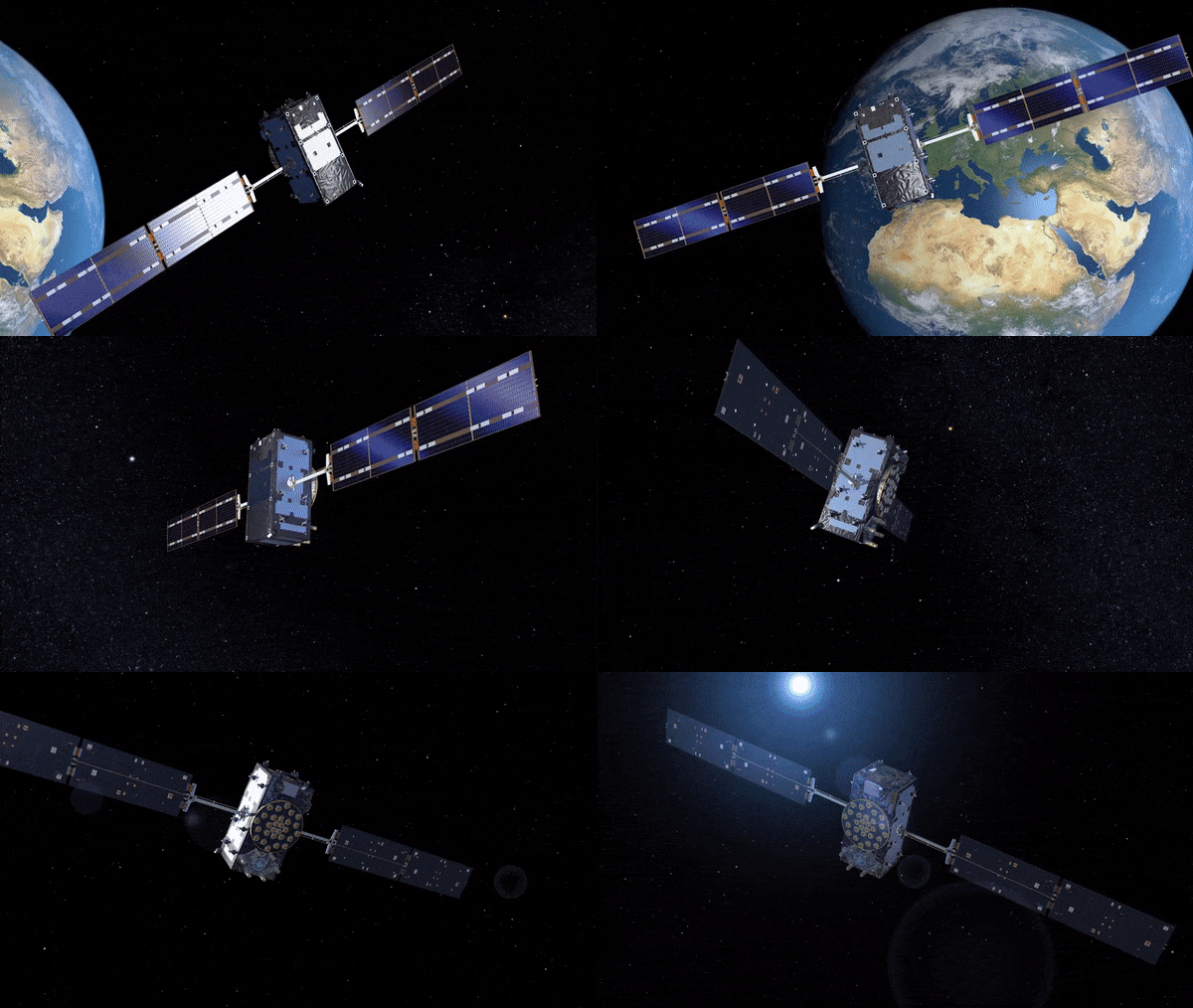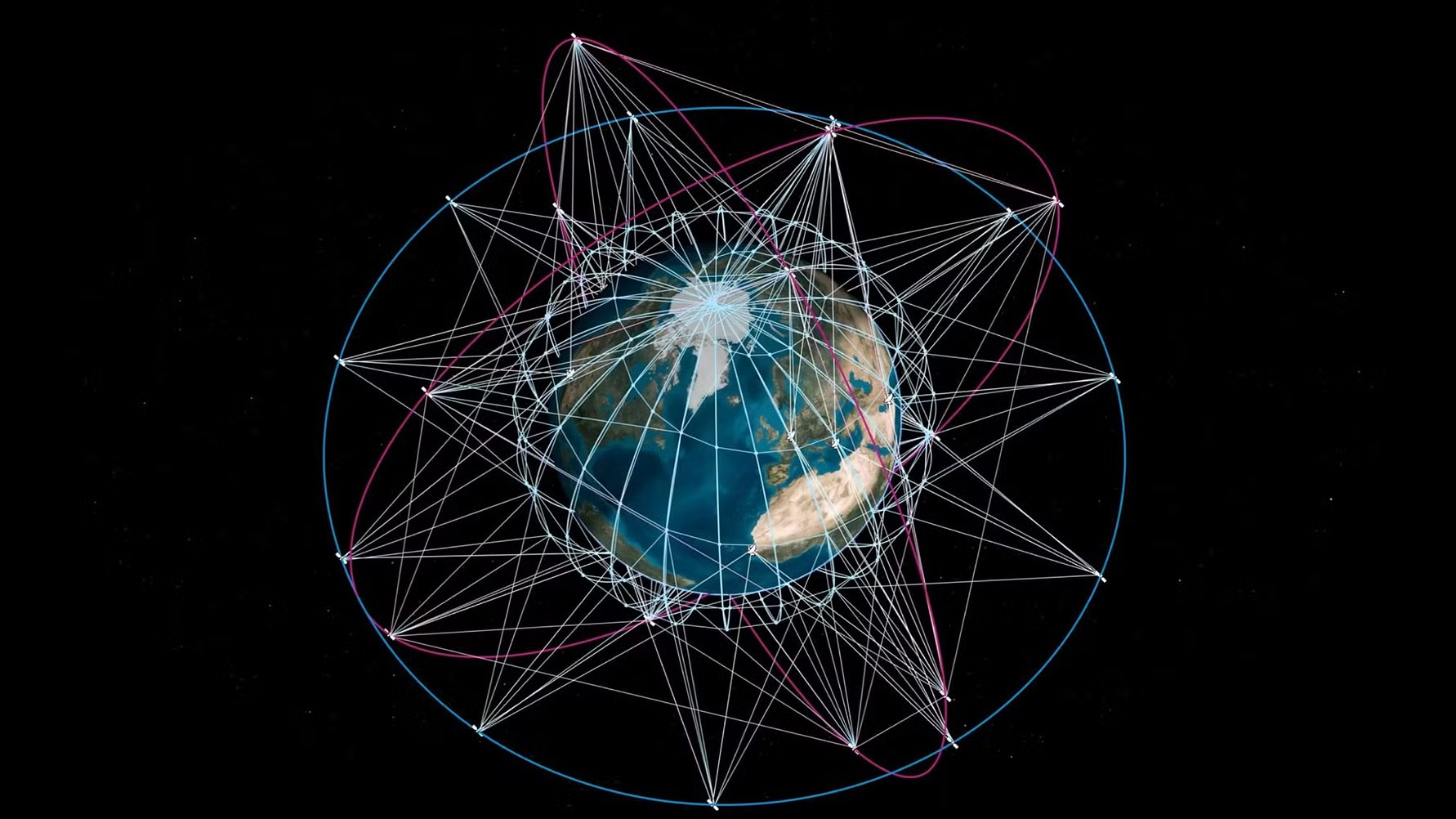
Ariane 6 stands tall on its launch pad

The Ariane 6 launch pad at Europe’s Spaceport in French Guiana now hosts for the first time a fully assembled example of ESA’s new heavy-lift rocket, following the addition of an upper composite to the core stage and four boosters already in place. The upper composite – consisting of two half-fairings and a payload mock-up with the structural adapter needed to join it to the core stage – made the 10 km trip from the encapsulation building to launch pad on 12 October.
China considering mission to Ceres and large dark matter space telescope

The Chinese Academy of Sciences is considering potential missions including a Ceres orbiter and a huge telescope to hunt for clues about the nature of dark matter.
The post China considering mission to Ceres and large dark matter space telescope appeared first on SpaceNews.
British institutions join search for answers on early universe
 Six British academic institutions will join a U.S.-led search for answers on the early universe.
The project brings together 85 institutions from 13 countries to analyze data from the Simons Observatory, a series of telescopes 3.2 miles above Chile's Atacama desert. The observatory has three instruments that are designed to measure cosmic microwave background, the heat and radiation tha
Six British academic institutions will join a U.S.-led search for answers on the early universe.
The project brings together 85 institutions from 13 countries to analyze data from the Simons Observatory, a series of telescopes 3.2 miles above Chile's Atacama desert. The observatory has three instruments that are designed to measure cosmic microwave background, the heat and radiation tha U.S. military waiting for industry to demonstrate space transportation concepts

U.S. Transportation Command is keeping an eye on space launch companies as they develop technology and mature concepts for point-to-point cargo delivery.
The post U.S. military waiting for industry to demonstrate space transportation concepts appeared first on SpaceNews.
SES to appeal Intelsat C-band sharing decision

SES filed plans Oct. 14 to appeal a court’s decision last month that disallowed its bid to equally split nearly $9 billion of anticipated C-band clearing proceeds with Intelsat.
The post SES to appeal Intelsat C-band sharing decision appeared first on SpaceNews.
Satellite broadband players poised to compete for U.S. military customers
While Starlink continues to build momentum in the U.S. defense market, other industry players are positioning to compete for military customers
The post Satellite broadband players poised to compete for U.S.
Researching the effects of simulated space habitats on crews under controlled and isolated conditions

Current international human space exploration roadmaps envisage month-long crew stays on the moon within the next few decades, with crewed missions to Mars the long term goal. The psychological effects of human spaceflight, especially in the sense of isolation and confinement, need to be explored ahead of deep space crewed missions.
To allow astronauts not only to survive but to thrive in alien environments, practice is needed. Practice involves operations on the ISS, but the ISS cannot simulate all aspects of a Lunar or Martian mission, such as the surface operations or long periods without sunlight. Therefore, research is being carried out under controlled and isolated conditions within simulated space habitats, to gain insights into the effects of such conditions on the research subjects and their impacts on crews' well-being and success.
Similarly, an analog environment cannot fully replicate that of the moon or Mars, but a variety of analog environments that simulate different aspects of the off-world environment can be used in conjunction to prepare for future missions.
First NASA asteroid sample return mission on track for fall '23 delivery
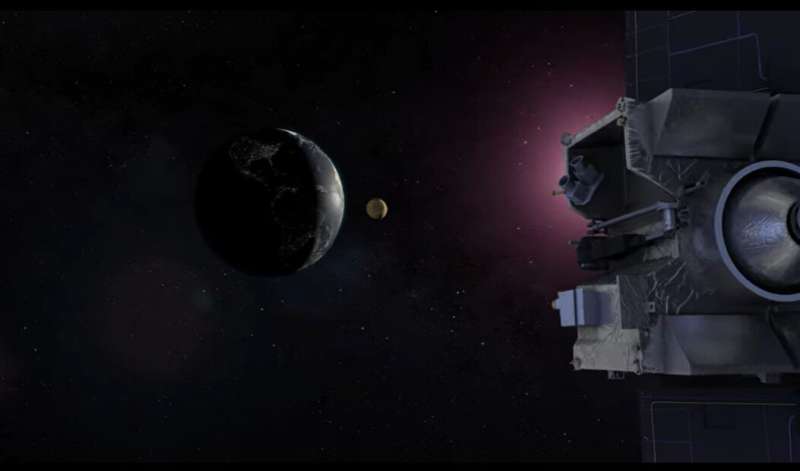
NASA's first asteroid sample return spacecraft, OSIRIS-REx, fired its thrusters for 30 seconds on Sept. 21 and nudged its trajectory toward Earth. The resulting course correction keeps the vehicle on track to deliver a sample of asteroid Bennu to Earth on Sept. 24, 2023, completing a seven-year mission.
The delivery itself, however, is not a simple parcel drop on Earth's front doorstep: NASA's OSIRIS-REx—formally the Origins Spectral Interpretation Resource Identification Security—Regolith Explorer—must approach Earth at a precise speed and direction to deliver its sample return capsule into Earth's atmosphere. "If the capsule is angled too high, it will skip off the atmosphere," said Mike Moreau, OSIRIS-REx deputy project manager at NASA's Goddard Space Flight Center in Greenbelt, Maryland. "Angled too low, it will burn up in Earth's atmosphere."
To ensure a safe delivery, "Over the next year, we will gradually adjust the OSIRIS-REx trajectory to target the spacecraft closer to Earth," said Daniel Wibben, trajectory-and-maneuver design lead with KinetX Inc.
Astronaut James McDivitt, Apollo 9 commander, dies at 93
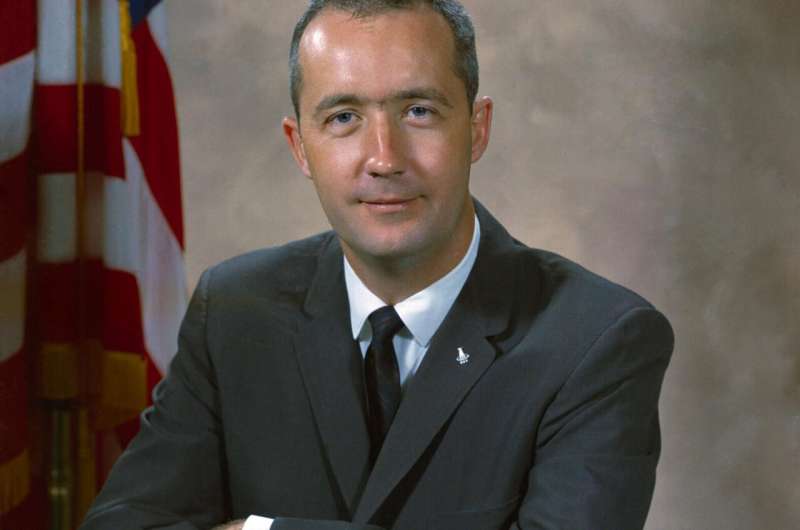
James A. McDivitt, who commanded the Apollo 9 mission testing the first complete set of equipment to go to the moon, has died. He was 93.
McDivitt was also the commander of 1965's Gemini 4 mission, where his best friend and colleague Ed White made the first U.S.
Phase Four unveils game changing engine for LEO constellations
 Phase Four, the creator of the radio-frequency thruster for satellite propulsion, reports that it will expand its Maxwell turn-key plasma propulsion line and offer satellite manufacturers an industry-first high performance engine using an inexpensive, domestically sourced iodine-based propellant. Max-V leverages the Maxwell Block 2 engine's innovative architecture and builds on the radio-frequen