Chinese military deeply alarmed over Starlink's dual-use capabilities
 Beijing's concerns echo criticisms of the South African-born billionaire's satellite internet system by Russia. On Sunday, Roscosmos chief Dmitry Rogozin warned that Elon Musk would be held accountable for supplying Starlink internet terminals to neo-Nazi militants fighting in Ukraine.
SpaceX's plans to increase the constellation of Starlink internet satellites from 12,000 to 42,000 "shoul
Beijing's concerns echo criticisms of the South African-born billionaire's satellite internet system by Russia. On Sunday, Roscosmos chief Dmitry Rogozin warned that Elon Musk would be held accountable for supplying Starlink internet terminals to neo-Nazi militants fighting in Ukraine.
SpaceX's plans to increase the constellation of Starlink internet satellites from 12,000 to 42,000 "shoul DOD focused on hypersonic missile defense development, Admiral Says
 Cruise missiles follow unpredictable flight paths and are now capable of supersonic and hypersonic speeds. Russia and China are developing advanced cruise missiles that can be launched from aircraft, ground launchers and ships or submarines, along with hypersonic missile capabilities.
Navy Vice Adm. Jon A. Hill, director, Missile Defense Agency, discussed the defense against these missiles
Cruise missiles follow unpredictable flight paths and are now capable of supersonic and hypersonic speeds. Russia and China are developing advanced cruise missiles that can be launched from aircraft, ground launchers and ships or submarines, along with hypersonic missile capabilities.
Navy Vice Adm. Jon A. Hill, director, Missile Defense Agency, discussed the defense against these missiles Scientists succeed for first time growing plants in soil from the moon
 Scientists have managed to grow plants in lunar soil for the first time ever, setting the stage for astronauts to potentially grow their own food on the moon during future missions.
University of Florida researchers were able to grow the plants in small samples of lunar soil - also known as lunar regolith - gathered during the Apollo 11, 12 and 17 missions in the 1960s and 1970s. But
Scientists have managed to grow plants in lunar soil for the first time ever, setting the stage for astronauts to potentially grow their own food on the moon during future missions.
University of Florida researchers were able to grow the plants in small samples of lunar soil - also known as lunar regolith - gathered during the Apollo 11, 12 and 17 missions in the 1960s and 1970s. But World View partners with SET to collect scientific data on earth's stratosphere
 World View, the leading stratospheric ballooning and space tourism company, has announced a partnership with Space Environment Technologies (SET) to include a suite of technologies aboard World View space capsules that will measure space radiation and other forms of data about Earth's atmosphere. SET's system, coined ARMAS (for "Automated Radiation Measurements for Aerospace Safety"), will accom
  Image:
Fly far, fly true
Image:
Fly far, fly true Gaia – ESA’s billion star surveyer
 Video:
00:01:00
Video:
00:01:00
ESA’s Gaia space telescope revolutionises our understanding of the Milky Way. It scans the sky to measure the position, movement, distance, and characteristics of billions of stars. It is creating the most precise map of our home galaxy yet, providing clues to its origin and evolution. Gaia not only studies the stars, but also what is in between them, as well as asteroids and planetary moons in our Solar System, binary stars and exoplanets, and quasars and galaxies outside of the Milky Way. Gaia provides us with a wealth of data, giving us a new sense of
Inmarsat agrees plan to move ground station out of the Netherlands
Inmarsat is seeking permission from Greece to move a ground station there from the Netherlands, which wants to sell the C-band spectrum the site uses for maritime safety services to 5G wireless operators.
The post Inmarsat agrees plan to move ground station out of the Netherlands appeared first on SpaceNews.
Moon goes blood red this weekend: 'Eclipse for the Americas'
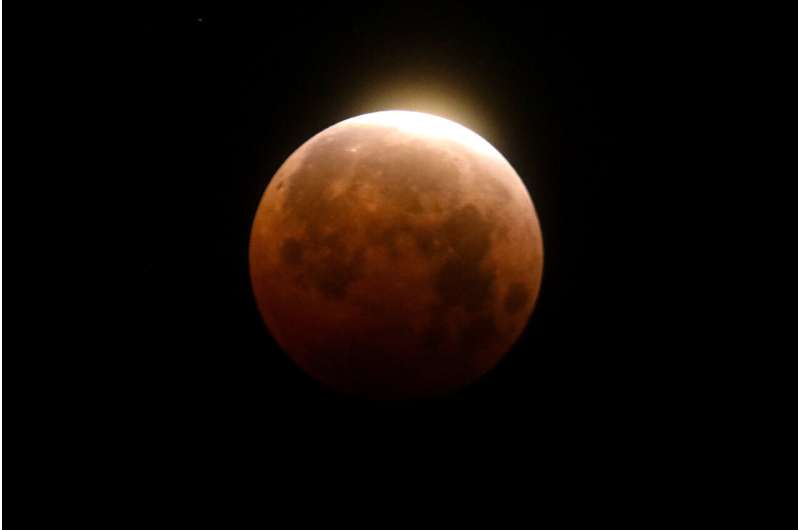
Image: Penultimate sunset at Concordia research station
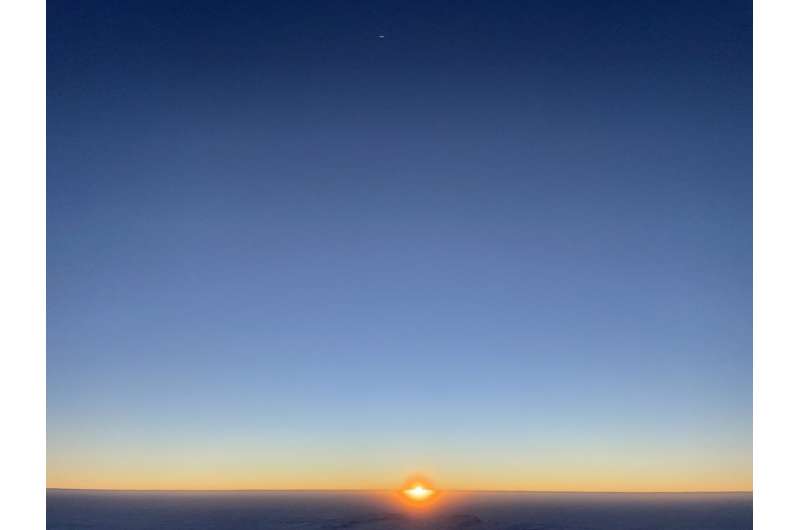
The penultimate sunset at Concordia research station in Antarctica marks the beginning of a very exciting time for the 12-member crew: the coming of Antarctic night and the winter-over.
Medical doctor Hannes Hagson and his crew mates are finally embarking on their "real" mission in Antarctica: living and work in isolation for six months in the name of spaceflight research.
The Italian-French outpost Concordia is located 3,233 m above sea level where temperatures can drop to –80°C in the complete frozen darkness outside. The sun disappears behind the horizon for four months. No supplies or people can be flown in during the winter months; and the high altitude causes the crew to experience chronic hypobaric hypoxia or lack of oxygen in the brain.
These conditions are as close to living on another planet as humans can get on Earth.
For this reason, Hannes is facilitating biomedical experiments on himself and his crewmates to understand how humans cope with living in extreme isolation. From sleep studies to gut health measurements to mindful practices, the crew are poked and prodded to help researchers understand and overcome the challenges extreme environments, like space, pose to present and future explorers.
Pace of work put strain on private astronaut mission to ISS
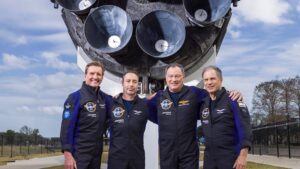
The private astronauts who spent two weeks on the International Space Station in April said they tried to pack too much into their schedules while on the station, putting a strain on both themselves and the professional astronauts there.