

Orbital Assembly and Irvine to study health on ISS for 100 Year Starship project
 Orbital Assembly Corporation (OAC), the only company advancing the development and operation of the first commercially viable, space-based business park with gravity, is partnering with the 100 Year Starship initiative, seed-funded by DARPA, founded and led former astronaut Dr. Mae Jemison. University of California Irvine professor Ronke Olabisi, Ph.D. will also collaborate on the study of Gravi
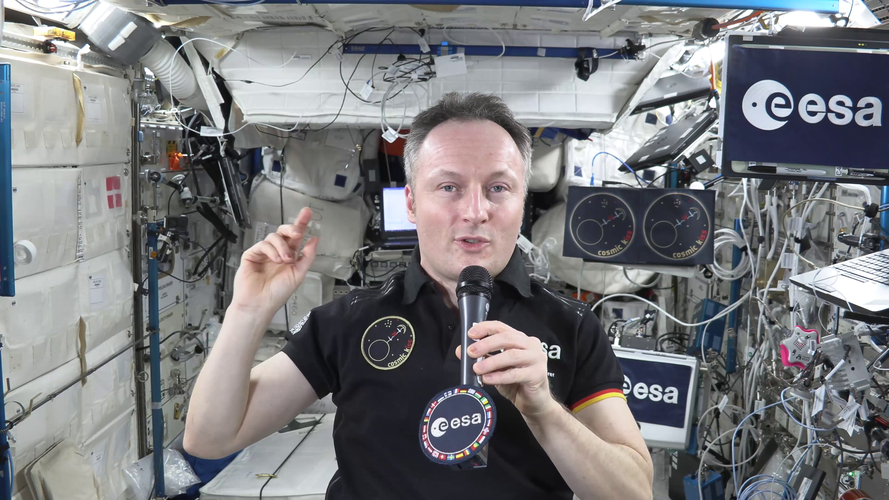
 Matthias's first spacewalk | Cosmic Kiss
 Video:
00:16:36
Video:
00:16:36
English Matthias's first spacewalk | Cosmic Kiss
On 23 March 2022, ESA astronaut Matthias Maurer successfully performed his first extravehicular activity (EVA) alongside fellow NASA astronaut Raja Chari. The spacewalk, dubbed "US EVA 80", was carried out in support of assembly, refurbishment and maintenance work on the International Space Station.
In this video, Matthias Maurer answers questions and reports on his experiences, feelings and the challenges he faced during his almost seven-hour-long spacewalk.
During his Cosmic Kiss mission, Matthias Maurer will live and work aboard the International Space Station for approximately six months, conducting and supporting more than 35 European
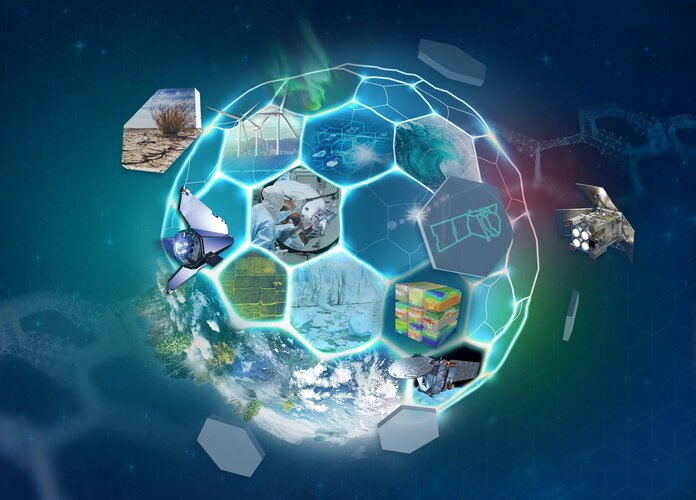
Join online: Earth Observation Industry Day 13 May
Earth Observation Industry Day
Join online and learn about ESA's Ministerial Council plans for TRUTHS and FutureEO, 13 May
NASA shifts Earth science mission to previously flown Falcon 9

NASA’s embrace of reused rockets continued with an agreement this month to switch the upcoming launch of an Earth science satellite from a new to a previously flown Falcon 9, a change whose full terms remain proprietary.
Russian invasion of Ukraine exposes cybersecurity threat to commercial satellites
Cybersecurity experts have been warning for years of increasing attacks on commercial satellites and working with companies to enhance security.
The post Russian invasion of Ukraine exposes cybersecurity threat to commercial satellites appeared first on SpaceNews.
Pop goes the Moon
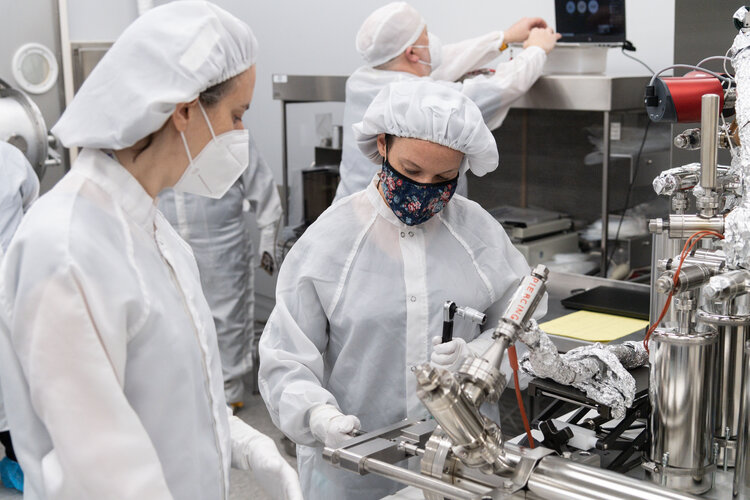 Image:
A satisfying, audible ‘pop’ marked a successful piercing of the sealed Apollo 17 sample container using the ESA designed and built piercing tool. The tool forms part of a gas sampling system with a gas extraction manifold, designed and built by Washington University St Louis, USA.
Francesca McDonald, science and project lead of ESA’s contribution to the Apollo Next-Generation Sample Analysis (ANGSA) programme, is pictured at the centre of this image with the piercing tool, which contains the pristine sample.
Francesca and colleague, Timon Schild, delivered the ESA piercing tool to NASA’s Johnson Space Center in late 2021 in preparation
Industry Space Days 2022: join Europe’s space community at ESA/ESTEC

Register now to attend ESA’s Industry Space Days (ISD) at the European Space Research and Technology Centre (ESTEC) in Noordwijk, the Netherlands, on 28–29 September 2022.
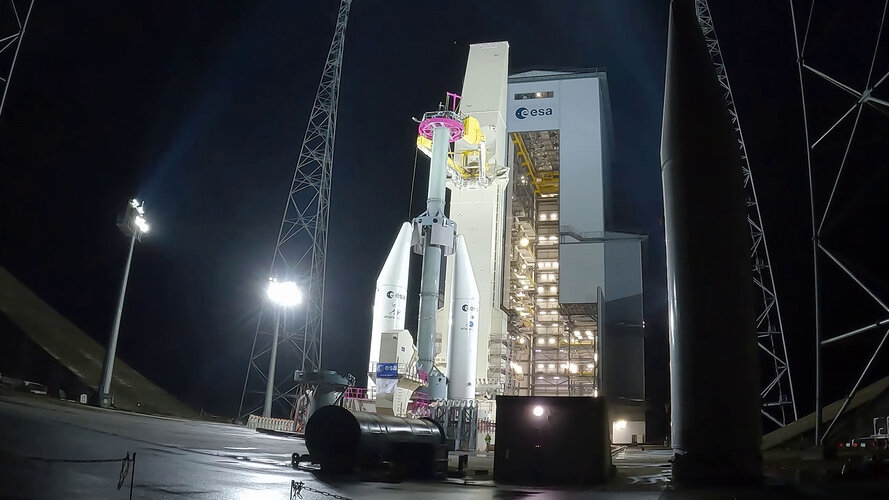
Ariane 6 cryo-arms mimic liftoff
 Video:
00:01:24
Video:
00:01:24
Europe’s Spaceport in French Guiana is preparing for the arrival of Ariane 6, ESA’s new heavy-lift rocket. The latest round of testing aims to validate the system of fuel lines and mechanical supporting arms that will keep Ariane 6 topped up with liquid hydrogen and liquid oxygen in the critical moments before liftoff. This work is part of the final preparations of the new Ariane 6 launch complex and all the systems necessary for a launch.
With the mobile gantry fully retracted – as for a launch – two articulated arms attached to the upper part of the
CAPSTONE cubesat ready for cislunar mission

NASA’s intention to replant bootprints on the moon is getting a kick-start by the launch of a microwave oven-sized smallsat, the Cislunar Autonomous Positioning System Technology Operations and Navigation Experiment, called CAPSTONE for short.
Capella unveils automated tasking products

Capella Space unveiled three products April 14 that automate tasking of the company’s constellation of synthetic aperture radar (SAR) satellites.
The post Capella unveils automated tasking products appeared first on SpaceNews.


