Oldest evidence of Mayan calendar found in Guatemala
 The oldest evidence of the Maya calendar has been excavated at San Bartolo, Guatemala, found among fragments of painted murals.
Acording to a new study, two fragments with a "7 deer" date notation date to between 300 and 200 BCE, based on radiocarbon dating.
Authors of the study said that the finding "represents a day in the 260-day divinatory calendar used throughout Mesoamerica
The oldest evidence of the Maya calendar has been excavated at San Bartolo, Guatemala, found among fragments of painted murals.
Acording to a new study, two fragments with a "7 deer" date notation date to between 300 and 200 BCE, based on radiocarbon dating.
Authors of the study said that the finding "represents a day in the 260-day divinatory calendar used throughout Mesoamerica Diverse life forms may have evolved earlier than previously thought
 Diverse microbial life existed on Earth at least 3.75 billion years ago, suggests a new study led by UCL researchers that challenges the conventional view of when life began.
For the study, published in Science Advances, the research team analysed a fist-sized rock from Quebec, Canada, estimated to be between 3.75 and 4.28 billion years old. In an earlier Nature paper*, the team found tiny
Diverse microbial life existed on Earth at least 3.75 billion years ago, suggests a new study led by UCL researchers that challenges the conventional view of when life began.
For the study, published in Science Advances, the research team analysed a fist-sized rock from Quebec, Canada, estimated to be between 3.75 and 4.28 billion years old. In an earlier Nature paper*, the team found tiny Hughes announces distribution agreement with OneWeb Technologies
 Hughes Network Systems, LLC (HUGHES), an innovator in satellite and multi-transport technologies and networks for 50 years, has announced it signed a distribution agreement with OneWeb Technologies Inc., a wholly owned subsidiary of OneWeb, to deliver managed Low Earth Orbit (LEO) services to the U.S. Department of Defense (DoD). The agreement follows the launch of the industry's first managed L
 MetOp-SG-B weather satellite: Scatterometer flies through tests
 The flight model of the Scatterometer Antenna Subsystem (SAS) of the MetOp Second Generation meteorological satellites has been officially delivered after four months of extensive testing at the Airbus facility in Madrid. It will now be transferred to Airbus in Friedrichshafen (Germany) where it will be integrated into the satellite along with the other instruments.
The SAS protoflight mod
The flight model of the Scatterometer Antenna Subsystem (SAS) of the MetOp Second Generation meteorological satellites has been officially delivered after four months of extensive testing at the Airbus facility in Madrid. It will now be transferred to Airbus in Friedrichshafen (Germany) where it will be integrated into the satellite along with the other instruments.
The SAS protoflight mod Far side: the moon’s use as a new astronomical site

Astronomers have always sought out remote and isolated spots from which their precision observations of the surrounding universe can be made. Now, add one more far-flung location – the moon.
The post Far side: the moon’s use as a new astronomical site appeared first on SpaceNews.
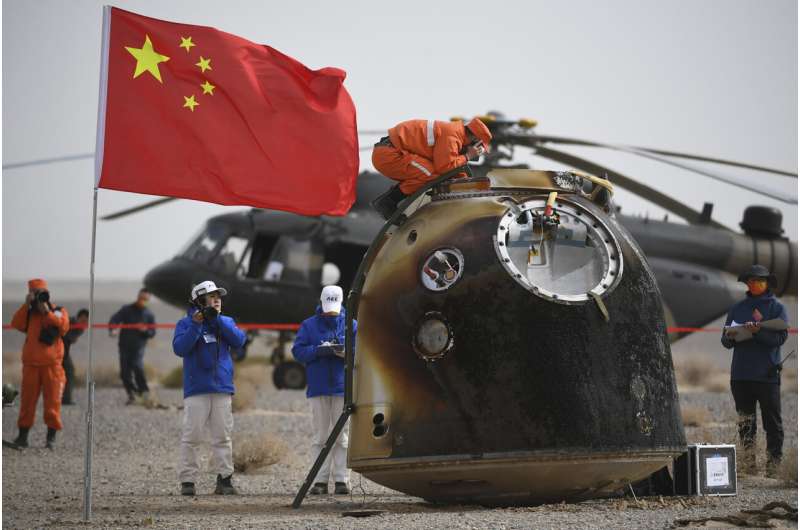
Shenzhou-13 astronauts return to Earth after 182-day mission

Three astronauts safely returned to Earth April 15 after spending a national record 182 days in orbit, completing China’s second crewed space station mission.
On National Security | The moon emerging as the next frontier for military operations

As NASA pushes forward to get humans back on the moon, questions have emerged on what this means for the Space Force and what role it might play in lunar activities.
NASA to roll back SLS for repairs
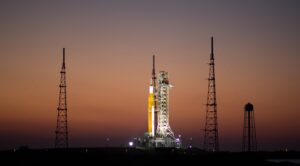
NASA announced late April 16 it will roll back the Space Launch System from the launch pad for various repairs, further delaying the rocket's long-anticipated first launch.
The post NASA to roll back SLS for repairs appeared first on SpaceNews.
SpaceX launches NROL-85 spy satellite for U.S. National Reconnaissance Office

SpaceX Falcon 9 rocket launched a U.S. National Reconnaissance Office spy satellite into orbit April 17 from Vandenberg Space Force Base, California
China sending up next space station crew in June