



What does the future of the Science Programme look like?
In the coming years, ESA will continue to operate the Cosmic Vision missions currently in space, whilst finalising those that haven’t yet left Earth. This includes readying Smile and Plato for launch in 2026 .
Simultaneously, but with a longer-term outlook, the new budget will help shape ESA's Voyage 2050 missions, for which ESA will work closely with science communities across ESA's 23 Member States. Together, we will define exciting new missions through an open, competitive process that lies at the heart of the Science Programme.
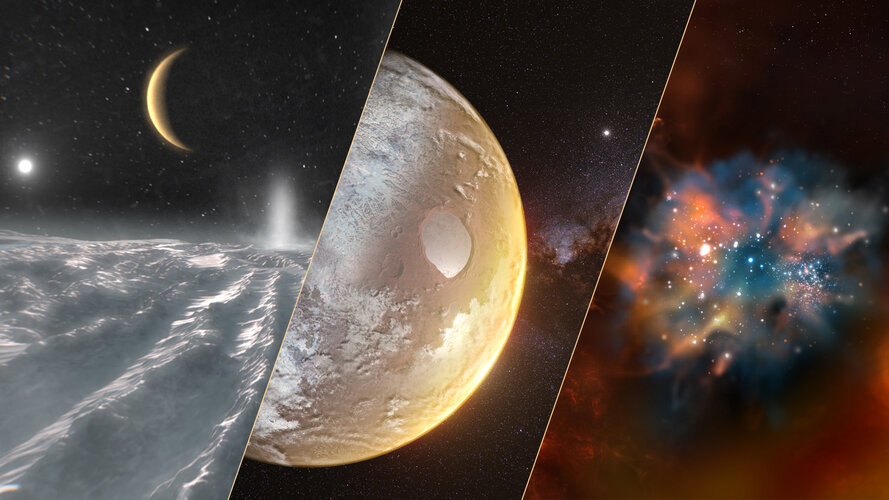
As headlined at CM25, the focus will be on moving forward with the fourth large-class mission, which will travel to Saturn, tour its icy moons and land on Enceladus to seek signs of life. While the mission concept is already in place, scientists and engineers will work together to develop the instruments and other technologies still needed to make this mission possible.
Member State industries are a critical pillar of ESA science mission success. Ambitious missions drive the invention of state-of-the-art technologies, and build new capability in national industries and economies. The insightful data ESA's future missions collect will be delivered into the hands of researchers across our Member States and, ultimately, around the world, allowing them to make breakthrough discoveries in astrophysics, planetary science, cosmology and heliophysics.
“The excellence of ESA's Science Programme is an ideal vehicle for international collaboration and partnership,” said Carole.
“Over the past 50 years since the founding of the European Space Agency, the Scientific Programme has matured to be a world leader, demonstrating Europe’s ability to innovate, inspire and deliver. The decisions taken at CM25 put us on the path to shape the next 25 years of European global leadership and international cooperation in frontier space science and technology.”