

ISS transition to commercial stations poses challenges for partners

NASA’s plans to shift from the International Space Station to commercial space stations may force one key partner to rethink how it cooperates in low Earth orbit.
The post ISS transition to commercial stations poses challenges for partners appeared first on SpaceNews.
U.S. and Europe say space cooperation with Russia not affected yet by Ukraine crisis
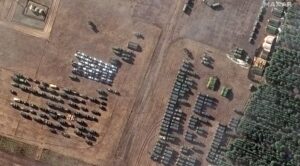
American and European officials said Feb. 23 that space cooperation with Russia remains unaffected even as that country continues to threaten a full-scale invasion of Ukraine.
The post U.S. and Europe say space cooperation with Russia not affected yet by Ukraine crisis appeared first on SpaceNews.
Space Force procurement command trying to bring ‘unity of effort’ to space programs

Claire Leon, a former Boeing executive who previously led the national security space launch program, is now in charge of a new office that will coordinate military space programs.
The post Space Force procurement command trying to bring ‘unity of effort’ to space programs appeared first on SpaceNews.
Is Marscrete the answer to building on Mars?

How can we build on Mars? A casual chat with a geologist led a University of Canterbury (UC) engineering academic and his team to spend years researching how to build on Mars. It all started with Associate Professor Allan Scott and Geology Professor Chris Oze (Occidental College) pondering what materials were available on Mars to make concrete or "Marscrete."
Earthly concrete is made with Portland cement, which is produced by heating limestone to drive off the CO2. Cement, the main binder, is mixed with sand, stone, and water to create concrete.
But the pressing question is: What is available on Mars to bind the materials of Marscrete together?
"Unfortunately, on Mars there is not a lot of limestone so we are looking at alternative ways to find some sort of binder system," says Associate Professor Allan Scott.
Dog kennel hit by meteorite sells at auction
A Christie's auction of rare meteorites Wednesday sold a rock from space that narrowly missed a German Shepherd when it smashed into his kennel in Costa Rica.
But the offer of the third-largest piece of Mars on Earth failed to make an impact at the auction house's annual sale of unusual meteorites.
The buyer paid $21,420 for the three-by-1.5 inch (eight-by-four centimeter) carbonaceous chondrite stone that landed in the garden of dog Roky's owner's home in Aguas Zarcas in April 2019.
The wood and tin doghouse itself, complete with a seven-inch hole marking where the meteorite punctured the roof, sold separately for $44,100, Christie's said.
That was much less than the pre-sale estimate of between $200,000 and $300,000.
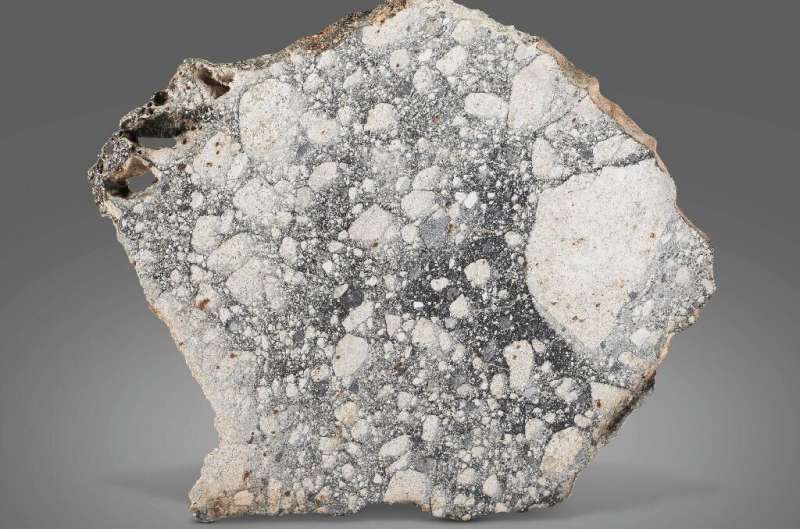
A bidder paid $189,000 for a chunk of lunar rock that was discovered in Morocco in 2007, below pre-sale estimates of up to $300,000.
Another slice of the Moon—found in the Sahara desert in Mauritania—fetched $69,300 during the two-week online sale that ended Wednesday.
The rise and fall of the riskiest asteroid in a decade

Meet the Experts: The James Webb Space Telescope
 Video:
00:12:24
Video:
00:12:24
Are you curious to know how a telescope works? Join ESA astronomer Giovanna Giardino as she gives an insight into the inner workings of the world’s largest telescope in space, the extraordinary James Webb Space Telescope.
Find more episodes in the Meet the Experts series here.
Globalstar selects MDA and Rocket Lab for new satellites
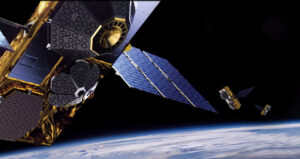
Globalstar has selected MDA Ltd. and Rocket Lab to supply a set of satellites to replenish its constellation, funded by a mystery customer.
The post Globalstar selects MDA and Rocket Lab for new satellites appeared first on SpaceNews.
NRO warns satellite operators of possible Russian attacks

The director of the National Reconnaissance Office, Christopher Scolese, warned that Russia’s military could target satellites in space to disrupt communications and GPS services.
The post NRO warns satellite operators of possible Russian attacks appeared first on SpaceNews.


