
Advanced analysis of Apollo sample illuminates Moon's evolution, cooling
 Sophisticated analysis of a rock sample taken from the Moon during the Apollo 17 mission revealed new information about the complex cooling and evolutionary history of the Moon. The findings, from University of Hawai'i (UH) at Manoa researchers, were published in Nature Communications.
Apollo 17 astronauts collected the rock sample troctolite 76535 from the Moon's surface in 1972, and it r
Sophisticated analysis of a rock sample taken from the Moon during the Apollo 17 mission revealed new information about the complex cooling and evolutionary history of the Moon. The findings, from University of Hawai'i (UH) at Manoa researchers, were published in Nature Communications.
Apollo 17 astronauts collected the rock sample troctolite 76535 from the Moon's surface in 1972, and it r IXPE Unfolds its Origami Boom for Science
 NASA's newest X-ray observatory - the Imaging X-ray Polarimetry Explorer, or IXPE - extended its boom successfully Dec. 15, giving IXPE the ability to see high-energy X-rays. The mission, which launched on Dec. 9, is one step closer to studying some of the most energetic and mysterious places in the universe in a new way.
The IXPE observatory features thre
NASA's newest X-ray observatory - the Imaging X-ray Polarimetry Explorer, or IXPE - extended its boom successfully Dec. 15, giving IXPE the ability to see high-energy X-rays. The mission, which launched on Dec. 9, is one step closer to studying some of the most energetic and mysterious places in the universe in a new way.
The IXPE observatory features thre Satellite Vu orders first satellite from SSTL

Surrey Satellite Technology Ltd. (SSTL) won a contract from British Earth observation startup Satellite Vu to build the first satellite in a constellation designed to provide thermal infrared imaging for climate change applications.
Interoperability demo planned between DARPA’s Blackjack and PredaSAR satellites

PredaSAR won a $2 million contract from the U.S. Space Force to demonstrate interoperability between its satellites and the Blackjack military constellation.
Intelsat gets bankruptcy court approval to exit Chapter 11 in early 2022

Intelsat is poised to exit Chapter 11 in early 2022, after its bankruptcy court approved a restructuring plan that cuts the satellite operator’s debt from about $16 billion to $7 billion.
Satellogic nearing completion of SPAC merger
Earth observation company Satellogic expects to begin trading on the Nasdaq next week after completing a merger with special purpose acquisition corporation (SPAC).
Defense policy bill gives a budget boost to space programs
The 2022 National Defense Authorization Act adds more than $645 million to Defense Department space programs above the Biden administration’s request.
DiCaprio and Lawrence big up science in doomsday comedy
 For Hollywood A-listers Leonardo DiCaprio and Jennifer Lawrence, their new end-of-the-world comedy was a chance to send a little respect back to scientists.
In "Don't Look Up", released on December 24 on Netflix, they play two astronomers who discover a comet will wipe out life on Earth within six months, but then try in vain to get politicians and the media to take the threat seriously.
For Hollywood A-listers Leonardo DiCaprio and Jennifer Lawrence, their new end-of-the-world comedy was a chance to send a little respect back to scientists.
In "Don't Look Up", released on December 24 on Netflix, they play two astronomers who discover a comet will wipe out life on Earth within six months, but then try in vain to get politicians and the media to take the threat seriously. Year in images 2021
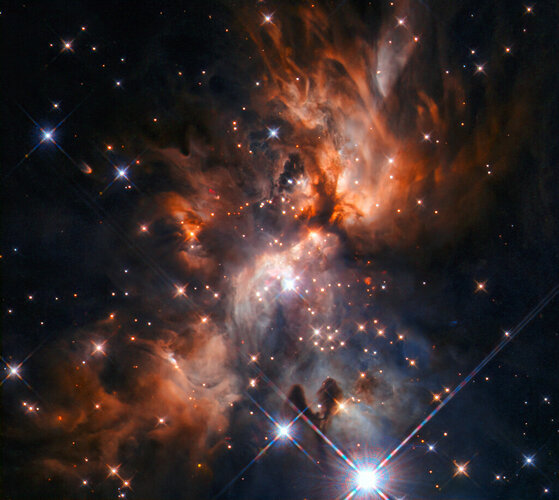
Year in images 2021
Our year through the lens: a selection of our favourite images for 2021
Press briefing Webb Telescope
 Video:
00:45:03
Video:
00:45:03
Replay of the 16 December 2021 online press briefing about the James Webb Space Telescope.
Speakers:
- Günther Hasinger, ESA Director of Science
- Daniel Neuenschwander, ESA Director of Space Transportations
- Thomas Zurbuchen, NASA’s Associate Administrator for science
- Antonella Nota, ESA Webb Project Scientist
- Gillian Wright, European Principal Investigator for the MIRI instrument
Developed and constructed over more than 30 years, Webb is a remarkable feat of engineering and technology – with the largest astronomical mirror ever flown in space, sophisticated new scientific instruments, and a sunshield the size of a tennis court.
Webb is designed to answer outstanding questions about the