

Cosmic concrete developed from space dust and astronaut blood
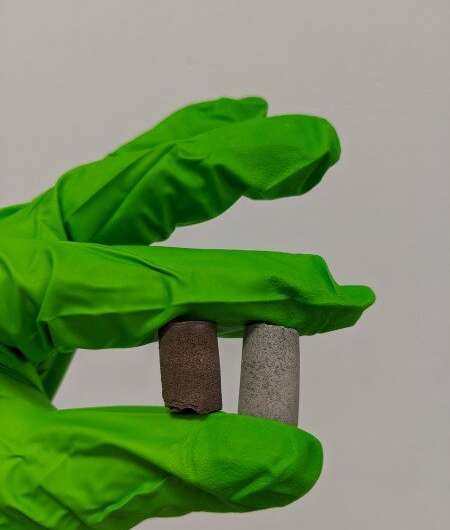
Transporting a single brick to Mars can cost more than a million British pounds—making the future construction of a Martian colony seem prohibitively expensive. Scientists at The University of Manchester have now developed a way to potentially overcome this problem, by creating a concrete-like material made of extra-terrestrial dust along with the blood, sweat and tears of astronauts.
In their study, published today in Materials Today Bio, a protein from human blood, combined with a compound from urine, sweat or tears, could glue together simulated moon or Mars soil to produce a material stronger than ordinary concrete, perfectly suited for construction work in extra-terrestrial environments.
The cost of transporting a single brick to Mars has been estimated at about US$2 million, meaning future Martian colonists cannot bring their building materials with them, but will have to utilize resources they can obtain on-site for construction and shelter. This is known as in-situ resource utilization (or ISRU) and typically focusses on the use of loose rock and Martian soil (known as regolith) and sparse water deposits.
Kibo | Space Station 360 (in French with English subtitles available)
 Video:
00:02:59
Video:
00:02:59
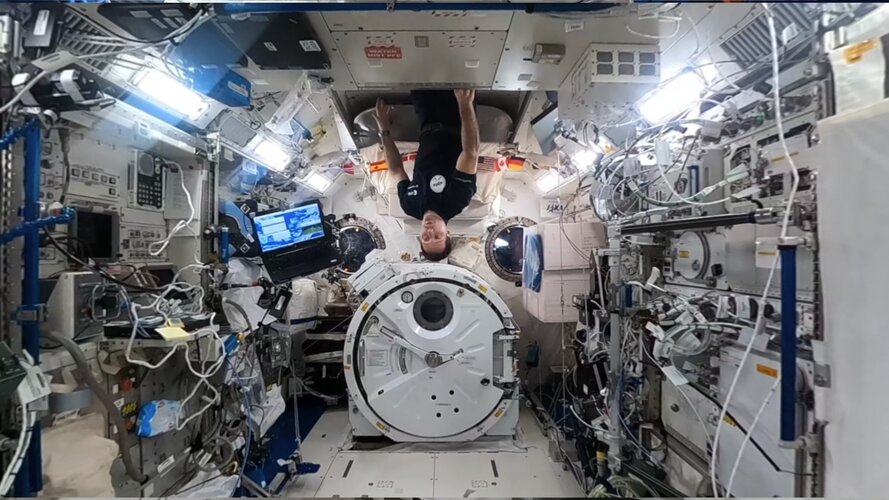
ESA astronaut Thomas Pesquet takes you on a tour of the International Space Station like no other. Filmed with a 360 camera, the Space Station 360 series lets you explore for yourself alongside Thomas’s explanation – this is the Kibo module.
Kibo is the Japanese module, also known as the Japanese Experiment Module or JEM. Thomas takes you through the hardware available for the astronauts and researchers on Earth and the unique airlock and storage space in Kibo.
The video is part of a series with Thomas showing each module in full 360 surround video.
Click and drag with your
Raymond: Small satellites and fast data transforming space business
The combination of small satellites and computing power is one of the most exciting developments in space technology, said Gen. John "Jay" Raymond, chief of the U.S. Space Force
Marlink’s sale values maritime connectivity specialist at $1.4 billion

Private equity firm Providence Equity Partners has agreed to buy a majority stake in Marlink, valuing the maritime connectivity specialist at $1.4 billion.
SpaceX’s Starlink broadband to be available in Japan’s remote areas next year
SpaceX’s Starlink satellite broadband service will be available in Japan’s remote areas starting in 2022.
EXPLAINER: 4 will circle Earth on 1st SpaceX private flight

For the first time in 60 years of human spaceflight, a rocket is poised to blast into orbit with no professional astronauts on board, only four tourists.
SpaceX's first private flight will be led by a 38-year-old entrepreneur who's bankrolling the entire trip. He's taking two sweepstakes winners with him on the three-day, round-the-world trip, along with a health care worker who survived childhood cancer.
SpaceX launches first dedicated polar Starlink mission
SpaceX launched its first dedicated polar Starlink mission Sept. 13 as the company moves into the next phase of deployment of its broadband satellite constellation.
Announcing Earth observation hackathon winners

In June 2021, more than 4300 participants from 132 countries and territories came together to solve challenges related to the COVID-19 pandemic. ESA, NASA and the Japan Aerospace Exploration Agency (JAXA) are pleased to announce CleverChart and TRACER as the winners of the Open Science Award.
BAE Systems to acquire smallsat company In-Space Missions
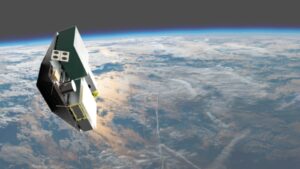
BAE Systems announced Sept. 14 that it will acquire In-Space Missions, a company that recently won a contract to build a British military satellite.
There's now a gas station in space
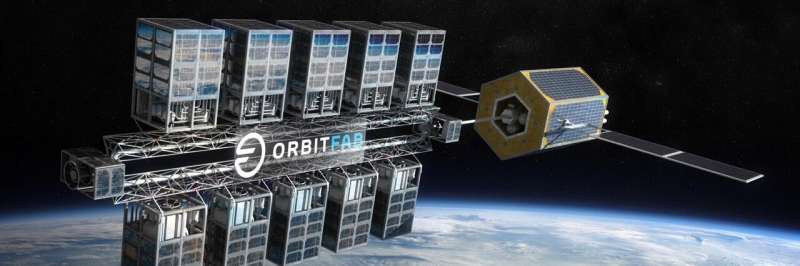
According to the Union of Concerned Scientists (UCS), over 4,000 operational satellites are currently in orbit around Earth. According to some estimates, this number is expected to reach as high as 100,000 by the end of this decade, including telecommunication, internet, research, navigation, and Earth Observation satellites. As part of the commercialization of low Earth orbit (LEO) anticipated in this century, the presence of so many satellites will create new opportunities, as well as hazards.
The presence of these satellites will require a great deal of mitigation to prevent collisions, servicing and maintenance. For example, the San Francisco-based startup Orbit Fab is working to create all the necessary technology for orbital refueling services for satellites. To help realize this goal, industry giant Lockheed Martin recently announced that they are investing in Orbit Fab's "Gas Stations in Space" refueling technology.
The San Francisco-based startup was founded in 2018 by Daniel Faber and Jeremy Schiel, both of whom have strong backgrounds in the commercial space industry. Between 2016 and 2019, Faber was the CEO of Deep Space Industries (DSI), one of the leading companies currently developing asteroid mining capabilities.


