

Tesat Technology chosen for US Govt Program
 Manufacturer with long-time heritage in laser communication selected for US governmental program.
Backnang, 31.03.2021: TESAT continues its success story for broadband laser communication in space. The development that ranges back to the laying of the cornerstone within the US NFIRE and TerraSar-X success in the year 2008, where TESAT first proved the functionality and capability of optica
Manufacturer with long-time heritage in laser communication selected for US governmental program.
Backnang, 31.03.2021: TESAT continues its success story for broadband laser communication in space. The development that ranges back to the laying of the cornerstone within the US NFIRE and TerraSar-X success in the year 2008, where TESAT first proved the functionality and capability of optica New reports highlight Russian, Chinese advances in space weapons

WASHINGTON — Russia over the past year has stepped up threats against satellites in orbit, a trend that is not likely to slow down. China, meanwhile, continues to display advances in space capabilities including the launch of an experimental spaceplane that may have deployed at least one small satellite on orbit.
ESA invites ideas to open up in-orbit servicing market
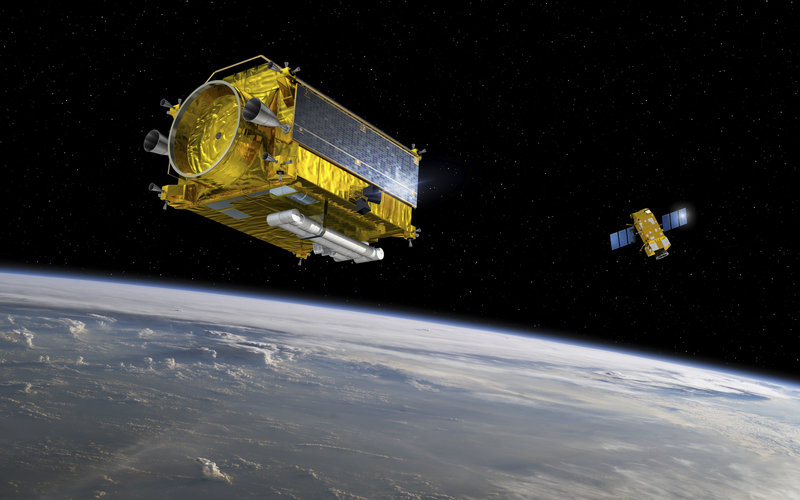
ESA is seeking to open the way to a new era of in-space activities such as refuelling, refurbishment, assembly, manufacturing, and recycling. The Agency is now soliciting ideas for In-Orbit Servicing activities from European industry and academia.
The quarterly ESA Impact is out now!

The quarterly ESA Impact is out now!
FCC proposes to allocate spectrum for commercial launches
WASHINGTON — The Federal Communications Commission will take up a long-awaited proposal at its next meeting to set aside a spectrum band for commercial launches.
Jessica Rosenworcel, acting chairwoman of the FCC, said in a March 31 statement that the commission would include on the agenda of its next open meeting April 21 a proposed rule to grant a secondary allocation of S-band spectrum, currently reserved for government uses, for telemetry for commercial launches.
NASA's Roman mission predicted to find 100,000 transiting planets

NASA's Nancy Grace Roman Space Telescope will create enormous cosmic panoramas, helping us answer questions about the evolution of our universe. Astronomers also expect the mission to find thousands of planets using two different techniques as it surveys a wide range of stars in the Milky Way.
Roman will locate these potential new worlds, or exoplanets, by tracking the amount of light coming from distant stars over time. In a technique called gravitational microlensing, a spike in light signals that a planet may be present. On the other hand, if the light from a star dims periodically, it could be because there is a planet crossing the face of a star as it completes an orbit. This technique is called the transit method. By employing these two methods to find new worlds, astronomers will capture an unprecedented view of the composition and arrangement of planetary systems across our galaxy.
Scheduled for launch in the mid-2020s, Roman will be one of NASA's most prolific planet hunters.
Former NASA administrator Jim Bridenstine joins Viasat’s board

TAMPA, Fla. — Jim Bridenstine has joined satellite operator Viasat’s board of directors in his second corporate role since stepping down as NASA’s administrator.
U.S.-based Viasat is enlarging its board to eight members to add Bridenstine, who became a senior advisor for private equity firm Acorn Growth Companies soon after resigning from NASA Jan.
Startups selected for geospatial intelligence accelerator program

WASHINGTON — A technology accelerator program funded by the National Geospatial Intelligence Agency has selected eight startups that will receive $100,000 grants, mentoring and coaching from government officials and venture investors.
The program organizers, the venture investment firm Capital Innovators and Missouri Technology Corp.
SPAC shareholders approve plan to merge with AST & Science

TAMPA, Fla. — AST & Science, which is developing a cellphone-compatible satellite broadband constellation, will start trading on the Nasdaq next week after getting shareholder approval April 1.
New Providence Acquisition Corp., a special-purpose acquisition company (SPAC) that already trades on the exchange under ticker NPA, said its stockholders have approved a plan to merge with the startup on or about April 6.
Japanese military strengthens ties with U.S. Space Command
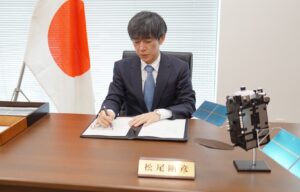
WASHINGTON — U.S. Space Command announced April 1 it has signed an agreement with Japan that will increase collaboration on space security.
Under the agreement, an officer from the Japan Air Self-Defense Force will be assigned full-time at U.S.


