
Hera and its CubeSats speak with mission control

ESA’s Hera asteroid mission and its two CubeSats interacted as if they were in space, within the foam pyramid-lined walls of the Agency’s Maxwell test chamber in the Netherlands. The trio communicated together, sharing data and ranging information at the same time as their Hera mothership received commands from its mission controllers at the European Space Operations Centre in Darmstadt, Germany.
Hughes Europe Enters Defense and Government Markets with Konnect VHTS Services
 Hughes Europe, a subsidiary of Hughes Network Systems, LLC, an EchoStar company (Nasdaq: SATS), announces its strategic expansion into the military, defense, and government sectors across pan-European nations. Troy Truman has joined Hughes and will act as the head of this initiative.
The initiative will meet the increasing demand for high-speed connectivity and the growing security concern
Hughes Europe, a subsidiary of Hughes Network Systems, LLC, an EchoStar company (Nasdaq: SATS), announces its strategic expansion into the military, defense, and government sectors across pan-European nations. Troy Truman has joined Hughes and will act as the head of this initiative.
The initiative will meet the increasing demand for high-speed connectivity and the growing security concern NASA Selects Proposals for Space Weather Study
 NASA has selected three proposals for concept studies of missions to investigate the complex system of space weather that surrounds our planet and its connection to Earth's atmosphere.
The three concepts propose how to implement the DYNAMIC (Dynamical Neutral Atmosphere-Ionosphere Coupling) mission, recommended by the 2013 Decadal Survey for Solar and Space Physics. The DYNAMIC mission aim
NASA has selected three proposals for concept studies of missions to investigate the complex system of space weather that surrounds our planet and its connection to Earth's atmosphere.
The three concepts propose how to implement the DYNAMIC (Dynamical Neutral Atmosphere-Ionosphere Coupling) mission, recommended by the 2013 Decadal Survey for Solar and Space Physics. The DYNAMIC mission aim First Camera Integrated for Plato Exoplanet Explorer
 The integration of Plato's cameras has commenced at OHB's Space Centre and Optics facility in Oberpfaffenhofen, Germany. The first of 26 cameras has been successfully attached to Plato's optical bench, ensuring precise alignment for the mission.
"Plato will use 24 'normal' cameras and 2 'fast' cameras to look at more than 100 000 stars and search for planets around them." The mission uses
The integration of Plato's cameras has commenced at OHB's Space Centre and Optics facility in Oberpfaffenhofen, Germany. The first of 26 cameras has been successfully attached to Plato's optical bench, ensuring precise alignment for the mission.
"Plato will use 24 'normal' cameras and 2 'fast' cameras to look at more than 100 000 stars and search for planets around them." The mission uses LeoLabs wins AFWERX contract to develop next-generation radar


China’s secretive spaceplane conducts proximity operations with small spacecraft

Space weather forecasting needs an upgrade to protect future Artemis astronauts
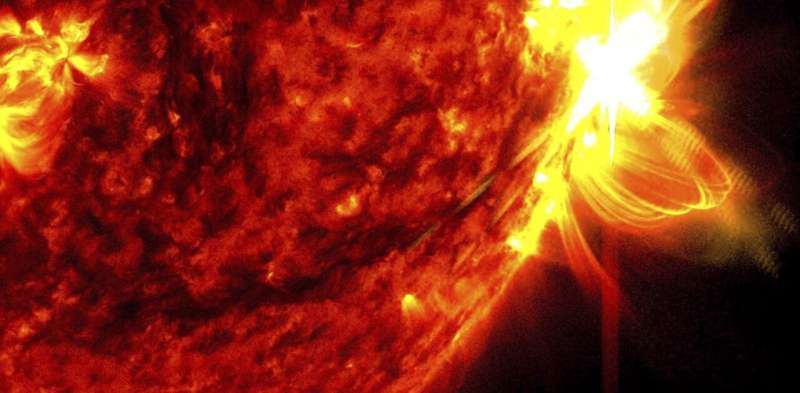
NASA has set its sights on the moon, aiming to send astronauts back to the lunar surface by 2026 and establish a long-term presence there by the 2030s. But the moon isn't exactly a habitable place for people.
Cosmic rays from distant stars and galaxies and solar energetic particles from the sun bombard the surface, and exposure to these particles can pose a risk to human health.
Both galactic cosmic rays and solar energetic particles, are high-energy particles that travel close to the speed of light.
While galactic cosmic radiation trickles toward the moon in a relatively steady stream, energetic particles can come from the sun in big bursts. These particles can penetrate human flesh and increase the risk of cancer.
Earth has a magnetic field that provides a shield against high-energy particles from space. But the moon doesn't have a magnetic field, leaving its surface vulnerable to bombardment by these particles.
U.S. to rely on commercial satellites to image spacecraft in orbit


Candace Givens, Northrop Grumman – Leading Women in Space


Virgin Galactic announces reverse stock split to boost share price