
Artificial gravity for Europe in space
 Image:
ESA and Vast memorandum signature at ILA
Image:
ESA and Vast memorandum signature at ILA 

ESA and Vast to study cooperation on future commercial space stations


SpaceX and the categorical imperative to achieve low launch cost

Ariane 6 fairing closure
 Image:
Ariane 6 fairing closure
Image:
Ariane 6 fairing closure Planet’s first hyperspectral satellite is ready to launch


Space Force agency taps 20 companies for $1 billion ground systems IDIQ


Scientists record Earth's radio waves from the Moon
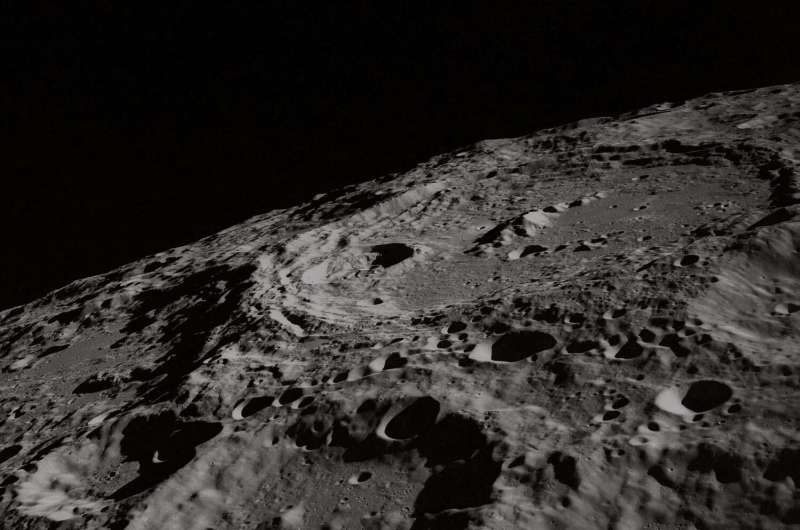
On Feb. 22, a lunar lander named Odysseus touched down near the Moon's South Pole and popped out four antennas to record radio waves around the surface—a moment University of Colorado Boulder astrophysicist Jack Burns hails as the "dawn of radio astronomy from the Moon."
It was a major achievement for the tenacious lander, which was built by the Houston-based company Intuitive Machines and had to overcome a series of technical difficulties to make it to the lunar surface. Burns is co-investigator on the radio experiment that flew aboard Odysseus called Radio wave Observations at the Lunar Surface of the photo Electron Sheath (ROLSES).
He'll give an update on the ROLSES data, and will share what's in store for future radio astronomy from the Moon, this week at the 244th Meeting of the American Astronomical Society in Madison, Wisconsin.
"It was heroic for Intuitive Machines to land under these conditions, and to deploy our antennas, take some data and get that data back to Earth," said Burns, professor emeritus in the Department of Astrophysical and Planetary Sciences at CU Boulder.